
Loading...

TL;DR:
- Tone significantly influences audience trust, engagement, and conversion rates.
- Consistent brand tone increases revenue and reduces marketing costs.
- Enforcing human-like tone in AI content enhances authenticity and audience connection.
Most marketers spend months obsessing over keywords, posting schedules, and headline formulas, yet overlook the single variable that shapes whether a reader stays, clicks, or converts: tone. Emotional tones achieve 87% above average reach on Instagram, a number that should stop any content team in its tracks. Tone is not decoration. It is the invisible hand that steers how your audience feels about your brand before they even register what you said. In this guide, you will learn why tone is a measurable performance driver, how to calibrate it across channels, and how to prevent AI-generated content from falling into the flat, forgettable trap that kills both trust and conversions.
| Point | Details |
|---|---|
| Tone drives engagement | The right tone makes content stand out and resonates with target audiences far more than just keywords. |
| Consistency boosts results | Maintaining a consistent tone can increase revenue and lower marketing spend for brands. |
| AI content needs human touch | AI-generated content only performs when enforced tone, review, and anti-pattern corrections keep it authentically human. |
| Balance strategy | Chasing short-term metrics can undermine brand trust, so combine data with brand principles for lasting connections. |
Tone and voice are not the same thing, though many marketers use them interchangeably. Voice is a consistent personality, while tone adapts to context and channel. Think of it this way: your brand voice is who you are, confident, empathetic, or authoritative. Your tone is how you show up in a given moment, warmer in a welcome email, more precise in a product spec sheet, lighter on Instagram.
This distinction matters because it gives you permission to flex without losing identity. A brand that sounds exactly the same in a crisis response as it does in a birthday promo email has not mastered tone. It has just picked one setting and stuck with it, which rarely serves the reader.
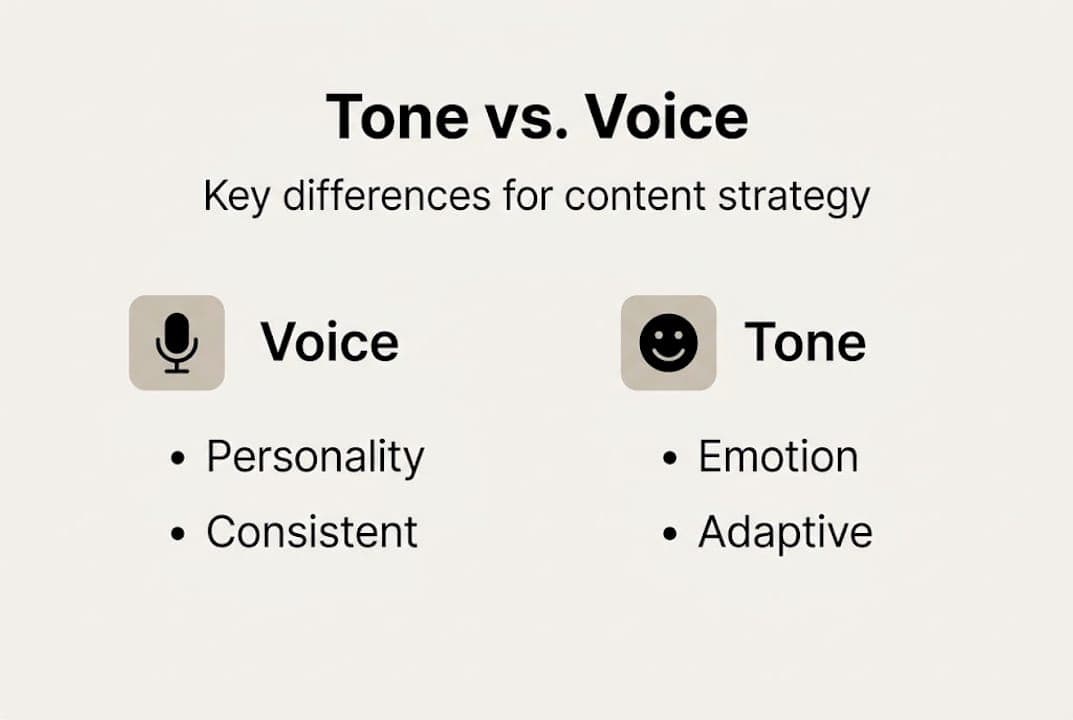
| Dimension | Voice | Tone |
|---|---|---|
| Definition | Core brand personality | Emotional register per context |
| Changes? | No | Yes, by channel and audience |
| Example | Confident, human, direct | Formal in B2B emails, playful on social |
| Controlled by | Brand guidelines | Content strategy and writer judgment |
Here is why this matters for your bottom line. Consistent brand tone increases revenue by up to 33%, and brands that fail to maintain it end up paying significantly more to achieve the same results in paid media. That is not a soft branding metric. That is a hard cost.
Tone also shapes trust at a neurological level. Readers process emotional cues in content before they consciously evaluate the argument. A mismatched tone, say, overly casual copy on a financial services page, creates a subtle friction that drives bounce rates up and conversions down. The reader cannot always name why they left. They just did.
Key ways tone influences outcomes:
For teams working with AI tools, maintaining tone in AI writing is one of the most overlooked levers in content quality. AI can produce volume. Tone enforcement is what turns that volume into value.
The data on tone and performance is clearer than most marketers realize. Emotional tones yield 87% higher reach and motivational tone produces the highest like rate across social platforms. That is not a marginal lift. That is the difference between content that circulates and content that sits.

Conversion data tells a similar story. Urgent copy outperformed inspirational copy by 10% in direct conversion tests, which challenges the assumption that warm, aspirational messaging always wins. Context determines which tone converts. Urgency works when the reader is already aware of the problem. Inspiration works when they need a reason to care.
| Tone type | Reach impact | Engagement impact | Best use case |
|---|---|---|---|
| Emotional | +87% reach | High shares | Brand storytelling, awareness |
| Motivational | High | Highest like rate | Community, social media |
| Urgent | Moderate | High CTR | Promotions, limited offers |
| Informational | Lower | High saves | SEO content, how-to guides |
| Generic/AI-flat | Below average | Low trust signals | Avoid |
How to analyze your own content's tone performance:
Pro Tip: Do not stop at engagement metrics. A post with high likes and zero sign-ups means your tone is entertaining but not converting. Map tone performance to the specific action you want at each funnel stage.
The risk of defaulting to a generic AI tone is real. Content that reads as flat, neutral, or over-polished triggers lower CTR and erodes reader trust over time. Sounding less robotic naturally is not just a style preference. It is a measurable performance factor. Even video marketing tone follows the same rules: emotional resonance drives retention and recall far more than information density alone.
Here is the paradox every content team faces. You need a consistent tone to build brand equity, but you also need to adapt that tone to each channel, audience, and moment. Get this wrong in either direction and you pay for it. Brands with consistent tone increase revenue by 23 to 33%, while inconsistent brands require 1.75x more media spend to achieve comparable results.
The solution is not picking one tone and broadcasting it everywhere. It is building voice pillars that anchor your identity while allowing tonal range within them. Think of your voice pillars as the walls of a room. Tone is how you arrange the furniture inside.
Voice is the unchanging brand personality, while tone adapts to each channel. A fintech brand might be voice-defined as "clear, trustworthy, and human." On LinkedIn, that tone is professional and data-driven. On Instagram Stories, it is lighter and more conversational. Same pillars, different expression.
Do's and don'ts for contextualizing tone:
Pro Tip: Run a tone audit by pulling 5 pieces of content from each major channel and reading them aloud in sequence. If they sound like they come from different brands, you have a consistency problem worth fixing before your next campaign.
Over-optimizing for short-term conversion can quietly erode long-term trust. A brand that shifts to high-pressure urgency across all channels to hit a quarterly target may see a spike, then a trust dip that takes months to recover. Balancing tech and authenticity in AI-assisted content is one place where this tension shows up most clearly. And writing for digital audiences requires knowing when to hold your brand voice steady even when trends push elsewhere.
AI tools can produce content at scale, but without deliberate tone enforcement, that content risks falling into a predictable flatness that readers recognize and distrust. AI content without strong tone enforcement is at risk for a "generic AI penalty," where detection tools flag it and audiences disengage from its sameness.
The fix is not just better prompts. It is a systematic process that treats tone as a quality specification, not an afterthought.
Tone enforcement strategies for AI workflows:
Pro Tip: Treat sentence length variation as a measurable quality spec. Human-sounding emails outperform AI-generated ones precisely because humans naturally mix short punchy sentences with longer ones. If your AI output averages 18 to 22 words per sentence with little variation, that is a red flag worth correcting before publish.
Too-generic tones do not just risk AI detection. They erode the audience relationship over time. Readers who feel like they are reading a template rather than a human perspective stop engaging, even if the information is accurate. Humanizing AI-generated text involves more than swapping words. It requires enforcing the emotional register your audience expects. Pair that with AI content optimization tips and a focused effort on avoiding bland AI phrasing, and you have a repeatable system that scales without sacrificing authenticity.
Here is the uncomfortable truth most tone guides skip: chasing engagement metrics alone can hollow out your brand faster than any algorithm change. Not all engagement or conversion spikes sustain brand growth, and the brands that learn this the hard way usually did so by optimizing tone for clicks rather than for the audience relationship.
The real risk is not that your tone will be too bold or too casual. It is that it will become too calculated. Readers, especially in niche expert communities, can sense when content has been engineered for a reaction rather than written to genuinely help. That perception is hard to reverse.
Tone legacy is built through consistency and calibration over time, not through viral spikes. The brands with the most loyal audiences are not necessarily the ones with the highest reach on any given post. They are the ones whose readers know exactly what to expect and trust that the brand will deliver it.
The smarter path is to blend experimentation with core brand principles. Test tone variants, yes. But anchor every test in the question: does this serve our audience or just our metrics? That discipline, applied consistently, is what separates brands that grow with their audience from brands that grow at their audience's expense. A data-driven content optimization approach works best when it is guided by principles, not just performance dashboards.
Understanding tone is one thing. Enforcing it at scale across AI-generated content is where most teams hit a wall.
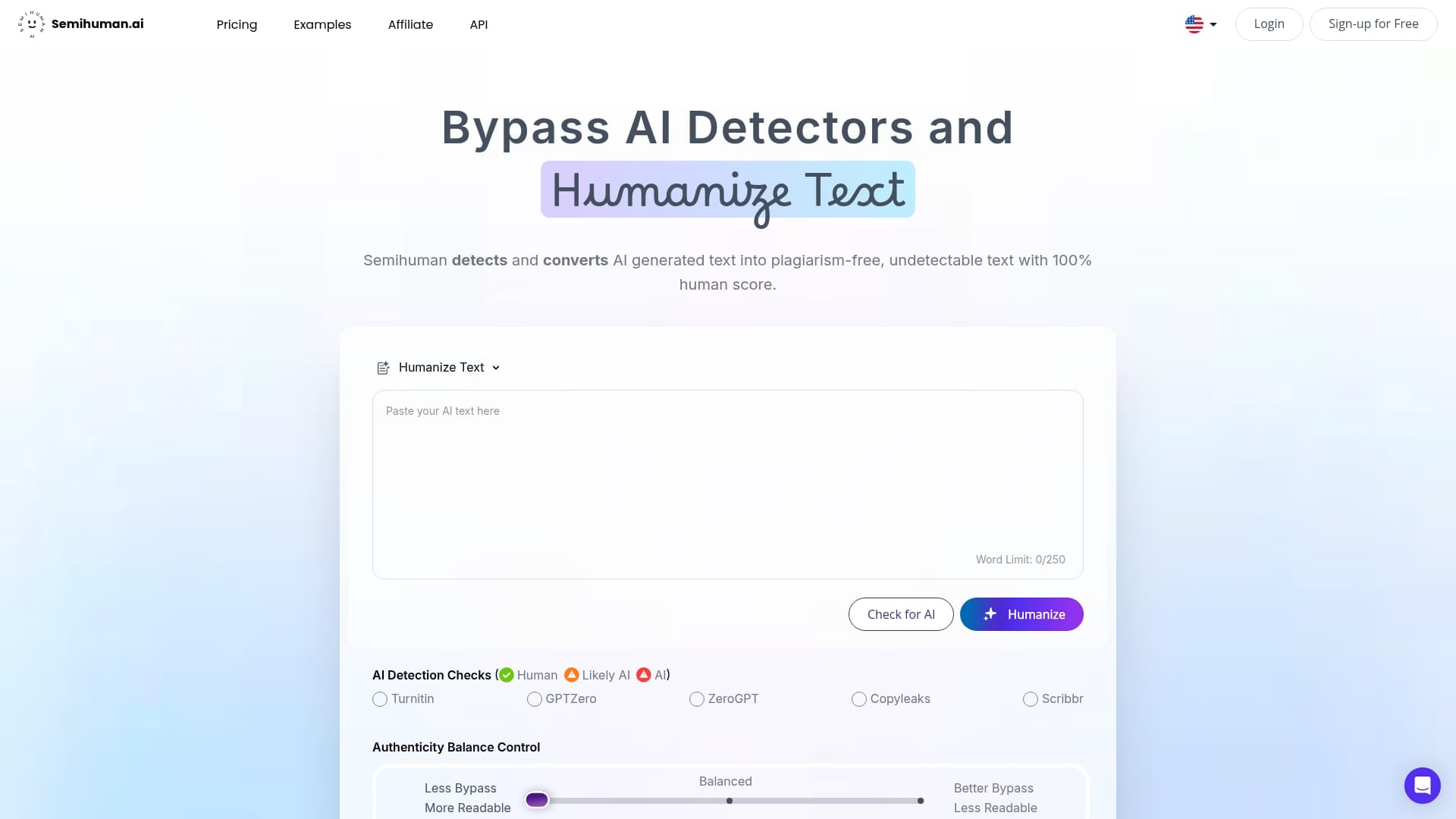
Semihuman AI is built for exactly that challenge. Whether you need to humanize a batch of AI drafts, fine-tune the emotional register of your copy, or ensure your content bypasses AI detection without losing quality, the platform gives you the tools to do it efficiently. Use the SEO text generator to produce audience-aligned content from the start, the AI text paraphraser to reshape tone without losing meaning, and the option to bypass AI detectors when authenticity is non-negotiable. Tone enforcement does not have to be manual or slow.
Voice is personality, the consistent brand identity that stays the same across all content, while tone adapts by channel, audience, and context to match the emotional register of each specific message.
Emotional and urgent tones boost engagement and conversion significantly, with emotional tones driving 87% above average reach and urgent copy outperforming inspirational alternatives by 10% in direct conversion tests.
Without deliberate tone enforcement or human review, AI risks a generic penalty where the content reads as flat and formulaic, reducing both reader trust and engagement.
Yes. Consistent tone boosts revenue up to 33% and reduces the media spend required to achieve the same results compared to brands with inconsistent tonal identity.
Human review and tone enforcement are the most effective methods: define quantifiable tone specs, vary sentence length, and correct AI-specific phrasing patterns before publishing.


Start
Humanizing
for Free!
Humanize