
Loading...

TL;DR:
- Pure AI-generated content quickly loses search rankings without added originality.
- Adding unique data, expert quotes, and personal insights enhances long-term SEO and credibility.
- A hybrid AI-human workflow produces sustainable, authoritative content that builds brand trust.
Pure AI-generated content looks like a shortcut to SEO success until the rankings vanish. A real-world experiment tracked AI-only articles and found that only 3% ranked in the top 100 by month three. That is not a slow fade. That is a cliff. For content creators and marketers who rely on search traffic, this is a wake-up call. Originality is no longer a bonus feature you layer on top of a content strategy. It is the foundation. This guide breaks down why originality matters online, how search engines actually measure it, and what you can do to build content that holds its ground long after publication.
| Point | Details |
|---|---|
| Originality drives SEO | Content with unique insights and perspectives consistently ranks higher and lasts longer in search results. |
| AI needs human touch | Using only AI-generated text leads to quick ranking drops unless enhanced with personal experience or expert analysis. |
| Raters assess meaning, not just words | Google prioritizes genuinely new ideas, not just different wording, to judge search quality and value. |
| Authenticity builds trust | Sharing original stories and verifiable data earns loyalty from both audiences and search engines. |
Search engines have gotten remarkably good at detecting whether content adds something new to a conversation. Google does not just scan for copied sentences. It uses semantic embeddings for uniqueness, meaning it evaluates whether the meaning of your content is duplicated across the web, even if the wording is different. That is a significant shift from the early days of SEO, when spinning articles or paraphrasing competitors was a viable tactic.
Today, meaning duplication is treated as low-value content. If your article covers the same ground as a hundred others without adding a fresh angle, a new data point, or a unique perspective, Google's systems recognize it and rank it accordingly. This is where the risks of duplicate content go beyond penalties for copied text and into the more subtle territory of derivative thinking.
The framework Google uses to assess content quality is called E-E-A-T, which stands for Experience, Expertise, Authority, and Trustworthiness. These signals are directly tied to originality. A piece written by someone with genuine experience in a topic, citing real data and offering informed opinions, scores higher on E-E-A-T than a generic overview assembled by an AI with no stake in the subject. Understanding AI writing risks means recognizing that generic output actively works against your E-E-A-T score.
"Google's quality raters are specifically trained to identify AI-generated content that lacks genuine expertise and original insight, assigning it lower quality scores that suppress rankings."
Here is a quick comparison of how original versus derivative content performs across key ranking factors:
| Ranking factor | Original content | Derivative AI content |
|---|---|---|
| Semantic uniqueness | High | Low |
| E-E-A-T score | Strong | Weak |
| Backlink attraction | Frequent | Rare |
| Long-term ranking stability | Stable | Drops sharply |
| Audience engagement | High | Low |
Audiences also respond differently to original content. When a reader encounters a genuine perspective, a surprising insight, or a personal story, they stay longer, share more, and return. These behavioral signals feed back into rankings. Originality is not just an ethical choice. It is a performance driver.
Pro Tip: Before publishing any piece, ask yourself: what does this article say that nothing else on the first page of Google already says? If you cannot answer that, revise before you publish.
AI tools are genuinely useful for drafting, outlining, and scaling production. The problem is not using AI. The problem is stopping there. When content teams use AI output without adding original value, they are building on sand.

The evidence from SEO experiments is direct: pure AI content can rank briefly for low-competition terms, but it fails fast for high-competition or authority-dependent topics. New domains are especially vulnerable. Without topical authority built through original, cited, and expert-attributed content, even technically well-structured AI articles lose ground quickly.
Here is how the trajectory typically looks:
The myth of low-effort scale is seductive. Publish 500 articles a month, capture long-tail traffic, and watch revenue grow. In practice, Google's systems are built to surface the most helpful and original content. Flooding the web with derivative articles triggers quality filters, not rewards. Content metrics for AI show that volume without quality leads to diminishing returns fast.
"Sites that published large volumes of AI-generated content without human editing saw significant ranking drops, with some losing over 50% of organic traffic within a single algorithm update cycle."
Established sites are not immune either. A brand with years of authority can absorb a few low-quality posts, but consistent AI-only output erodes trust signals over time. Google's quality raters can assign a 'Lowest' quality rating to pages that lack expertise and originality, and those ratings influence how the entire domain is treated. The path to humanizing AI content is not optional for brands that want to protect what they have built.
| Content type | Short-term ranking | Long-term ranking | Trust signals |
|---|---|---|---|
| Pure AI, no edits | Moderate | Very low | Weak |
| AI with light edits | Moderate | Low | Moderate |
| AI with full human layer | Strong | Strong | Strong |
| Fully original human content | Strong | Very strong | Strongest |
The good news is that you do not have to choose between efficiency and originality. The most effective approach is a hybrid workflow that uses AI for speed and humans for substance. A hybrid AI-human workflow means using AI to generate a solid draft, then layering in original data, personal experience, and expert attribution to transform it into something genuinely valuable.
Here is a practical process for doing this consistently:
For humanizing content for SEO, expert attribution is one of the highest-value moves you can make. A single sentence from a recognized authority in your niche does more for E-E-A-T than five paragraphs of well-written AI output. It signals that real people with real credentials are behind the content.
Pro Tip: Survey your existing audience quarterly. The questions they ask and the frustrations they share are content angles your competitors have not covered yet. Use that raw material to add genuinely original sections to AI drafts.
Original data is another powerful differentiator. Even a small internal study, a poll of 100 customers, or an analysis of your own platform metrics gives you something no one else can replicate. Data-driven content optimization consistently outperforms generic overviews because it gives readers and search engines something they cannot find anywhere else.
Originality checklist before publishing:
Originality is not just about surviving algorithm updates. It is about building something that compounds over time. Originality signals quality through E-E-A-T and information gain, and the data consistently shows that human-original content outperforms AI-only content in long-term ranking stability.
Here is what that compounding effect looks like in practice:
The return on investment for original content is also dramatically better when measured over 12 to 24 months. A single well-researched, original article can hold a top-three position for years, generating traffic and leads without additional spend. AI-only content, by contrast, often requires constant replacement as rankings drop, creating a churn cycle that costs more than it saves.
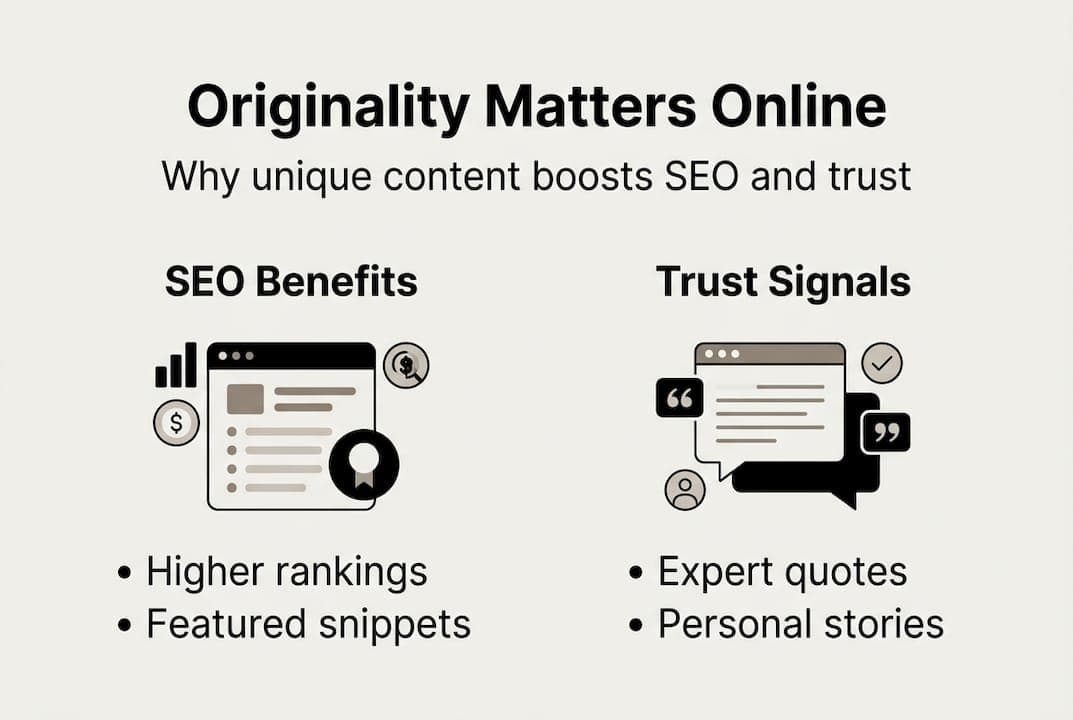
For SEO benefits of authentic content, the numbers are clear. Humanized, original content earns more featured snippets, more backlinks, and more sustained visibility. AI content personalization tactics that layer in audience-specific insights further boost engagement, and personalization has been shown to boost SEO by 35% in recent analyses. Originality and personalization together create content that is genuinely hard to displace.
Most marketers know AI-only content is not ideal. They use it anyway because it feels fast and cheap. But the data tells a different story. Initial visibility collapses quickly without originality, even when the content is technically helpful in the short term. The shortcut is an illusion.
What conventional wisdom misses is that originality compounds. Every original article you publish builds authority that makes the next one easier to rank. Every expert quote, every unique data point, every personal insight adds to a body of work that search engines and audiences trust. AI-only content does not compound. It churns.
The brands that will win the next five years of SEO are not the ones publishing the most content. They are the ones publishing content that no one else could have written. Treat originality as a key performance metric, not a nice-to-have. Track it, measure it, and build workflows that enforce it. AI in content marketing is here to stay, but the winners will be those who use it as a starting point, not a finish line.
If you are ready to stop the ranking churn and start building content that actually holds its position, the right tools make a real difference. Semihuman AI is built specifically for creators and marketers who want the efficiency of AI without sacrificing the originality that search engines reward.
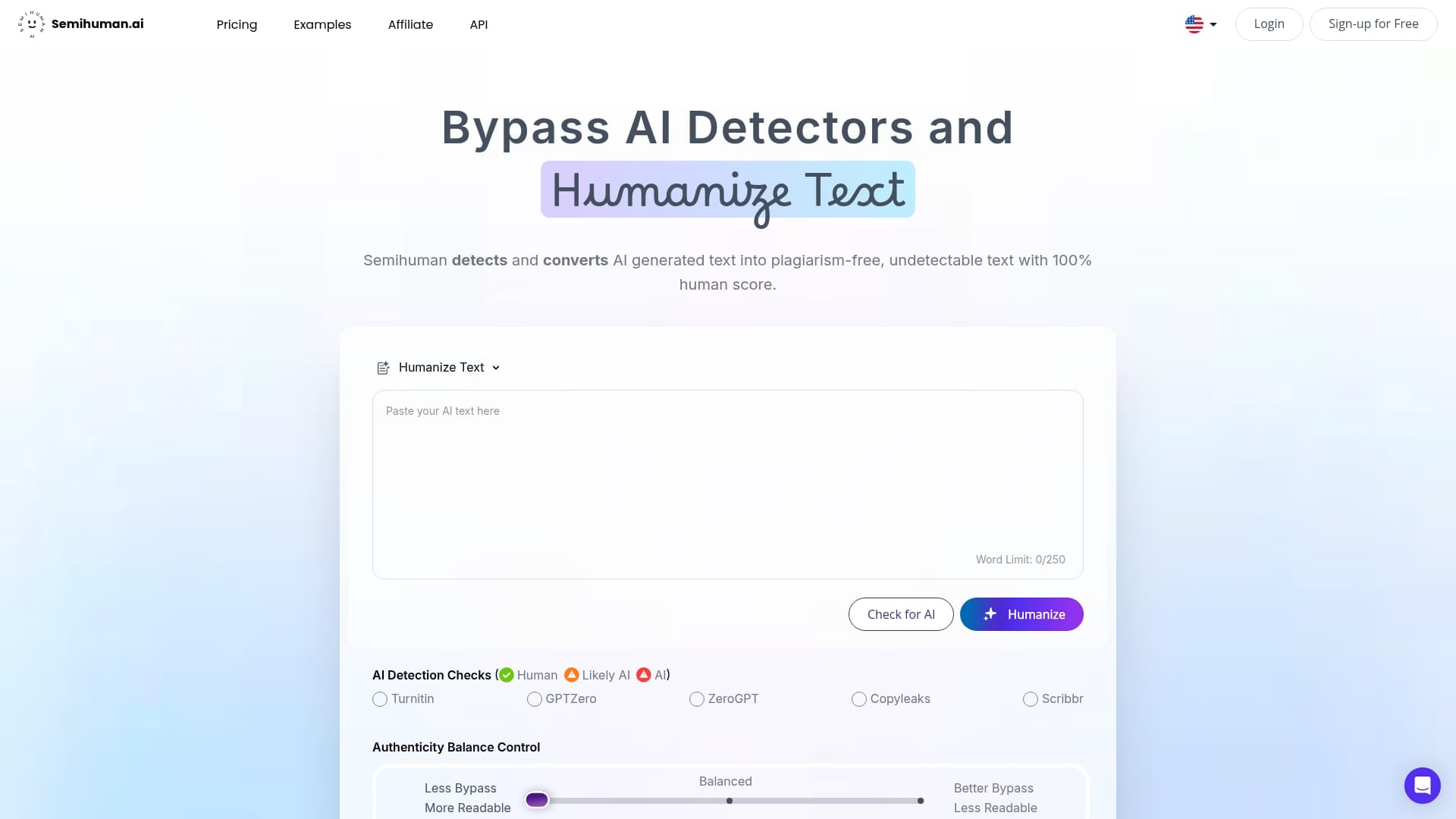
With Semihuman's SEO text generator, you can produce drafts that are already optimized for human-like quality and keyword integration. The AI-proof writing tools help you transform any AI draft into content that passes detection tools and satisfies E-E-A-T requirements. Try the platform and see how much faster you can produce original, high-ranking content without starting from scratch every time.
AI-generated content may briefly rank for low-competition terms, but without added originality and human insight, positions drop sharply within two to three months. Pure AI content loses visibility fast without original value layered in.
E-E-A-T stands for Experience, Expertise, Authority, and Trustworthiness, and it is the framework Google uses to assess content quality and credibility. Strong E-E-A-T signals are essential for earning and keeping strong search rankings over time.
Layer in unique data, personal narratives, and direct expert quotes, then edit for voice and accuracy. Hybrid AI-human strategies consistently boost E-E-A-T scores and reduce AI detection risk.
Yes. Relying on AI alone produces content that lacks the originality signals Google rewards, leading to lower trust scores and disappearing rankings. Original content is essential for building long-term authority that survives algorithm changes.

Start
Humanizing
for Free!
Humanize