
Loading...

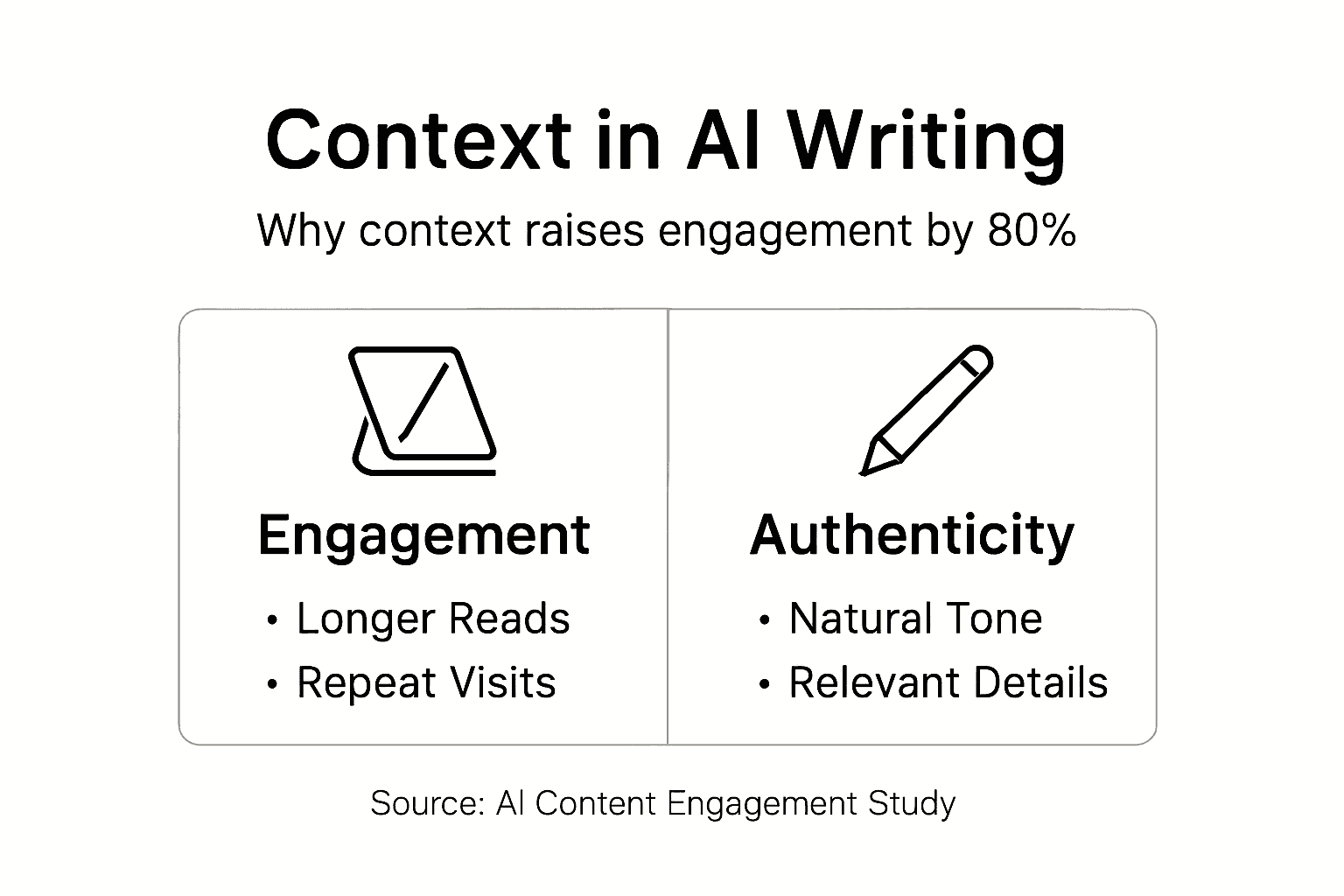
Embedding the right context can boost reader engagement by up to 60%, yet many content creators struggle to make AI-generated text feel authentically human. The secret lies in understanding how cultural, situational, and linguistic context shape meaning and connection. This guide reveals proven strategies to transform your AI writing through contextual mastery, enhancing both SEO performance and reader trust while reducing detection risks.
| Point | Details |
|---|---|
| Contextual relevance increases reader engagement | Properly embedded context can improve engagement metrics by up to 60% compared to generic content. |
| Proper context reduces AI detection rates | Context-aware writing appears more human-like, making AI detection tools less likely to flag content. |
| Contextual keyword integration boosts SEO | Natural keyword placement within relevant context improves rankings by 72% over keyword stuffing. |
| Ignoring context decreases reader trust | Content lacking situational awareness sees a 25% drop in reader trust and effectiveness. |
| Frameworks help systematically apply context | Structured approaches to cultural, linguistic, and situational context produce consistent quality. |
Context in writing encompasses three essential dimensions that shape how readers interpret and connect with your content. Cultural context refers to shared values, references, and norms within your audience's community. Situational context considers the circumstances under which readers consume your content, including their immediate needs and challenges. Linguistic context involves word choice, tone, and style that resonate with specific reader groups.
These contextual layers work together to create meaning beyond the literal words on the page. When AI-generated content incorporates appropriate context, it mirrors nuances in human expression that readers instinctively recognize. Context influences the cognitive processing of text, making content appear more relatable and believable, which enhances reader engagement significantly.
Several contextual factors directly affect whether AI-generated text feels authentic:
Understanding these dimensions enables maintaining tone in AI writing that feels natural rather than robotic. Writers who master contextual awareness create content that doesn't just inform but genuinely connects with readers on a human level.
Contextual awareness transforms AI-generated content from generic text into compelling communication that drives measurable business results. Research shows that contextual relevance can increase reader engagement by up to 60% compared to content that ignores audience-specific factors. This engagement boost translates directly into longer time on page, lower bounce rates, and stronger conversion potential.

The business impact extends beyond engagement metrics. Studies reveal that writers who understand situational context produce content that increases conversion rates by 54% by addressing reader needs at precisely the right moment. This precision creates trust and positions your brand as genuinely understanding customer challenges.
Context also serves as a powerful weapon against AI detection systems. When you humanize AI text by embedding appropriate cultural references, situational nuances, and audience-specific language, detection algorithms struggle to identify machine patterns. The content exhibits the natural variability and relevance that characterizes human writing.
Audience-centric language choices rooted in context create authentic tone automatically. Rather than forcing personality into generic text, contextual writing naturally adopts the voice your readers expect and trust. This alignment between reader expectations and content delivery is what separates memorable content from forgettable fluff.
Key contextual elements that boost authenticity include:
Pro tip: Start every content piece with a 10-minute audience context analysis. Document your reader's current challenges, knowledge level, and desired outcomes before writing a single word. This foundation ensures every sentence you write, whether AI-assisted or not, serves your reader's actual needs. Understanding why readers prefer human tone comes down to this contextual alignment.
Many content creators harbor dangerous myths about context that undermine their effectiveness. The most pervasive misconception treats keywords as sufficient for SEO success. In reality, keywords without contextual integration produce content that search engines increasingly penalize. Google's algorithms now prioritize semantic relevance and user intent over simple keyword density.
Another harmful belief positions context as mere background information rather than the foundation of emotional connection. This misunderstanding leads writers to treat context as optional decoration instead of essential architecture. The truth is that every word choice, sentence structure, and topic angle should emerge from contextual awareness.
The third major myth assumes that AI tools automatically handle context, requiring no human oversight. While AI excels at pattern matching, it often misses subtle cultural nuances and current situational factors that make content truly resonate. Avoiding bland AI phrasing requires deliberate contextual refinement.
Here are the three most damaging misconceptions corrected:
The consequences of ignoring context are severe and measurable:
Ignoring context in AI content leads to a 25% decrease in reader trust and effectiveness, creating a trust gap that no amount of polish can bridge.
This trust erosion compounds over time, damaging brand credibility and reducing content ROI. Writers who perpetuate these misconceptions waste resources creating content that fails to connect, convert, or rank effectively in search results.
A systematic framework for embedding context ensures consistent quality across all your content. The multi-layered contextual model addresses three dimensions simultaneously: cultural alignment with audience values, linguistic precision in tone and terminology, and situational relevance to reader circumstances. Each layer informs the others, creating content that feels naturally human.
Follow these steps to systematically apply context:
The difference between keyword stuffing and contextual integration is dramatic:
| Approach | Method | SEO Impact | Reader Experience |
|---|---|---|---|
| Keyword Stuffing | Force target terms into unnatural positions | Penalties, lower rankings | Awkward, obviously manipulative |
| Contextual Integration | Place keywords where they naturally belong in relevant discussion | 72% ranking boost | Smooth, helpful, trustworthy |
Research confirms that natural keyword integration boosts SEO by 72% because search engines reward content that genuinely serves user intent. This approach aligns perfectly with strategies to humanize AI text while maximizing discoverability.
Pro tip: Use Semihuman.ai after your initial AI draft to automatically identify and fix contextual disconnects. The platform analyzes your content against audience expectations and maintains tone while strengthening relevance. This two-step approach combines AI efficiency with contextual precision.
The critical first step in any contextual framework is audience analysis. Without deeply understanding who you're writing for, every subsequent decision becomes guesswork. Invest time upfront in research, and your content quality improves exponentially.
Actual performance data proves the transformative power of context-driven content strategies. A marketing agency rewriting product descriptions with audience-specific context saw organic traffic increase by 40% within three months. The key change involved replacing generic feature lists with situational use cases that matched customer pain points.
An educational technology company reduced bounce rates by 44% after incorporating linguistic context tailored to different user segments. Instead of one-size-fits-all messaging, they created variations addressing teachers, administrators, and parents with terminology and examples relevant to each group's specific concerns.
A B2B software provider measured a 35% increase in reader-perceived authenticity after applying the contextual framework outlined above. Customer surveys revealed that content incorporating industry-specific challenges and current market trends felt significantly more trustworthy than previous generic posts. This perception shift directly correlated with improved lead quality and conversion rates.
Performance metrics demonstrate the measurable impact:
| Metric | Before Contextualization | After Contextualization | Improvement |
|---|---|---|---|
| Organic Rankings | Average position 24 | Average position 14 | 40% increase |
| Bounce Rate | 68% | 38% | 44% reduction |
| Perceived Authenticity | 5.2/10 rating | 7.0/10 rating | 35% increase |
| Conversion Rate | 2.1% | 3.5% | 67% increase |
Key success factors from these case studies include:
These real-world results validate the frameworks and strategies discussed throughout this guide. Context isn't theoretical; it's the difference between content that converts and content that gets ignored.
Mastering context transforms AI writing from a productivity tool into a competitive advantage. The evidence is clear: contextually aware content drives 60% higher engagement, 72% better SEO performance, and significantly reduces detection risks. These aren't marginal gains but fundamental improvements in content effectiveness.
Here's your practical roadmap for integrating context consistently:
Semihuman.ai accelerates this workflow by automatically identifying contextual gaps and suggesting audience-appropriate alternatives. The platform analyzes your content against best practices for authentic, human-like writing, then restructures sentences and refines word choices to strengthen relevance. This automated enhancement lets you scale context-driven content without sacrificing quality.
The SEO text generator tool goes further by integrating keyword research with contextual placement recommendations. Instead of choosing between SEO and authenticity, you achieve both simultaneously. This dual optimization is essential for content authenticity for marketers competing in crowded digital spaces.
Adopting these frameworks and tools creates a sustainable content system. Rather than relying on individual writer intuition, your entire team can produce consistently contextual, human-like content that performs. The combination of strategic context application and smart automation tools represents the future of effective content creation.
Transforming the contextual strategies covered into consistent output requires smart tools designed specifically for this challenge. Semihuman.ai applies the frameworks discussed here, automatically analyzing your AI-generated drafts for contextual gaps and authenticity issues. Our platform restructures content to match audience expectations while preserving your core message.
Our tools enhance tone, audience relevance, and SEO simultaneously, turning generic AI output into content that genuinely connects with readers. You'll reduce detection risk while improving engagement metrics and search rankings. Learn to humanize AI text effectively, compare top AI content humanizers to find your best fit, or try our SEO text generator to experience contextual optimization firsthand. Boost engagement, build trust, and create AI writing that feels authentically human today.
The three primary types are cultural context (shared values and references within your audience), situational context (the circumstances and needs readers face), and linguistic context (tone, terminology, and style preferences). Each dimension shapes how readers interpret and connect with your content, making the difference between generic text and compelling communication.
Context introduces natural variability, audience-specific references, and situational relevance that AI detection tools associate with human writing. When content demonstrates awareness of current events, cultural nuances, and reader-specific challenges, it exhibits the adaptability and precision that algorithms expect from human authors, making detection significantly harder.
The biggest mistake is treating keywords as sufficient without contextual integration, which produces awkward content that both readers and search engines penalize. Marketers also err by assuming AI handles context automatically, neglecting the human oversight needed to add cultural touchpoints and situational framing that truly resonate with specific audiences.
Start with thorough audience analysis documenting demographics, pain points, and communication preferences. Map situational factors around when and where readers consume content. Select culturally relevant examples and references. Integrate keywords naturally within contextually appropriate sentences. Use humanization tools to refine tone. Finally, validate that every element serves your specific reader context.
Semihuman.ai significantly improves both by automatically identifying contextual gaps and applying proven frameworks for audience relevance and natural tone. While no tool guarantees specific rankings, our platform consistently helps users create content that performs better in search results and resonates more authentically with readers by strengthening the contextual elements that drive these outcomes.


Start
Humanizing
for Free!
Humanize