
Loading...

Many creators assume AI content ranks automatically if they follow basic SEO rules. The reality is harsher. Mass AI sites lose 40-60% traffic within months, and entire domains get deindexed for publishing thousands of unedited articles. The problem isn't AI itself but how it's used. Content fails to rank when it misses search intent, lacks depth, or shows no real expertise. This article explains why your content struggles to gain visibility and provides proven strategies to fix ranking issues, especially for AI-generated material that needs human refinement to succeed long term.
| Point | Details |
|---|---|
| Intent alignment | Mismatching content format to user intent hurts rankings and should be addressed by auditing top results. |
| Topical authority | Developing a topic cluster with interconnected content boosts credibility and long term rankings. |
| Real expertise signals | E E A T requires credentials and real world experience rather than generic AI output. |
| Hybrid editing advantage | Hybrid editing combines AI generation with human review to add depth and practical insights for sustained traffic. |
Content fails to rank primarily due to search intent mismatch, lack of topical authority, weak E-E-A-T signals, and poor content quality or depth. Understanding these core failures helps you diagnose why your pages languish on page three or beyond.
Search intent mismatch is the most common killer. You might target the right keyword but deliver the wrong content format. If searchers want a quick checklist and you provide a 3,000-word essay, they bounce. Google notices. Your rankings drop because user behavior signals poor relevance. Always audit the top 10 results to understand what format, depth, and angle users expect.
Topical authority builds over time as you publish interconnected content around a subject. A single article on a broad topic won't rank if your site has no related content. Search engines favor sites that demonstrate depth and expertise across a topic cluster. Publishing scattered, unrelated articles signals you're not a trusted source in any specific area.
E-E-A-T (Experience, Expertise, Authoritativeness, Trustworthiness) affects credibility, especially for YMYL (Your Money Your Life) and competitive niches. Content lacking author credentials, original research, or real-world experience struggles to compete. Google wants to see that a knowledgeable person created the content, not just an algorithm churning out generic text.
Surface-level or thin content fails to satisfy user queries. If your article repeats common knowledge without adding unique insights, case studies, or actionable frameworks, it offers no reason to rank above competitors. Depth matters, but only when it adds genuine value. Padding word count with filler backfires because users recognize and abandon low-quality pages quickly.
"The biggest ranking mistake is assuming keywords alone drive success. Intent alignment and content depth determine whether you rank or disappear."
Key factors causing ranking failure:
Understanding how AI affects search rankings requires recognizing these foundational issues first. AI-generated content magnifies these problems when used without strategic human oversight.
AI-generated content faces specific vulnerabilities beyond the general ranking issues all content encounters. Mass AI content typically appears templated and lacks the depth that comes from real experience. Algorithms produce consistent structure and predictable phrasing, making articles feel interchangeable. Users recognize this pattern and disengage, sending negative signals to search engines.

AI content without human editing fails to demonstrate genuine experience, the first E in E-E-A-T. Experience means showing you've actually done what you're writing about. AI can't share personal case studies, unique observations, or lessons learned from real projects. This absence is particularly damaging in competitive niches where readers expect insider knowledge and practical wisdom.
New sites publishing unedited AI content see a troubling pattern. They might rank initially as Google indexes fresh content, but traffic drops 40-60% within three months. Some sites with 1,800 AI articles were completely deindexed. The March 2026 core update specifically targeted mass AI content strategies, rewarding sites that blend AI efficiency with human expertise instead.
Hybrid strategies combining AI drafting and human refinement show significantly better results. Using AI to generate outlines, first drafts, or research summaries saves time while preserving the human touch that search engines reward. The key is adding original insights, restructuring for natural flow, and injecting personality that reflects genuine expertise.
"Sites relying purely on AI content without human editing face rapid traffic loss. The solution isn't abandoning AI but using it as an assistant, not a replacement for human expertise."
Specific AI content ranking challenges:
The data is clear. Mass AI content strategies fail without human intervention. Sites that balance technology with authenticity maintain rankings by ensuring every piece demonstrates real expertise and provides value beyond what competitors offer.
Fixing ranking problems requires systematic audits and strategic improvements that address intent, authority, and quality signals. These techniques work for both AI-generated and traditionally written content, though AI material often needs more aggressive human editing to compete.
Regularly audit alignment with searcher intent and SERP content. Search your target keyword and analyze the top 10 results. Note their format (listicle, guide, comparison), depth, and angle. If they're all product roundups and you wrote a how-to guide, you've mismatched intent. Adjust your content to mirror what's ranking while adding unique value.
Organize content into topical clusters for authority. Create pillar pages covering broad topics, then link to detailed cluster content addressing specific subtopics. This structure signals expertise and helps search engines understand your site's focus. A single article on email marketing won't rank as well as a hub-and-spoke model with 10-15 interconnected pieces.
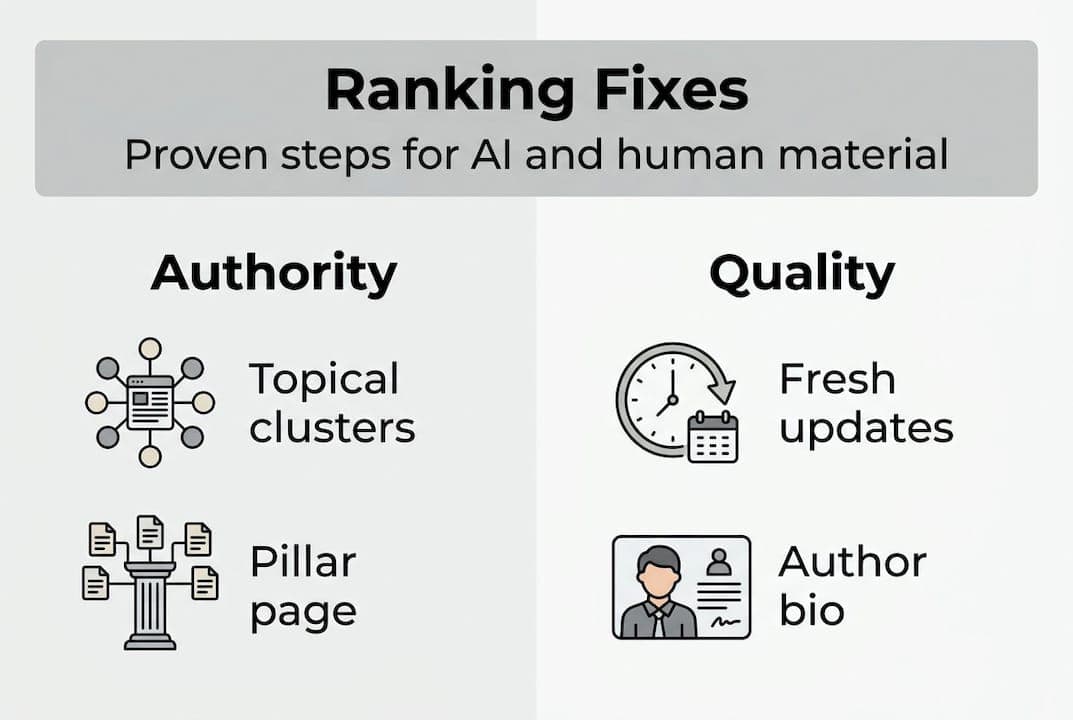
Showcase real author credentials and experience prominently. Add detailed author bios with relevant qualifications, work history, and achievements. Include bylines, headshots, and links to professional profiles. For YMYL topics, credentials are non-negotiable. Even for less sensitive niches, demonstrating expertise builds trust.
Use original data, case studies, and insights to boost E-E-A-T. Conduct surveys, analyze industry trends, or share results from your own projects. Original research differentiates your content and attracts backlinks. Case studies prove you've applied concepts successfully, adding the experience component that AI content typically lacks.
Refresh content to prevent decay and signal freshness. Google favors recently updated pages for many queries. Set a schedule to review and update your top-performing content every 6-12 months. Add new statistics, remove outdated information, and expand sections that could provide more value.
Pro Tip: When humanizing AI content, focus on adding specific examples and personal observations that only someone with real experience could provide. Generic advice is easy to spot and fails to engage readers.
| Strategy | Implementation | Expected Impact |
|---|---|---|
| Intent audit | Analyze top 10 SERP results, adjust format and depth | Improved relevance signals, lower bounce rates |
| Topical clusters | Create pillar pages with 10-15 linked subtopic articles | Stronger authority signals, better internal linking |
| Author credentials | Add detailed bios, qualifications, professional links | Enhanced E-E-A-T, increased trust |
| Original insights | Conduct research, share case studies, add unique data | Differentiation, natural backlinks |
| Content refresh | Update every 6-12 months with new stats and insights | Maintained rankings, freshness signals |
Key improvements for better rankings:
Exploring top AI content humanizers can help streamline the editing process while maintaining quality. Effective content marketing strategies integrate these ranking fixes into your workflow, and understanding the SEO benefits of AI humanization clarifies why hybrid approaches outperform pure automation.
Beyond the obvious ranking factors, several less visible risks can undermine your content efforts. Recognizing these pitfalls helps you avoid wasted time and potential penalties that damage your entire site.
New domains must overcome sandbox delays before gaining trust. Google often holds new sites in a probationary period where rankings remain suppressed regardless of content quality. This sandbox effect can last 3-6 months. Publishing high-quality content consistently during this period builds authority for when the sandbox lifts. Don't panic if rankings are slow initially on a brand new domain.
Publishing AI content at massive scale without quality control invites penalties. Google's spam update specifically targets sites abusing mass AI content strategies, particularly affiliate sites churning out thousands of thin product reviews. The penalty often affects the entire domain, not just individual pages. Quality over quantity is essential, especially when using AI generation tools.
Regularly updating content is crucial to avoid content decay. Pages that rank well initially can lose visibility as competitors publish fresher, more comprehensive content. Without updates, your content becomes stale and less relevant. Search engines prioritize recently updated pages for many queries, particularly those related to current events, technology, or evolving best practices.
Site-wide penalties affect all pages if spammy AI tactics are detected. Using AI to generate hundreds of low-quality pages, duplicate content across multiple domains, or create doorway pages triggers algorithmic filters that suppress your entire site. Recovery requires removing or substantially improving the offending content, which can take months of effort.
Pro Tip: If you're scaling content production with AI, implement a quality threshold where every piece must pass human review before publication. Set a maximum publishing frequency to avoid triggering spam filters.
Critical pitfalls to avoid:
Understanding the future of content writing means recognizing that sustainable success requires balancing efficiency with quality. AI accelerates content creation, but only when paired with strategic human oversight that ensures each piece meets user needs and search engine quality standards.
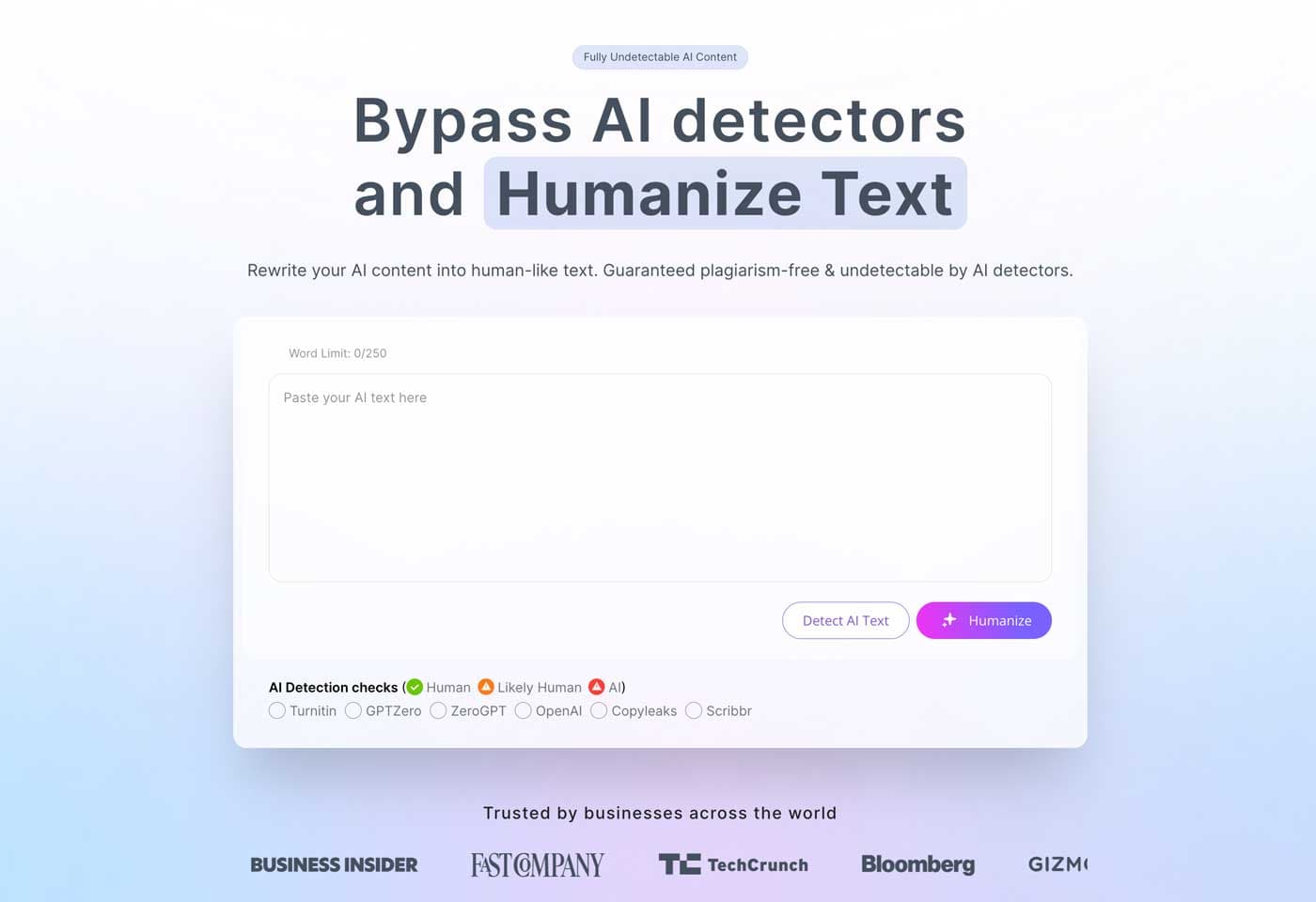
Ranking AI-generated content successfully requires tools that bridge the gap between automation efficiency and human authenticity. Semihuman AI specializes in transforming AI-generated text into naturally human-like content that satisfies both search engines and readers.
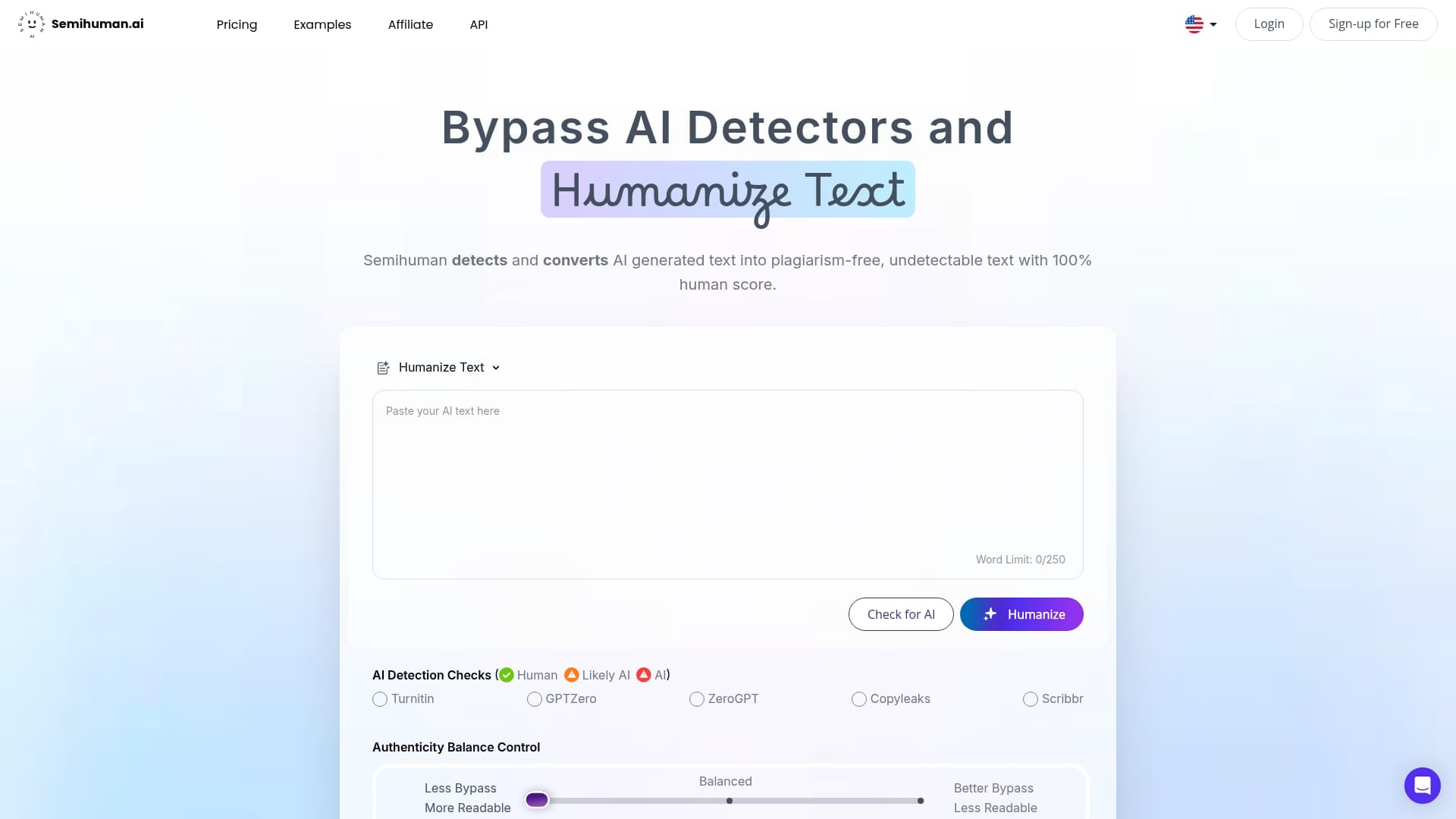
Our platform blends AI generation with expert human editing workflows, ensuring your content meets E-E-A-T standards while maintaining the efficiency that makes AI valuable. The system analyzes AI-generated drafts, identifies areas lacking depth or originality, and guides you through adding the specific insights and examples that demonstrate real expertise.
Tools like our SEO text generator create optimized content that aligns with search intent while preserving natural language patterns. The AI proof writing feature ensures your content passes detection systems by restructuring sentences and varying patterns that flag automated text. Integration is straightforward, allowing you to audit, proof, and optimize content without disrupting your existing workflow. Visit Semihuman AI to see how hybrid AI-human content strategies deliver sustainable rankings.
Unedited AI content lacks genuine experience signals that search engines increasingly prioritize. Initial rankings occur because Google indexes new content quickly, but algorithmic reassessment within weeks identifies missing expertise markers, thin insights, and templated structure. Traffic drops 40-60% as the content gets demoted in favor of pages demonstrating real authority.
Use AI as a drafting assistant, not the final creator. Generate outlines, research summaries, or first drafts with AI, then add human insights, case studies, and expert credentials during editing. Regularly audit content for intent alignment and update it to prevent decay. This hybrid approach combines efficiency with the authenticity that ranks.
E-E-A-T signals are essential for ranking and building trust with search engines. AI content scores low on the Experience component because it can't demonstrate real-world application of concepts. To rank well, you must add author credentials, original case studies, and unique insights that prove genuine expertise. Without these elements, AI content struggles in competitive niches regardless of keyword optimization.
Publishing hundreds of unedited AI articles triggers spam filters and site-wide penalties. The biggest mistake is prioritizing quantity over quality, assuming more content automatically means better rankings. Another critical error is neglecting content updates, allowing decay that erodes initial ranking gains. Successful scaling requires quality thresholds, human review processes, and strategic publishing schedules that avoid spam detection.
Typical improvements appear within 4-8 weeks after implementing fixes, though this varies by competition level and domain authority. New domains face longer timelines due to sandbox effects. Major updates like adding topical clusters or comprehensive content refreshes may take 2-3 months to show full impact. Consistency matters more than speed, so maintain quality standards while waiting for search engines to reassess your pages.


Start
Humanizing
for Free!
Humanize