
Loading...

Every Canadian and European marketer knows the pressure to produce authentic content quickly, but relying on AI-generated text alone comes with real obstacles. The line between machine efficiency and human authenticity matters when a brand's reputation or academic credibility is at stake. This guide breaks down the core differences between AI writing and human editing, showing how effective review transforms digital drafts into trustworthy, search-friendly assets.
| Point | Details |
|---|---|
| AI Writing Lacks Depth | AI-generated content often misses nuanced understanding and contextual depth, requiring human editors for valuable insights. |
| Essential Role of Human Editing | Human oversight is crucial for ensuring accuracy, originality, and coherence in AI-generated text. |
| Risks of Unedited Content | Unedited AI content can harm brand credibility due to inaccuracies or tone mismatches, necessitating rigorous review processes. |
| Best Practices for Editing | A structured, multi-layered editing approach improves the quality and integrity of AI-generated content, enhancing communication effectiveness. |
AI writing represents a transformative technological approach to content generation, utilizing advanced language models to produce textual content across various domains. These sophisticated algorithms can rapidly draft text by analyzing massive datasets and predicting language patterns. However, AI-generated content inherently lacks the nuanced understanding and contextual depth that human writers bring to their work.
The core distinction between AI writing and human editing lies in the critical evaluation and refinement process. While AI tools like ChatGPT can quickly generate drafts, human oversight remains essential for ensuring accuracy, authenticity, and scholarly integrity. Human editors perform complex tasks that AI cannot replicate: contextualizing information, verifying facts, preserving unique authorial voice, and detecting subtle logical inconsistencies.
AI writing tools typically generate text by processing training data and predicting probable word sequences, which can result in generic, formulaic content. Comprehensive human editing involves a multifaceted approach of restructuring, fact-checking, and infusing genuine intellectual perspective. Professional editors evaluate AI-generated text through multiple lenses: grammatical precision, logical coherence, thematic consistency, and academic or professional standards.
Pro tip: Always run AI-generated content through a comprehensive human review process, focusing on substantive improvements beyond surface-level grammar corrections.
Here's a side-by-side look at how AI writing and human editing differ in key functions and outcomes:
| Aspect | AI Writing | Human Editing | Combined Impact |
|---|---|---|---|
| Speed | Instant text generation | Slower, thoughtful review | Efficient, high-quality output |
| Depth of Understanding | Lacks real-world context | Deep contextual awareness | Enhanced message accuracy |
| Originality | Often formulaic and generic | Preserves authorial uniqueness | Balanced creativity and rigor |
| Error Detection | Misses subtle logical gaps | Identifies inconsistencies and errors | Reliable, trustworthy content |
Artificial intelligence writing technologies frequently produce content riddled with significant structural and substantive limitations. AI hallucinations represent a critical problem where language models confidently generate information that appears plausible but is fundamentally incorrect. These fabricated details can range from subtle inaccuracies to completely fabricated statements, creating substantial risks for academic, professional, and journalistic content.
The predictive nature of AI writing algorithms leads to several consistent flaws that compromise content quality. Systematic text generation weaknesses include repetitive language patterns, generic phrasing, and contextual inconsistencies. AI tools often struggle with maintaining coherent narrative flow, especially in longer documents, and frequently drift from the original writing prompt. These limitations result in text that sounds superficially competent but lacks genuine depth, nuance, and critical thinking.

Beyond linguistic shortcomings, AI-generated content suffers from significant credibility challenges. Training data biases can inadvertently introduce stereotypes or skewed perspectives, while the lack of verifiable sourcing undermines academic and professional standards. The algorithms primarily remix existing information without true understanding, resulting in text that can appear authoritative but lacks genuine intellectual contribution. Professional writers and editors must scrutinize AI-generated drafts for logical gaps, factual inaccuracies, and contextual misalignments.
Pro tip: Develop a systematic review process that cross-references AI-generated content against multiple authoritative sources to identify and eliminate potential hallucinations and inaccuracies.
Editing AI-generated content transforms raw algorithmic output into polished, professional writing that meets rigorous academic and professional standards. Human editing enhances writing quality by systematically addressing structural weaknesses, improving narrative coherence, and eliminating potential factual inaccuracies. This critical intervention bridges the gap between machine-generated text and authentic, credible communication.
The collaborative process of human editing provides multiple layers of value beyond simple grammatical corrections. Professional editors bring nuanced understanding that AI cannot replicate, including contextual awareness, emotional intelligence, and domain-specific expertise. These interventions help mitigate risks associated with AI writing, such as unintentional plagiarism, tone inconsistencies, and logical discontinuities that can undermine the credibility of academic or professional documents.
Academic writing improvements through human editing extend far beyond surface-level refinements. By carefully restructuring AI-generated drafts, human editors cultivate critical thinking, preserve original intent, and ensure that complex ideas are communicated with precision and clarity. This process transforms AI writing from a raw generative tool into a sophisticated method of knowledge creation, where technological efficiency meets human intellectual rigor.
Pro tip: Develop a multi-stage editing workflow that includes structural review, fact-checking, tone alignment, and a final readability assessment to maximize the potential of AI-generated content.
Marketing professionals face significant challenges when deploying unedited AI-generated content, with potential consequences that can dramatically undermine brand credibility and audience trust. Reputational risks in content marketing emerge from the unchecked proliferation of algorithmic text that lacks nuanced human perspective and authentic communication strategies. Unverified AI outputs can introduce factual errors, inappropriate language, or messaging that feels disconnected from the brand's core values and audience expectations.
The proliferation of unedited AI content creates multiple strategic vulnerabilities for marketing teams. Automated writing frequently generates generic, repetitive language that fails to differentiate brands in competitive markets. Without careful human review, AI-generated materials risk producing bland, algorithmic text that lacks emotional resonance, creative spark, and the subtle linguistic cues that make communication compelling. These shortcomings can lead to reduced audience engagement, diminished brand perception, and potential loss of customer trust.
Moreover, unedited AI content exposes organizations to significant compliance and ethical risks. Marketing communications require precision, cultural sensitivity, and contextual understanding that current AI technologies cannot consistently deliver. Inaccurate claims, inappropriate tone, or inadvertently biased language can trigger reputational damage, legal challenges, and erosion of consumer confidence. Professional marketers must implement rigorous editing processes that transform raw AI-generated drafts into sophisticated, authentic communications that align with brand voice and strategic objectives.
Below is a summary of frequent flaws found in unedited AI-generated marketing content and their potential business impact:
| Flaw Type | Example | Business Impact |
|---|---|---|
| Hallucinations | Fake statistics or sources | Damaged credibility |
| Tone Mismatch | Inappropriate language use | Loss of audience trust |
| Brand Voice Inconsistency | Bland, generic messaging | Poor brand differentiation |
| Compliance Issues | Unintentional bias or inaccuracies | Legal and ethical vulnerabilities |
Pro tip: Implement a structured content review protocol that includes fact-checking, tone alignment, and brand voice verification before publishing any AI-generated marketing materials.
Editing AI-generated text requires a systematic and comprehensive approach that goes beyond traditional proofreading. Academic editing strategies demand meticulous verification of every component, ensuring that AI-generated content meets rigorous standards of accuracy, originality, and intellectual integrity. Professional editors must critically assess algorithmic outputs, identifying and rectifying potential inaccuracies, contextual misalignments, and subtle linguistic inconsistencies that can compromise the overall quality of the text.
The editing process involves multiple strategic interventions designed to transform raw AI-generated content into polished, authentic writing. Comprehensive manuscript refinement requires a multi-layered review that addresses structural, grammatical, and substantive aspects of the text. This includes verifying factual claims, eliminating potential hallucinations, correcting language style, and ensuring that the final output maintains a coherent narrative flow while preserving the original communicative intent.
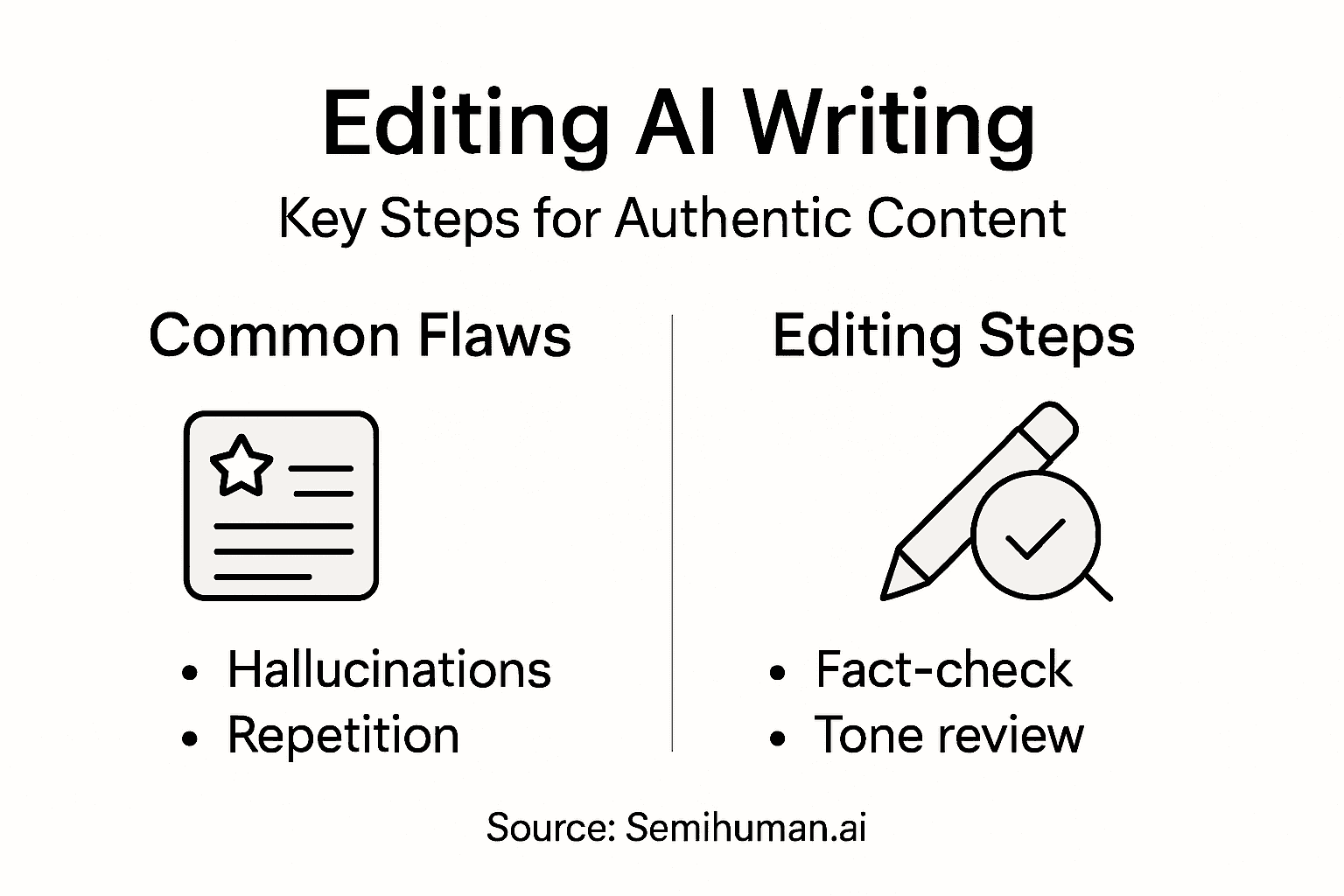
Moreover, ethical considerations play a crucial role in editing AI-generated text. Editors must maintain transparency about AI usage, carefully distinguish between AI assistance and human intellectual contribution, and ensure that the final document reflects authentic scholarly or professional standards. This involves not just surface-level corrections but a deep, critical engagement with the text that transforms algorithmic output into genuinely meaningful communication.
Pro tip: Develop a structured editing checklist that includes specific verification points for factual accuracy, tone consistency, and originality to systematically improve AI-generated content.
The article highlights the critical need for human editing to address common flaws in AI-generated text such as hallucinations, tone mismatch, and brand voice inconsistencies. If you struggle with ensuring your AI content sounds natural, trustworthy, and aligned with your unique voice, you are not alone. These challenges undermine credibility and SEO performance and put your marketing or academic projects at risk. The emotional frustration of spending time on AI drafts that still require heavy rewriting is a shared pain point for many creators and professionals.
Semihuman.ai is designed exactly to solve these problems by turning generic AI-generated text into genuinely human-like content. With features like advanced text restructuring, keyword integration, and AI detection evasion, our platform empowers you to maintain authenticity while improving your SEO rankings and bypassing tools such as Turnitin, GPTZero, and Copyleaks. Visit the Semihuman.ai homepage to explore how this AI-powered editing solution creates smarter, credible content for marketers, students, and content creators alike.
Take control over your AI content today and eliminate the risks of unedited text failing your audience or compliance standards.
Ready to create authentic, high-quality text that reads naturally and ranks well?
Explore Semihuman.ai now
Human editing is essential for AI-generated content because it addresses inaccuracies, ensures factual integrity, and adds contextual depth that AI tools typically lack. Human editors refine the text to align with academic and professional standards, making it more credible and authentic.
Common flaws in AI-generated writing include hallucinations or false information, generic phrasing, repetitive language, and contextual inconsistencies. These weaknesses can lead to superficial content that lacks depth and nuance, risking credibility and engagement.
Marketers can mitigate risks by implementing a structured editing process that includes fact-checking, tone alignment, and brand voice verification. This ensures that AI-generated content is credible, engaging, and aligned with the organization's values and messaging.
Best practices for editing AI-generated text include developing a structured editing checklist, verifying factual claims, maintaining narrative coherence, and ensuring tone consistency. Engaging critically with the content transforms it from raw output into polished, meaningful communication.

Start
Humanizing
for Free!
Humanize