
Loading...

TL;DR:
- Genuine conversational copy centers on the customer's internal dialogue, building emotional connection and relatability.
- Combining AI-generated drafts with human editing enhances authenticity, tone, and emotional resonance.
- Effective copywriting relies more on empathy and understanding customer feelings than on technology tools.
Most marketers assume conversational copywriting just means writing the way you talk. Drop the jargon, loosen the grammar, and you're done. But that's only the surface. Real conversational copy is built around the customer's internal dialogue, their doubts, desires, and the exact words they use when describing their own problems. Get it right, and conversational copywriting outperforms traditional styles in both engagement and conversions. This guide will define the concept clearly, contrast it with traditional copy, walk you through proven frameworks, and show you how to blend AI tools with human editing to make it work at scale.
| Point | Details |
|---|---|
| Authentic engagement wins | Conversational copywriting connects with audiences by mirroring their language and concerns. |
| Blend AI and human editing | Hybrid workflows yield higher performance than AI or human-only approaches. |
| Frameworks guide success | Applying structures like PAS ensures your copy stays customer-focused and actionable. |
| Adapt for context | Conversational style needs tweaking in regulated or professional settings to maintain credibility. |
Conversational copywriting is not a style choice. It's a strategy. It means writing copy that reflects how your customer already thinks, using the language they use, addressing the fears they have, and meeting them where they are emotionally. It's the difference between a brand talking email-templates instrumentation-client.ts instrumentation.ts translations someone and a brand talking with them.
Traditional copy tends to lead with features, credentials, and polished brand voice. Conversational copy leads with the reader. As one customer-centric copywriting framework puts it, great copy is "direct, personal, and built around the customer's internal conversation." That shift in starting point changes everything.
Four core features define this style:
This approach grew with digital marketing. As brands moved online, they quickly learned that formal ad copy felt cold on social media, in emails, and in chatbots. Audiences started ignoring content that felt corporate. Conversational copy filled that gap, and AI tools have accelerated its adoption by making it faster to draft, test, and iterate.
Here's how conversational and traditional copy compare at a glance:
| Feature | Conversational copy | Traditional copy |
|---|---|---|
| Tone | Warm, direct, personal | Formal, polished, brand-led |
| Structure | Loose, reader-paced | Rigid, feature-first |
| Language source | Customer interviews, forums | Brand guidelines |
| Primary goal | Emotional connection | Information delivery |
| Best channel | Email, social, chatbots | Print, B2B proposals |
For content marketers focused on writing for digital audiences, this distinction is critical. Choosing the wrong style for the channel can tank engagement even when the underlying offer is strong.
Now that the definition is clear, it's essential to see how conversational copywriting differs from traditional methods and where each tactic fits best.
The biggest difference isn't tone. It's intention. Traditional copy is written to inform or impress. Conversational copy is written to connect and convert. That shift in purpose changes structure, word choice, sentence length, and even punctuation.

Look at the data. Conversational copy delivers a higher click-through rate across most digital channels, though it can risk seeming unprofessional in B2B or finance contexts where authority and precision carry more weight. This is a real tradeoff, not just a stylistic preference.
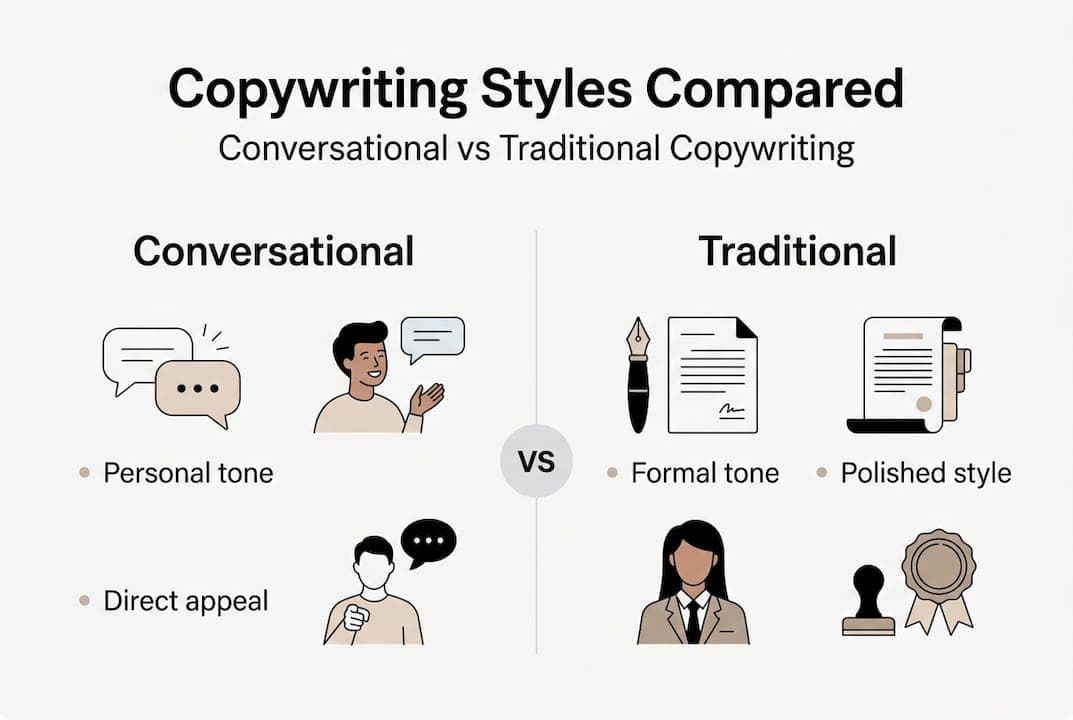
Here's a side-by-side breakdown:
| Dimension | Conversational | Traditional |
|---|---|---|
| Tone | Casual, warm | Formal, authoritative |
| Sentence length | Short, varied | Longer, structured |
| Risk | May seem informal | May feel cold or distant |
| CTR performance | Higher on average | Lower in digital channels |
| Conversion rate | Stronger in direct response | Stronger in complex B2B sales |
"The best copy doesn't sound like marketing. It sounds like a conversation you were already having in your head."
Conversational copy shines in email marketing, landing pages, social ads, and chatbot scripts. It struggles when the audience expects gravitas, such as legal services, enterprise software procurement, or regulated financial products. In those settings, a hybrid approach works best.
Pro Tip: You don't have to choose one or the other. Blend them. Use conversational language for your headlines and opening lines to pull readers in, then shift to a more structured tone for technical details. This keeps copywriting tips relevant across professional contexts without sacrificing clarity.
The key is reading your audience before you write a single word. Tone is a tool. Use it deliberately.
Understanding the differences is only the first step. Here's how you can actually implement conversational copywriting by following proven methodologies and frameworks.
The most common mistake marketers make is trying to write conversationally from memory. They guess at what their audience sounds like instead of listening first. The fix is simple: go to the source.
Here's a step-by-step process that works:
Mapping customer internal conversations and revising value propositions as customer benefits are recognized best practices in high-performing copy. The process isn't glamorous, but it's what separates copy that converts from copy that just sounds good.
Pro Tip: Set up a simple Google Doc where you paste real quotes from customer interviews and forum posts. When you sit down to write, open that doc first. It keeps your language grounded in reality, not assumption.
For teams using AI tools, this research phase becomes even more important. Humanizing AI text starts with feeding the right inputs. And knowing why AI writing needs editing helps you catch the places where the draft drifts from real customer language.
With these frameworks in mind, let's see how modern marketers combine AI tools with human editing to reach the next level, and the hidden traps to watch for.
AI has made it faster than ever to produce conversational-sounding copy. But speed is not the same as quality. The biggest mistake teams make is treating AI output as finished work. It isn't.
Hybrid approaches, where AI handles the first draft and a human editor refines tone, context, and emotional accuracy, can lift ROI by 15 to 42%. That's a significant gain, but only when the editing step is taken seriously.
Here are the most common pitfalls to avoid:
One area where conversational AI copy genuinely excels is after-hours customer engagement. Cart recovery rates improve noticeably when conversational bots are used outside business hours, with some campaigns reporting recovery rates of 21.4% compared to 17.8% for standard messaging. That's a meaningful lift from a relatively simple change.
The best hybrid workflow looks like this: use AI to generate a draft based on your customer research, then edit for tone and emotional resonance, then test against a real audience segment. Repeat. AI-generated copy can achieve higher CTR in some contexts, but humans still drive more conversions in direct response campaigns where trust is the deciding factor.
For a deeper look at where automation creates risk, the future of content writing and AI writing risks are worth exploring before you build out your workflow. And if you're writing chatbot scripts specifically, chatbot copy best practices offer practical guidance on keeping automated conversations from feeling robotic.
Here's the uncomfortable truth most copywriting advice skips: the tool you use matters far less than the empathy you bring to the edit.
Marketers spend enormous energy choosing between AI platforms, debating prompts, and optimizing workflows. But the copy that actually moves people almost always traces back to one thing: someone took the time to understand what the reader was feeling and wrote directly to that feeling.
Editing AI drafts for authentic, emotional resonance makes the biggest difference, not just choosing the right tool. We've seen high-CTR campaigns fall flat on conversions because the copy was clever but not connected. It grabbed attention and then failed to hold trust.
Viral copy and high-performing copy are not the same thing. One gets shared. The other gets acted on. The difference is almost always emotional accuracy.
True conversational copywriting requires you to revise and test against real customer concerns, not just internal feedback. That means showing drafts to actual customers, reading responses out loud, and asking whether the copy sounds like something a trusted friend would say. Most teams skip this step because it's slow. That's exactly why doing it creates an advantage.
For anyone serious about editing for authenticity, the edit is not a final polish. It's where the real writing happens.
The key to great conversational copy is blending human creativity with smart AI, and knowing when to let each one lead. AI handles speed and scale. You bring the empathy, the customer insight, and the editorial judgment that makes copy actually land.
Semihuman.ai is built for exactly this workflow. Whether you need to humanize an AI draft so it reads naturally, or you want to make sure your content clears AI detection tools without losing its voice, the platform gives you the control to do both. You can use the SEO text generator to build optimized content from scratch, or run existing drafts through the humanizer to sharpen tone and authenticity. If staying ahead of detection tools matters to your workflow, you can also bypass AI detectors while keeping your content genuinely readable and effective.
The main goal is to engage readers by speaking directly to their needs and emotions using relatable, natural language. Conversational copy centers on the customer's thoughts and concerns to build real connection.
Conversational copywriting is direct, personal, and customer-focused, while traditional copy tends to be more formal and feature-driven. Conversational styles result in higher reader engagement and a stronger sense of authenticity.
AI can draft conversational copy quickly, but human editing is essential for emotional impact and genuine connection. Human-edited AI copy outperforms raw AI output in conversions by a significant margin.
Frameworks like PAS (Problem, Agitation, Solution), mapped to the customer journey, are widely used and proven. Copywriters structure copy around customer journey stages and internal conversations for maximum relevance.
It works well for B2C and many B2B sectors but may need adjusting for highly regulated or traditional industries like finance or legal services. A conversational tone can risk seeming unprofessional in some B2B and finance contexts.


Start
Humanizing
for Free!
Humanize