
Loading...

Over 90 percent of people admit that visuals help them remember information better, yet many American content creators still underestimate their real power. In a world where attention spans are shrinking fast, visual elements turn simple messages into unforgettable experiences and drive deeper understanding. This guide reveals how graphics, color, and smart design choices shape effective communication and why mastering these elements matters for anyone aiming to stand out online.
| Point | Details |
|---|---|
| Importance of Visual Elements | Visual elements are essential for transforming written content into engaging experiences, enhancing comprehension, and guiding audience understanding. |
| Strategic Integration | Effective visual communication requires a cohesive narrative that aligns visuals with text, ensuring clarity and consistency across content. |
| Cognitive Benefits | Incorporating visuals leads to faster information absorption and improved memory retention, making complex ideas more accessible. |
| Best Practices | Key practices for visual integration include maintaining relevance, ensuring visual clarity, and optimizing designs for various devices to enhance user experience. |
Visual elements are the foundational building blocks that transform written content from plain text into engaging, memorable experiences. These components go far beyond simple decoration - they are strategic communication tools that enhance comprehension, capture attention, and guide audience understanding. Understanding graphic design intelligence reveals how intentional visual composition can dramatically improve content effectiveness.
Visual elements encompass a wide range of design components, including:
Each of these elements serves a specific purpose in content creation. Images can illustrate complex concepts, charts can simplify data interpretation, and color choices can evoke emotional responses. Web page visual interactions demonstrate how these components fundamentally influence user engagement and information processing.
The strategic integration of visual elements requires understanding both design principles and audience psychology. Effective visual communication isn't about adding random graphics, but creating a cohesive narrative that guides the viewer's eye, explains complex information, and maintains consistent brand messaging. Professional content creators think of visual elements as a language - one that communicates quickly, emotionally, and intuitively across diverse audience segments.
Visual elements represent a diverse ecosystem of design components that serve distinct communication objectives across various media platforms. Analyzing visual elements in social media reveals the complex interplay between aesthetic design and strategic communication. Understanding these elements allows content creators to craft more compelling, engaging narratives.
Photographic Imagery represents one of the most powerful visual communication tools. Photographs can:
Graphic Illustrations offer another critical visual language. Unlike photographs, illustrations provide flexibility in representing abstract ideas, conceptual frameworks, and imaginative scenarios. Visual media creation techniques demonstrate how digital compositing and computer-generated imagery can transform complex information into digestible visual narratives.

Data visualizations and infographics represent sophisticated visual elements that transform numerical information into comprehensible graphics. Charts, graphs, and statistical representations allow audiences to quickly understand complex datasets, making information more accessible and engaging. Professional content creators strategically select visual elements that not only communicate information but also create memorable, shareable experiences across different audience segments.
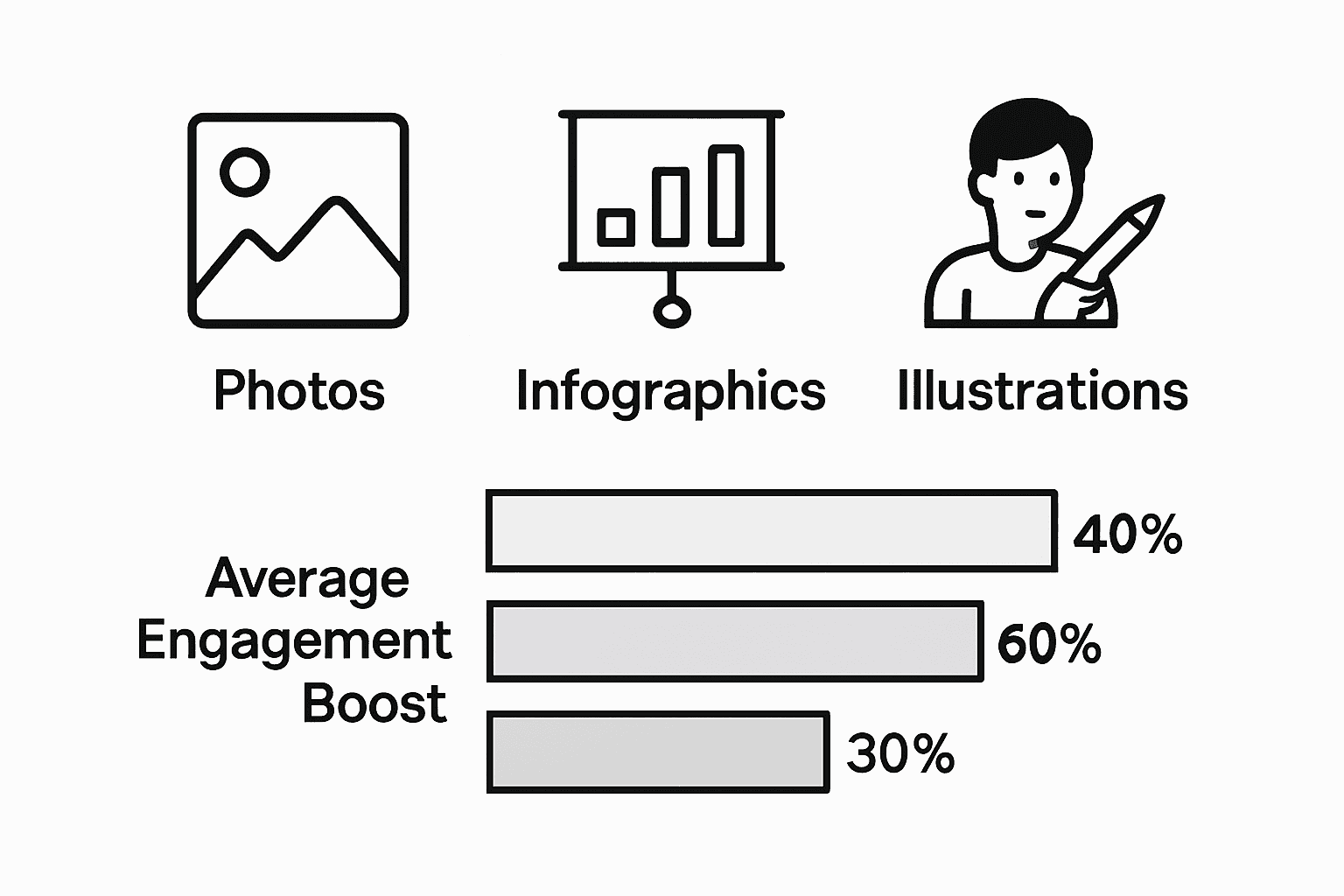
Visual elements are powerful psychological triggers that transform passive content consumption into active engagement. Infographic text placement and descriptiveness research demonstrates how strategic visual design can dramatically improve information retention, comprehension, and audience interaction.
Cognitive Processing plays a crucial role in visual engagement. The human brain processes visual information 60,000 times faster than text, making graphics an incredibly efficient communication tool. Key cognitive benefits include:
Visual complexity in educational content reveals that carefully designed visuals can significantly reduce user dropout rates and increase learning engagement. Professional content creators understand that visuals are not mere decorative elements but strategic communication instruments that guide audience attention, simplify complex narratives, and create memorable experiences.
Engagement metrics consistently show that content with relevant, high-quality visuals generates substantially higher interaction rates. User Experience in Written Content demonstrates that well-integrated visual elements can increase reader retention, sharing probability, and overall content perceived value. By transforming abstract information into tangible, digestible visual narratives, creators can bridge comprehension gaps and create more inclusive, accessible communication experiences.
Visual integration requires a strategic approach that goes beyond simply adding graphics to content. E-learning visual element research demonstrates that thoughtful visual selection can dramatically enhance user experience and information retention. Successful integration demands careful consideration of context, audience, and communication objectives.
Key best practices for effective visual integration include:
Semantic relationships in visual art highlight the importance of creating meaningful connections between text and visual components. Professional content creators understand that visuals should not merely decorate but actively contribute to narrative comprehension. This means selecting images, infographics, and illustrations that directly support and enhance the written message.
Technical considerations are equally crucial in visual integration. Content creators must pay attention to file sizes, loading speeds, responsive design, and cross-platform compatibility. User Experience in Written Content emphasizes that poorly implemented visuals can actually detract from user engagement, making technical execution as important as creative design. The goal is to create a seamless, intuitive visual experience that guides the audience through the content effortlessly.
Visual communication requires precision and strategic thinking. Multimedia integration research reveals that poorly executed visual elements can significantly undermine content effectiveness, creating barriers to audience comprehension and engagement.
Common visual mistakes content creators frequently encounter include:
Graphical abstract design principles highlight the importance of clarity and simplicity in visual communication. Professional creators understand that visuals should clarify, not complicate. This means selecting images that directly support the narrative, maintaining clean design principles, and ensuring each graphic serves a specific communicative purpose.
User Experience in Written Content emphasizes that technical execution matters as much as creative design. Content creators must rigorously test visual elements across different platforms, ensuring responsive design, appropriate file sizes, and seamless integration. The ultimate goal is creating visuals that enhance understanding, guide audience attention, and transform complex information into intuitive, memorable experiences.
The article highlights how strategic visual elements boost engagement by simplifying complex messages and capturing audience attention. However, combining these visuals with compelling, naturally flowing text remains a challenge for many creators. If your goal is to integrate clear, meaningful images with content that feels truly human and resonates deeply with your audience, you understand the importance of authenticity and connection. Semihuman.ai helps you tackle these pain points by transforming AI-generated drafts into polished, humanized content that complements your visuals perfectly.

Unlock the power of visuals paired with authentic narrative today. Visit Semihuman.ai and see how our AI-powered platform can elevate your content creation process by ensuring your writing is organic, easily understood, and SEO-friendly. Don’t let robotic or generic text weaken your carefully crafted visuals. Start crafting engaging content that stands out now with natural humanization tools.
Visual elements in content creation are components such as images, graphics, charts, typography, and color palettes that enhance the written narrative, making it more engaging and easier to understand.
Visuals engage audiences by enhancing comprehension, speeding up information processing, and creating emotional connections. Humans process visual data faster than text, resulting in improved retention and interaction rates.
Common mistakes include overcrowding images with too much information, using low-resolution graphics, inconsistent design, ignoring accessibility needs, and failing to optimize for various devices.
To effectively integrate visuals, maintain relevance between the images and text, use high-quality graphics, keep a consistent design language, balance complexity, and ensure visuals are optimized for all devices.




Start
Humanizing
for Free!
Humanize