
Loading...

Every digital marketer knows the uneasy feeling of hitting publish, then wondering if their content will raise red flags for originality or face SEO penalties. As AI-generated writing becomes more advanced, the boundaries between genuine creation and unauthorized imitation of intellectual work get harder to navigate. Understanding the distinct types of plagiarism—from paraphrasing without credit to complex patchwork tactics—gives marketers and content creators a clear roadmap for protecting both their reputation and search rankings.
| Point | Details |
|---|---|
| Understanding Plagiarism Types | Marketers must recognize and avoid different types of plagiarism, including verbatim, paraphrasing, mosaic, and idea plagiarism to protect their reputation. |
| Risks of Digital Content | Plagiarism in digital content can lead to legal consequences, SEO penalties, and professional damage that affect a business's visibility and credibility. |
| Importance of Originality | Maintaining originality is crucial for content creators, requiring comprehensive knowledge of plagiarism detection tools and proper citation practices. |
| Self-Plagiarism Awareness | Marketers need to be cautious of self-plagiarism, ensuring their content reflects unique contributions to uphold ethical standards and professional integrity. |
Plagiarism represents the unauthorized use or close imitation of another creator's intellectual work without proper acknowledgment. In digital content marketing, plagiarism has evolved beyond simple copy-pasting into complex forms that challenge traditional detection methods. Digital content plagiarism now encompasses various sophisticated techniques that extend well beyond straightforward text reproduction.
Traditionally, plagiarism involved direct copying of text, but modern digital environments have expanded its definition. Today, plagiarism can include paraphrasing without attribution, using AI-generated content without transformation, translating text from another language, or appropriating core ideas without crediting original sources. This complexity means marketers must be increasingly vigilant about content originality and intellectual property rights.
Researchers have categorized plagiarism into distinct types that digital content creators must understand. These include verbatim plagiarism (direct word-for-word copying), paraphrasing plagiarism (rewriting text without meaningful transformation), mosaic plagiarism (combining sources without attribution), and idea plagiarism (using conceptual frameworks without acknowledgment). Each type carries potential legal and professional consequences that can significantly damage a marketer's reputation and credibility.
Here's a summary of key plagiarism types relevant to digital content marketing:
| Type of Plagiarism | Defining Feature | Typical Detection Difficulty | Impact on Reputation |
|---|---|---|---|
| Verbatim | Exact word-for-word copying | Easy with most tools | Severe damage |
| Paraphrasing | Rewriting without meaningful change | Moderate | High risk |
| Mosaic | Patchwork from multiple sources | Challenging | Significant harm |
| Idea | Using concepts without credit | Very difficult | Long-term effects |
Pro tip: Regularly run your content through advanced plagiarism detection tools and always maintain a comprehensive citation practice to ensure content authenticity and ethical standards.
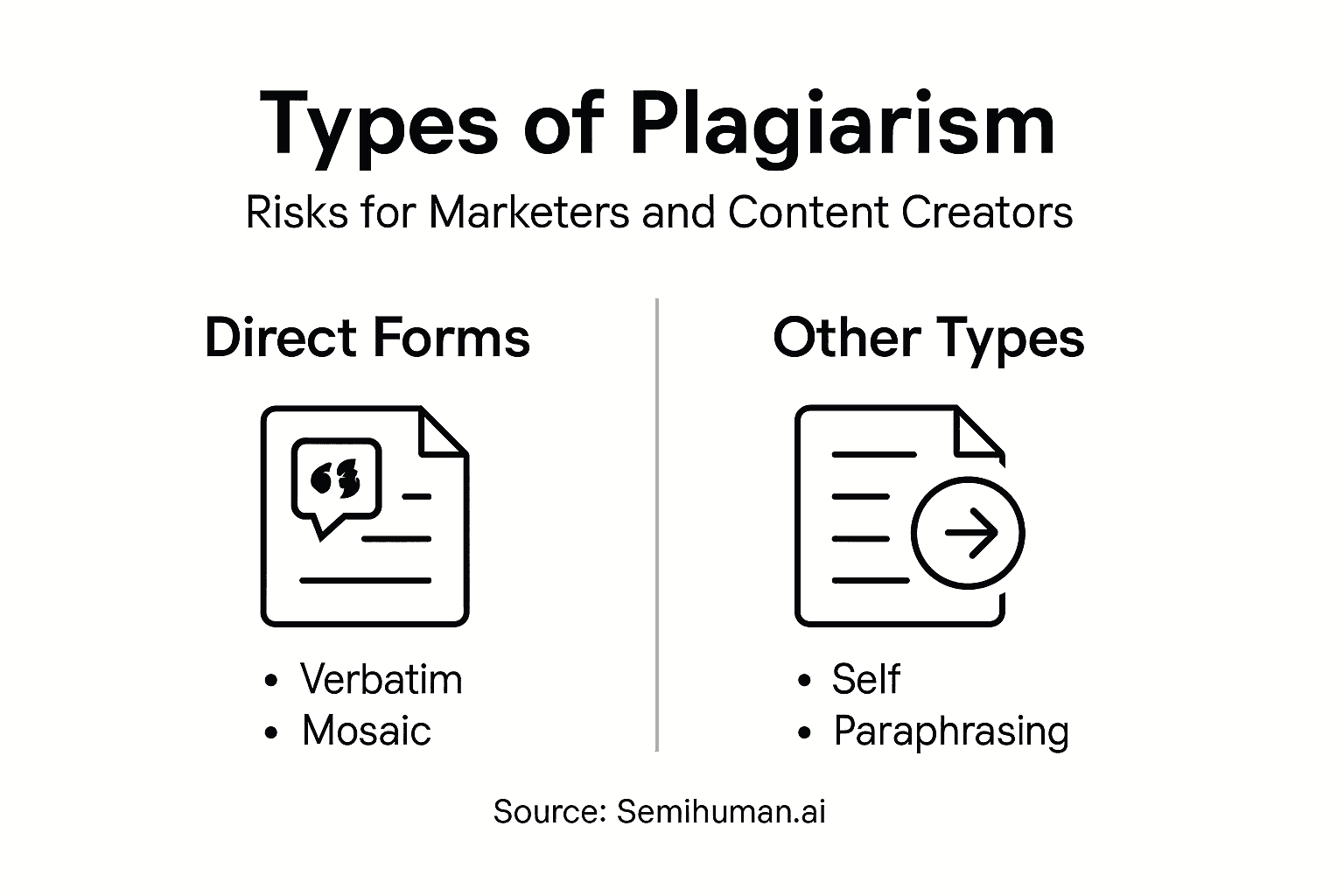
Direct plagiarism represents the most blatant form of academic misconduct, involving verbatim copying of another author's text without proper attribution or quotation marks. Plagiarism detection methods have evolved to identify these clear-cut instances of intellectual theft, making such practices increasingly risky for content creators and marketers.
In contrast, mosaic plagiarism presents a more subtle and complex challenge. This sophisticated form of plagiarism involves strategically weaving together phrases and ideas from multiple sources, creating a patchwork of borrowed content that appears superficially original. Unlike direct plagiarism, mosaic plagiarism requires more nuanced detection techniques, as the text incorporates elements from various sources while attempting to disguise the original borrowed material.

The key distinctions between direct and mosaic plagiarism lie in their execution and detection complexity. Direct plagiarism is an outright copy-paste approach that makes no attempt to hide the source, while mosaic plagiarism involves careful manipulation of source materials to create an illusion of originality. Both types fundamentally violate academic and professional ethical standards, potentially resulting in severe consequences such as content removal, professional reputation damage, and legal repercussions for marketers and content creators.
Pro tip: Develop a systematic approach to content creation that includes multiple plagiarism checks, citation verification, and using paraphrasing techniques that genuinely transform source material into your unique voice.
Self-plagiarism emerges as a nuanced form of academic misconduct that challenges traditional understanding of originality. Text recycling practices represent a complex ethical landscape where authors reuse their previous work without appropriate acknowledgment, creating potential intellectual integrity concerns for content creators and marketers.
Marketers and content creators frequently encounter self-plagiarism through various manifestations, including duplicate publication, redundant content reproduction, and strategic repurposing of existing materials. These practices can range from minor text reuse in methodological sections to extensive republication of entire research findings or content pieces without transparent citation or permission. The consequences extend beyond simple ethical violations, potentially damaging professional reputation and triggering potential legal or professional sanctions.
Research identifies multiple subtypes of self-plagiarism that content professionals must understand. Salami slicing involves breaking a comprehensive research project into multiple smaller publications, while duplicate publication represents direct republication of identical content across different platforms. These strategies might seem strategically advantageous but fundamentally undermine academic and professional content creation standards, risking credibility and potential exclusion from respected publishing platforms.
Compare common content originality challenges marketers face:
| Issue | What It Means | Potential Consequences | Mitigation Strategy |
|---|---|---|---|
| Self-Plagiarism | Reusing own previous work | Legal and reputational | Track publication history |
| Patchwriting | Superficial phrase-level changes | SEO penalties, integrity | Deep comprehension, rewriting |
| Duplicate Publication | Republishing same material | Platform bans, lawsuits | Unique contributions only |
Pro tip: Develop a comprehensive content tracking system that logs previous publications and ensures each new piece represents genuinely unique intellectual contribution, using careful paraphrasing and transparent attribution techniques.
Paraphrasing represents a critical skill in academic and professional writing, requiring nuanced understanding of intellectual property and source representation. Patchwriting research reveals the complex challenges content creators face when attempting to transform original source material into their own words, highlighting the thin line between acceptable restatement and potential plagiarism.
The fundamental distinction between paraphrasing and patchwriting lies in the depth of transformation and intellectual engagement with source material. Paraphrasing demands a comprehensive reimagining of the original text, where the core idea is restated using entirely original language and sentence structure. Patchwriting, conversely, involves superficial modifications like synonym replacement or minor syntactical changes, which often retain too much of the original text's structure and vocabulary to be considered truly original.
Source attribution becomes the critical mechanism for maintaining academic and professional integrity when working with external materials. Effective paraphrasing requires not just linguistic skill but a deep understanding of the original concept, allowing writers to reframe ideas authentically while providing clear credit to the original source. Marketers and content creators must develop sophisticated techniques that go beyond mechanical rewriting, focusing instead on genuine comprehension and unique intellectual contribution.
Pro tip: Always read and fully comprehend source material before attempting to paraphrase, using your own language and thought process to reframe the original concept while maintaining its essential meaning.
Marketing professionals must navigate a complex landscape of potential consequences when dealing with plagiarized content. Legal risks in content creation extend far beyond simple academic penalties, potentially involving federal lawsuits, substantial monetary damages, and professional reputation destruction. The stakes are particularly high for businesses relying on original content as a core marketing strategy.
Search engines like Google have sophisticated algorithms designed to detect and penalize unoriginal content, which can dramatically impact a website's visibility and search rankings. Plagiarism can trigger severe SEO consequences, including content de-indexing, reduced page rankings, and potential complete removal from search results. These penalties can undermine years of digital marketing investment, making content originality a critical business imperative.
The legal framework surrounding content plagiarism encompasses multiple dimensions, from copyright infringement to breach of contract. Professional marketers must understand that plagiarism isn't just an ethical issue but a potential legal liability. Intellectual property violations can result in cease-and-desist orders, financial settlements, and long-term brand reputation damage that extends well beyond immediate content-related penalties.
Pro tip: Implement a rigorous content verification process using multiple plagiarism detection tools and always maintain comprehensive documentation of content sources and original creation.
Plagiarism risks like direct copying, mosaic plagiarism, and even self-plagiarism create serious challenges for marketers striving for original digital content. With complex detection tools and SEO penalties threatening your content's impact, achieving genuine originality while maintaining high-quality messaging can feel overwhelming. This article highlights the importance of deep paraphrasing, source attribution, and ethical content creation to protect your brand's reputation.
Take control now by transforming AI-generated drafts into naturally human-like, authentic content with Semihuman.ai. Our AI-powered platform helps you restructure text, integrate keywords seamlessly, and bypass AI detection — ensuring your content is both original and optimized for SEO. Explore how to reduce plagiarism risks and elevate your marketing efforts by visiting Semihuman.ai today. Start creating unique, trustworthy content that resonates and ranks with confidence.
Plagiarism can be categorized into several types: verbatim plagiarism (word-for-word copying), paraphrasing plagiarism (rewriting without meaningful change), mosaic plagiarism (combining sources without attribution), and idea plagiarism (using concepts without credit). Each type presents unique challenges and risks for content creators.
Engaging in plagiarism can severely damage a marketer's reputation, leading to loss of trust from audiences, potential legal consequences, and severe penalties from platforms that may remove content or exclude the marketer from their services.
Direct plagiarism involves copying text verbatim without attribution, while mosaic plagiarism weaves together phrases from multiple sources. Mosaic plagiarism can be harder to detect as it combines ideas but still fails to provide proper citations.
Marketers can avoid self-plagiarism by maintaining a comprehensive content tracking system, ensuring that new materials are genuinely unique and appropriately cited to acknowledge previous work.

Start
Humanizing
for Free!
Humanize