
Loading...

TL;DR:
- AI detection tools rely on statistical signals and transformer classifiers to identify generated content.
- No single detector is fully reliable; accuracy varies with content edits, length, and language.
- Future of authenticity involves content watermarking and origin tracking, not just detection.
Picking the right AI detection tool feels overwhelming when every platform claims to be the gold standard. You've got GPTZero, Originality.ai, Turnitin, and a dozen others all promising near-perfect accuracy. For content creators, marketers, and students, the stakes are real: flag the wrong content and you risk academic consequences, damaged credibility, or wasted budget. This guide cuts through the noise by breaking down how these tools actually work, comparing the biggest names side by side, and matching each to real-world use cases so you can make a confident, informed choice.
| Point | Details |
|---|---|
| Understand detector mechanics | AI detection relies on measuring text predictability and using advanced classifiers, but every method has trade-offs. |
| Top tools for 2026 | GPTZero, Originality.ai, and Turnitin are among the most trusted AI detection systems for various users. |
| Accuracy and edge cases | Detectors are highly accurate on pure AI but may struggle with edited, paraphrased, or non-native text which increases false positives. |
| Match tools to tasks | Different scenarios—academic, marketing, freelance—require different AI detection strategies for best results. |
| Future trends | Expect more focus on watermarking and content provenance as detection and evasion advances. |
Before you evaluate any tool, it helps to understand what's happening under the hood. AI detection is not magic. It's pattern recognition built on a few well-established statistical and machine learning concepts.
The three core signals most tools rely on are perplexity, burstiness, and Zipf's Law conformity. Perplexity measures how surprising or unpredictable a piece of text is. AI models tend to produce low-perplexity text because they gravitate toward the most statistically likely word choices. Burstiness captures variation in sentence complexity. Human writers naturally mix short punchy sentences with longer elaborate ones. AI text tends to stay in a medium-complexity zone. Zipf's Law describes how word frequency distributes in natural language. AI detectors primarily use statistical metrics like perplexity, burstiness, Zipf's Law conformity, sentence length skewness, and fine-tuned transformer classifiers to identify generated content.
Beyond these statistical signals, most modern detectors also deploy transformer classifiers. These are machine learning models, often fine-tuned versions of architectures like DistilBERT or RoBERTa, trained specifically to recognize patterns common in generative AI output. They look at token sequences and context windows the same way a language model does, which makes them surprisingly effective at catching pure AI text.
Here is where things get practical:
Understanding these AI detection metrics for marketers matters because it shapes your expectations. No single detector catches everything, and balancing authenticity in AI content is as much about workflow as it is about the tool you choose. The top AI detection tools in 2026 each make different tradeoffs between precision, recall, and false positive rates.
With the mechanics in mind, here is a clear-eyed look at the platforms most people actually use.
Frequently used AI detection systems include GPTZero, Originality.ai, Winston AI, Copyleaks, Turnitin, ZeroGPT, QuillBot AI Detector, and Grammarly AI Detector. Each targets a slightly different audience and use case.
| Tool | Accuracy (pure AI) | Cost | Best for |
|---|---|---|---|
| GPTZero | ~99% | Free/Paid | Educators, institutions |
| Originality.ai | ~96.7% | Paid | Agencies, SEO teams |
| Winston AI | ~98% | Paid | Marketing professionals |
| Copyleaks | ~95%+ | Paid | Enterprise, multilingual |
| Turnitin | High (undisclosed) | Institutional | Universities |
| ZeroGPT | ~75% | Free | Quick informal checks |
| Grammarly | Moderate | Free/Paid | Casual, in-workflow use |
See real-world AI detection examples if you want concrete case studies alongside these tool profiles. For more detailed AI detector software comparisons, independent benchmarking sources offer side-by-side test results.
Pro Tip: Run the same piece of text through two or three free tools before drawing any conclusion. If GPTZero and ZeroGPT both flag a passage, that's a stronger signal than one tool doing it alone.
Knowing the tools is one thing. Understanding where each one breaks down is what separates a smart choice from a frustrating mistake.

| Tool | Strength | Weakness | Institutional use |
|---|---|---|---|
| GPTZero | High accuracy, sentence-level view | Struggles with short texts | Yes |
| Originality.ai | Plagiarism + AI combo | Costs add up at scale | Agencies, not schools |
| Winston AI | Clean UI, readability scores | Less tested on non-English | Growing |
| Copyleaks | Multilingual, LMS integration | Expensive for individuals | Strong |
| Turnitin | Ubiquitous in academia | Opaque scoring, no API for users | Dominant |
| ZeroGPT | Free, instant | Lower accuracy, no integrations | Rarely |
The accuracy gap between tools is real. Empirical benchmarks show Originality.ai at 85% base accuracy and 96.7% on paraphrased content, while GPTZero reaches 99% on pure AI text. Those numbers sound impressive, but they hide important edge case behavior.
"The tools that score highest on pure AI text often underperform the most when content has been lightly edited or paraphrased by a human." This gap matters far more in practice than headline accuracy figures suggest.
The main pain points across almost every tool fall into predictable categories:
For AI detection for content authenticity, understanding these failure modes helps you interpret results rather than accept them at face value. The context also matters in AI detection for marketers because a flagged piece of marketing copy may just reflect tight, formulaic writing, not AI generation. For more on how institutions navigate this, AI detection in education highlights ongoing debates about accuracy standards and fairness.
Different situations demand different tools. Here is how to match the right detector to your actual needs.
For hybrid or lightly edited content, no single tool is reliable enough to use alone. Cross-reference at least two tools and apply human judgment to the flagged sections. For short text under 150 words, skip automated detection entirely and rely on your own editorial instincts.
Pro Tip: For high-stakes writing like grant applications or major editorial pieces, consider pairing standard AI detection with content watermarking tools that embed an invisible authorship signal from the start. It creates a verifiable origin trail that no detector can match.
When avoiding AI detection in practice matters for your workflow, the most durable approach is genuine human revision, not tool-hopping. And if you use AI for efficiency in newsletters or SEO content, resources on humanizing AI content for newsletters offer practical editing frameworks.
Most comparison guides treat AI detection as a solved problem. Pick the most accurate tool, apply it consistently, done. That view is dangerously incomplete.
The real challenge is that detectors struggle most with hybrid and edited AI content, achieving only 60-75% accuracy in those scenarios. Adversarial prompting and paraphrasing evade even the best classifiers with relative ease. The tools reviewed in this article were state of the art at the time of writing, but the generative AI landscape moves fast.
What does the next wave look like? Watermarking and content provenance are emerging as the more reliable long-term answer. Rather than detecting AI after the fact, these approaches embed authorship signals at the point of creation. They are not foolproof either, editing can degrade watermarks, but they represent a fundamentally different and more robust strategy.
Our view is that relying on any single detector is increasingly risky. The market is moving toward blended detection layered with origin tracking. Organizations serious about content authenticity should start building those workflows now, not after the next round of model improvements makes today's detectors obsolete. Understanding the future of content authenticity means planning for the tools that do not exist yet, not just optimizing for the ones that do.
Understanding AI detection is one thing. Acting on that knowledge in your daily content workflow is where the real work happens. Whether you are a marketer trying to keep your content pipeline authentic or a creator navigating the line between AI efficiency and original voice, you need tools built for that nuance.
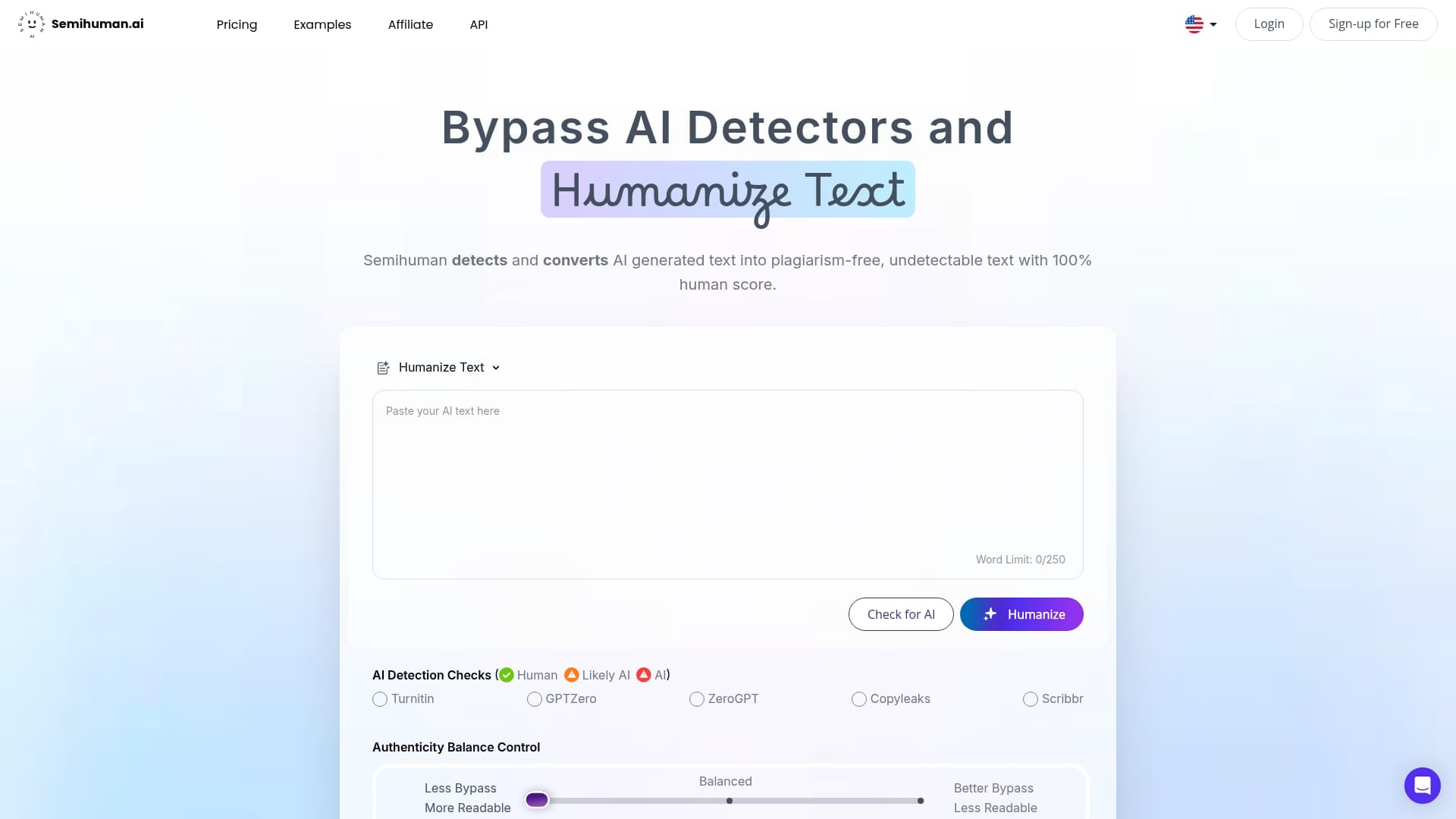
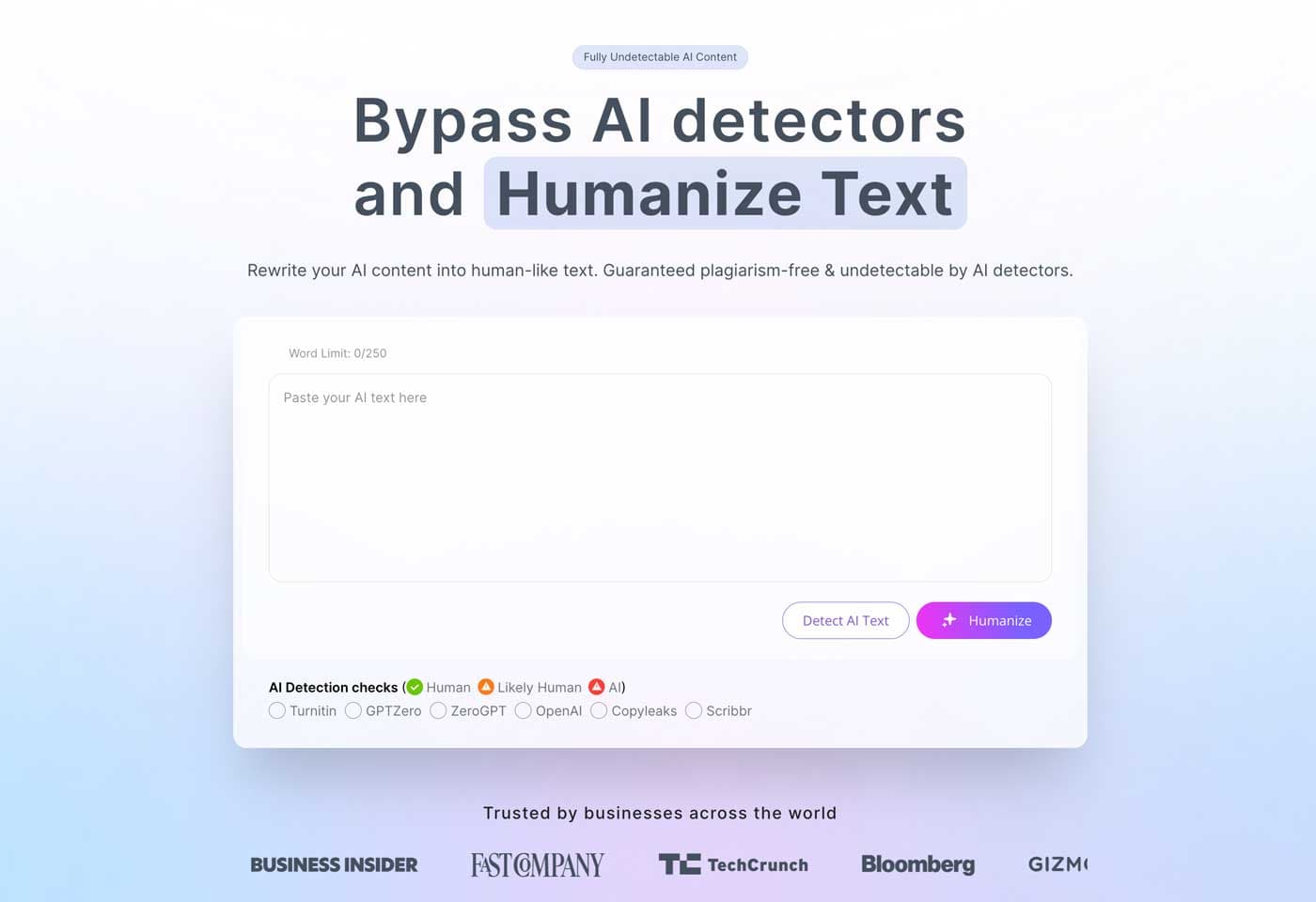
Semihuman.ai is designed exactly for that challenge. Our platform helps you transform AI-generated drafts into content that reads naturally and passes authenticity checks without sacrificing your production speed. Start with the SEO Text Generator to create content that balances optimization with genuine human tone. Or explore the full suite of AI writing tools to find the right fit for your workflow. Smarter detection starts with smarter content creation.
Originality.ai and GPTZero lead in accuracy, with benchmarks showing Originality.ai at 96.7% on paraphrased content and GPTZero at 99% on pure AI text, though no tool performs perfectly across all content types.
False positives increase to 15-20% on short texts, non-native English, and technical writing where natural writing patterns overlap with AI output signatures.
Free tools like ZeroGPT and Grammarly work for quick initial screening, but less accurate on edges like paraphrased or lightly edited AI content, making them unreliable for professional or academic decisions.
Focus on genuine human editing with varied sentence structures and avoid pasting large unedited AI blocks; for critical documents, watermarking is reliable as an origin signal though fragile to heavy editing.
Detection is an ongoing race, and adversarial prompts and paraphrasing already evade current classifiers effectively, suggesting hybrid detection plus provenance tracking will define the next generation of solutions.

Start
Humanizing
for Free!
Humanize