
Loading...

TL;DR:
- Shareability is driven more by psychological relevance than content quality or emotion. Content that connects personally or socially to the audience significantly increases sharing intention, while framing and motives like FoMO further enhance reach. Ethical, authentic strategies that build trust and relevance over time yield sustainable sharing habits.
Most marketers assume that better content gets shared more. That assumption is wrong, and the research makes it uncomfortable to ignore. Value-based decision processes that blend content evaluation with social context actually govern sharing behavior, meaning two pieces of equally polished content can perform worlds apart based purely on psychological fit. Understanding what really triggers the share button gives you a measurable edge over teams still optimizing only for quality.
| Point | Details |
|---|---|
| Value-based sharing | Sharing decisions blend content evaluation with perceived social and personal relevance. |
| Five sharing motives | Emotional, social, informational, identity, and conversational drivers all influence what gets shared. |
| Framing matters | The way you present content can raise self-relevance and social relevance, boosting shareability. |
| Beware polarization | Emotional or moral content boosts shares but can divide audiences and change reputational signals. |
| Measure and optimize | Use mediation-based methods and controlled experiments to test what truly drives your audience's sharing. |
Not all sharing is merit-based. A viral post about a local weather event can outperform an award-winning investigative piece simply because it feels more personally relevant to the audience seeing it. That gap comes down to psychology, not craft.
Research confirms that sharing is governed by a neural valuation system, the same brain circuitry that helps people decide whether to buy something or avoid it. When someone encounters content, their brain quickly evaluates: "Does this matter to me? Will sharing this matter to others?" That split-second assessment determines the outcome far more than writing quality or production value.
Two key psychological concepts shape this evaluation:
Studies show that self-relevance and social relevance are both independent drivers of sharing intention, and they can work together or separately. A piece of content can trigger sharing because it speaks directly to the reader's life, or because the reader immediately thinks of a specific person who needs to see it.
Understanding content originality's role in making content feel fresh and personally relevant is one of the first practical places to apply this. Originality increases the perception that content is worth passing on because it delivers something the audience hasn't already seen. Paired with strong content authenticity in marketing, this combination signals trustworthiness, and trusted content gets shared.
| Psychological factor | Definition | Effect on sharing |
|---|---|---|
| Self-relevance | Content connects to personal identity or goals | Strong direct effect on sharing intention |
| Social relevance | Content is valuable to someone in sharer's network | Independent, additive effect on sharing intention |
| Content quality | Writing, accuracy, production value | Weaker than relevance in isolation |
| Trust and authenticity | Perceived credibility of source | Amplifies effects of relevance |
"Social sharing is a value-based decision, not a reflex. The content that gets shared is the content that scores highest in the sharer's personal valuation system at that moment."
Once you understand decision processes, you can categorize social sharing motivation into clear types. Research on emotional and conversational sharing identifies five primary motives that push people to pass content along:
Each motive maps to a different type of content. Emotional regulation explains why people share funny videos after stressful weeks. Social bonding explains why nostalgia content performs so well with older demographics. Information seeking explains the sustained sharing of news articles and research briefs.
For Gen Z audiences specifically, message value, gratifications, and FoMO collectively shape what gets shared. Fear of Missing Out (FoMO), meaning the anxiety of being excluded from relevant experiences or conversations, boosts sharing when content feels tied to a moving cultural moment. If your content can signal "this conversation is happening right now," FoMO acts as a multiplier.
Actionable points for your strategy:
Pro Tip: Before publishing, ask yourself which of the five motives this piece is primarily serving. If you can't answer in one sentence, the content may be too generic to trigger a strong psychological response.
Applying these insights to personalizing content for motives is one of the most efficient ways to close the gap between impressions and actual shares. Audience segments don't all share for the same reason, and one-size-fits-all strategies consistently underperform.
Exploring broader content marketing strategies that account for these motivational differences is especially relevant as algorithms increasingly reward engagement depth over raw reach. Understanding emerging content personalization trends can further sharpen your targeting precision.
| Motive | Best content formats | Key audience signal |
|---|---|---|
| Emotional regulation | Short videos, memes, personal stories | High stress events, major news cycles |
| Social bonding | Nostalgia, shared experiences, community posts | Tight-knit community groups |
| Seeking social support | Confessional threads, polls, open questions | Vulnerable or transition periods |
| Social comparison | Rankings, "how you compare" content, scores | Competitive or aspirational audiences |
| Information seeking | News summaries, research breakdowns, how-tos | High-curiosity, professional audiences |
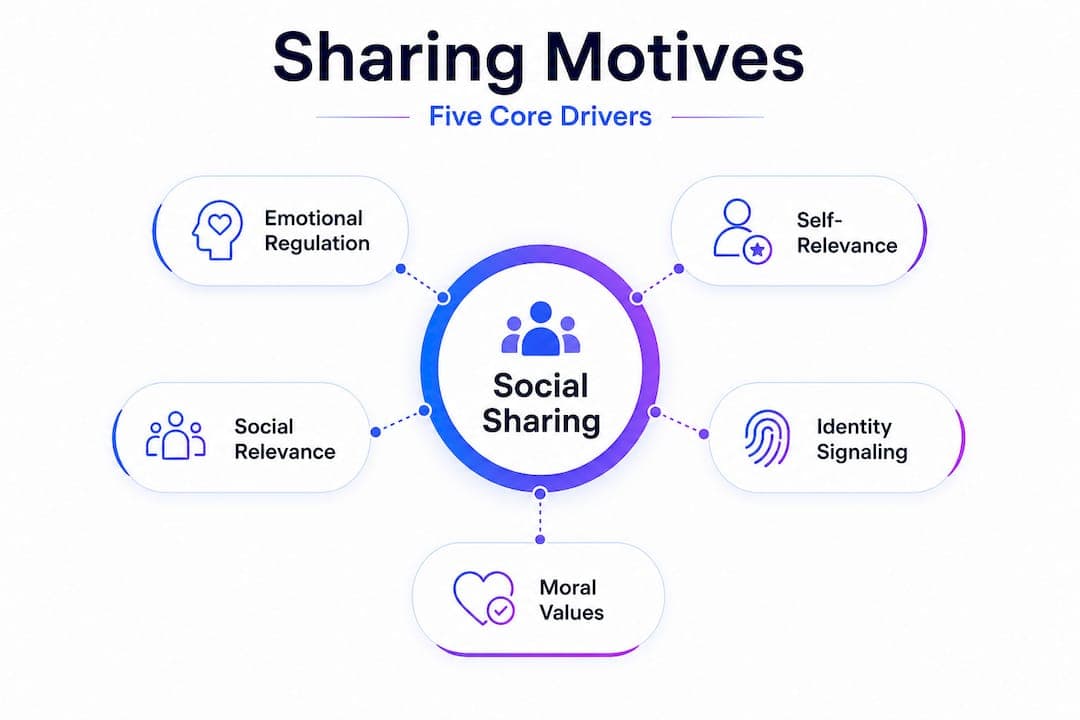
With the core motives in mind, the question becomes: how can content be crafted or positioned to maximize sharing psychology? Framing is the answer.
Framing refers to how a piece of content is contextualized or presented, not what it literally says. The same underlying message can produce dramatically different sharing behaviors based purely on how it is introduced. Experimental research confirms that framing that boosts relevance perceptions causally increases sharing intentions, not just correlates with them. That causal link is important: it means you can deliberately engineer your framing to predictably move your audience.
Here is a four-step process for testing message framing in your own content:
Following content trends for authenticity matters here because framing that feels manipulative or performative backfires. Audiences with strong authenticity radar, especially in the 25 to 40 age range, penalize content that feels engineered. The goal is genuine alignment, not psychological manipulation.
Consider how you use visual versus text content tactics within your framing strategy. Visual framing (choosing an image that centers the individual viewer versus one that depicts a group) can shift perception of self versus social relevance without changing a single word of copy. For maximizing organic reach through authentic SEO strategies, combining strong framing with search-intent alignment gives you both shareability and discoverability.

Not all psychological drivers are straightforward. Sometimes boosting one lever has hidden side effects that hurt your brand or audience relationships.
Moral-emotional content, meaning content that uses language tied to values, fairness, harm, or moral outrage, is among the most powerful sharing accelerators available. Research shows that each additional moral-emotional word in a political message increased the likelihood of sharing by roughly 12%. That is not a trivial effect size. At scale, layering moral-emotional language throughout a campaign can produce significant reach gains.
However, the same research stream shows that moral-emotional content can causally increase sharing while simultaneously reducing openness toward outgroups and reinforcing in-group identity. Translation: it makes your existing fans share more aggressively while making people outside your core audience less receptive, and sometimes hostile.
This creates a real strategic trade-off:
"Moral-emotional amplification is a volume dial, not just a switch. Turn it too high and it stops recruiting new readers. It just makes existing ones louder."
For brands dealing with sensitive topics, social causes, or politically adjacent content, the practical warning is clear: use moral-emotional framing deliberately and sparingly. Test it on sub-audiences before full deployment. Monitor not just share counts but sentiment in comments, because identity-signaling content can create sharing metrics that look great while quietly damaging brand perception among swing audiences.
Building ethical content strategies is not just good practice here, it is measurable competitive advantage. Brands that earn long-term trust through consistent ethical framing tend to build sharing habits that compound over time rather than spike and burn.
To harness these insights for campaigns, let's turn to measurement and optimization methods you can use right now.
The most rigorous approach borrows from psychology research: mediation-based measurement. This means tracking not just whether someone shared, but why they intended to share. That middle layer of data (the psychological mechanism) is where the diagnostic value lives. Research shows that mediation-oriented measurement connects perception changes to sharing intentions and actual behaviors, giving you a cleaner read on what levers actually moved.
Here is a practical step-by-step for implementing this in your content operation:
Understanding the platform role in brand growth matters when designing measurement systems, since each platform rewards different motive clusters. LinkedIn amplifies information seeking and social comparison. Instagram and TikTok reward emotional regulation and social bonding. Designing platform-specific variants of your framing tests gives you cleaner, more actionable data.
Pro Tip: Build a simple motive-tagging system into your content calendar. For each piece, log which of the five motives it primarily targets. After 90 days, you will have enough data to see which motives drive the most shares in your specific audience, and you can weight your editorial mix accordingly.
The biggest trap in applying sharing psychology is oversimplification. Marketing teams read the headline finding ("emotional content gets more shares") and immediately push for more emotional content in everything. Within a few months, the feed becomes exhausting, the audience tunes out, and share rates paradoxically drop.
Here is the more honest lesson from the research: sharing is contextual. The same content can score high or low on every psychological driver depending on who sees it, when, and in what conversational context. Relevance, not emotion, is the most durable variable. Relevance is why your audience shares a dry infographic more often than a beautiful but disconnected story.
Sustainable sharing strategies are built on audience trust compounded over time. That means delivering consistent relevance, not manufacturing emotion on demand. It means testing framing carefully rather than assuming moral urgency will drive reach. And it means treating your audience as participants in a conversation, not targets for psychological triggers.
What actually works over the long run is a blend: content that is emotionally honest, personally or socially relevant, framed with care, and consistently delivered from a credible source. The brands that get this right do not chase viral moments. They build sharing habits.
Developing authentic content for digital audiences is the foundation of that approach. Every framework in this article ultimately points back to authenticity as the durable amplifier of everything else.
Understanding the psychological drivers of social sharing is only half the equation. The other half is execution, creating content that reliably activates relevance, emotional connection, and the right motivational triggers at scale.

That is where Semihuman.ai fits naturally into your workflow. If you are generating content at volume using AI tools, the gap between psychologically resonant writing and generic AI output can undo all the strategic insight you have gained. Semihuman.ai's AI-powered SEO text generator helps you produce content that reads with the nuance and specificity that relevance-driven sharing actually requires. Pair that with AI proof writing tools to ensure your final output maintains the human authenticity that builds trust and drives organic sharing. Put the psychology to work, at scale.
It refers to the internal motives and value judgments that drive why, when, and what people share online, blending content evaluation and perceived social context. Research confirms that sharing involves value-based decisions rather than automatic responses to content quality alone.
Making content personally significant or socially valuable to an audience increases the intention to share, proven by experimental research. Studies show that both relevance dimensions function as independent psychological mechanisms that additively raise sharing intention.
Emotional and moral-emotional content boosts sharing but may polarize audiences and signal group identity, so effects are nuanced. Moral-emotional content can increase shares while simultaneously reducing outgroup openness, a trade-off that requires deliberate management.
Strategies include mediation-based measurement, controlled experiments with framing, and tracking shifts in relevance or sharing intention over time. Mediation-oriented measurement connects the psychological perception changes that precede sharing to actual sharing behaviors, giving you richer diagnostic data.
FoMO can enhance information-seeking and status-seeking motives, raising the chance of sharing, especially in news and trend-driven contexts. Research shows that FoMO positively moderated the effects of information seeking and status seeking on sharing intent among younger audiences.


Start
Humanizing
for Free!
Humanize