
Loading...

Every writer knows the struggle of making digital content feel genuinely personal in a landscape flooded with machine-generated text. Mastering an authentic voice is no longer just a creative asset—it is a strategic necessity for building audience trust and outperforming search algorithms. This article unpacks the myths around writing voice, explores its types and differences from tone, and offers practical guidance for content marketers and freelance writers aiming to create content that resonates as truly human.
| Point | Details |
|---|---|
| Understanding Writing Voice | Writing voice is a multifaceted expression of identity and perspective beyond mere tone or emotion. It can be crafted and refined through intentional practice. |
| Types of Voice in Content | Writers can leverage various voice types such as Narrative, Analytical, Conversational, Expert, and Persuasive to effectively craft communication for different contexts. |
| Voice vs. Tone | Voice reflects the writer's identity and remains stable, while tone adapts to context and audience, requiring a nuanced understanding for effective communication. |
| Humanizing AI Content | When adapting AI-generated content, strategies should focus on maintaining authentic voice through personal anecdotes, natural speech patterns, and emotional undertones. |
Writing voice represents the unique personality and perspective writers embed into their text. Psycholinguistic research reveals voice is far more complex than simply word choice or style—it's a multifaceted expression of identity and perspective.
Contrary to popular misconception, writing voice isn't just about tone or emotion. Academic scholarship demonstrates voice encompasses a sophisticated blend of linguistic choices, personal experiences, and communicative intentions. It's not a singular, static characteristic but a dynamic interaction between writer and audience.
Voice manifests through several key elements:
Most writers misunderstand voice as something predetermined or unchangeable. In reality, voice can be deliberately crafted and refined through intentional practice and self-awareness. Professional writers learn to adapt their voice across different contexts while maintaining their core stylistic signature.
Pro tip: Develop your unique writing voice by reading extensively, analyzing writing styles you admire, and consistently practicing authentic self-expression in your work.
Academic research on authorial voice reveals multiple distinct types of voice that writers can leverage in content creation. Understanding these variations allows content creators to strategically craft their communication approach across different contexts and audiences.
Content voices can be broadly categorized into several primary types:
Linguistic research suggests that voice is not a monolithic concept but a dynamic interplay of linguistic, rhetorical, and personal characteristics. Comprehensive studies demonstrate that writers can consciously shift between these voice types depending on their communication goals.
Professional content creators understand that voice adaptation is crucial. A technical white paper requires a different voice compared to a social media post, and successful writers master the ability to modulate their tone, complexity, and approach while maintaining their core authenticity.

Pro tip: Practice transitioning between different voice types by reading diverse writing styles and consciously experimenting with tone and perspective in your own work.
Here's a quick overview comparing key types of writing voice and their typical business uses:
| Voice Type | Core Characteristics | Best Used For |
|---|---|---|
| Narrative | Story-driven, emotional, personal | Blogs, brand storytelling, memoirs |
| Analytical | Data-focused, objective, logical | Research reports, white papers |
| Conversational | Informal, dialog-like, engaging | Social media, marketing emails |
| Expert | Authoritative, detailed, credible | Technical guides, thought leadership |
| Persuasive | Motivational, action-oriented | Sales copy, calls-to-action |
Professional editing experts clarify the fundamental distinction between voice and tone in writing, revealing these are not interchangeable concepts but distinct communication strategies that writers must understand and master.
The key differences between voice and tone can be summarized through several critical characteristics:
Language experts suggest that while voice represents a writer's core identity, tone is a flexible tool for engaging different audiences. Think of voice as a person's fundamental accent, while tone is how they modulate their speech depending on the conversation.
Professional writers understand that mastering both voice and tone requires nuanced communication skills. A technical writer might maintain a consistent analytical voice while adjusting tone from formal to conversational depending on the specific document and target audience.
Pro tip: Develop your unique writing voice by consistently writing, while practicing tone flexibility through reading diverse writing styles and understanding different audience expectations.
The table below summarizes the main differences between voice and tone in professional writing:
| Characteristic | Voice | Tone |
|---|---|---|
| Purpose | Expresses author identity | Sets emotional attitude |
| Stability | Remains consistent | Changes by context |
| Key Driver | Writer's personality | Audience and topic |
| Impact | Builds brand consistency | Adjusts reader engagement |
Voice search technologies transform search behaviors by encouraging more nuanced, specific user queries that fundamentally reshape content discovery and engagement strategies. This shift demands a more sophisticated approach to creating authentic, trustworthy content that resonates with both human readers and search algorithms.
The critical ways voice impacts SEO and audience trust include:
Machine learning research confirms that modern SEO success hinges on understanding the sophisticated relationship between content voice, user trust, and search engine rankings. Audiences now expect content that feels genuinely human, with a clear, consistent voice that establishes credibility and expertise.
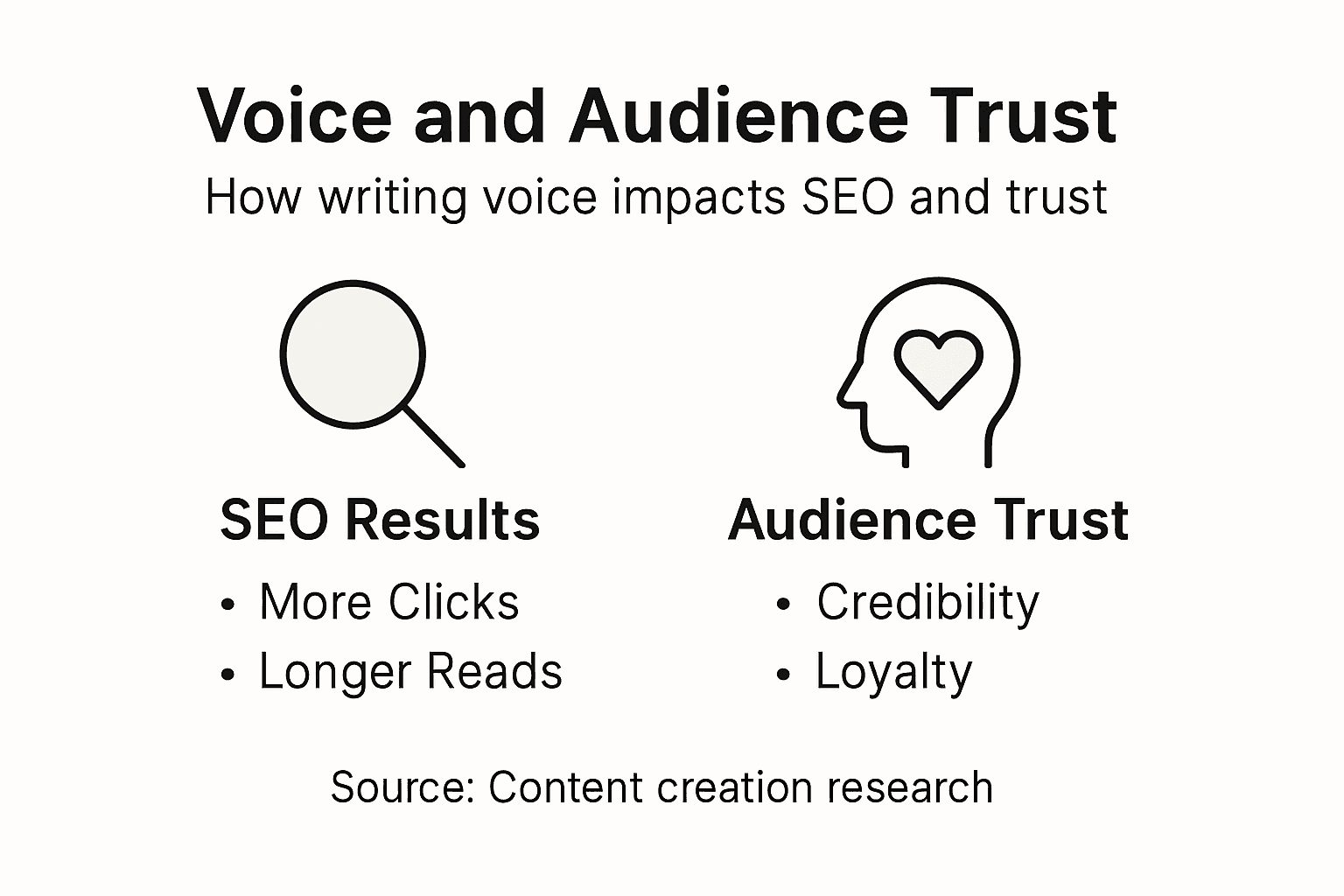
Professional content creators must recognize that voice is no longer just a stylistic choice—it's a strategic tool for building audience connections. A well-crafted voice can transform technical information into engaging narratives, bridge trust gaps, and ultimately improve search visibility by meeting increasingly sophisticated user expectations.
Pro tip: Develop a consistent, authentic writing voice by analyzing your target audience's communication preferences and practicing authentic, conversational content creation techniques.
Academic research highlights the critical challenge of preserving authentic human voice when working with AI-generated content. Transforming algorithmic text into a genuine, personalized narrative requires strategic intervention and nuanced linguistic refinement.
Key strategies for humanizing AI-generated content include:
Collaborative revision approaches demonstrate that human interaction is essential in maintaining authentic voice. Professional writers must actively engage with AI outputs, critically analyzing and reshaping machine-generated text to reflect individual writing style, personality, and unique perspective.
Successful content adaptation goes beyond simple grammatical corrections. It requires a deep understanding of personal communication nuances, emotional intelligence, and the subtle linguistic markers that distinguish human-crafted text from algorithmic generation. Writers must become skilled translators, transforming AI's raw output into compelling, authentic narratives.
Pro tip: Create a personal style guide that documents your unique linguistic quirks, preferred phrases, and communication patterns to consistently humanize AI-generated content.
Academic writing experts identify numerous voice-related pitfalls that can undermine the authenticity and effectiveness of written communication. Recognizing and addressing these common mistakes is crucial for maintaining a compelling and credible writing style.
Key voice mistakes writers frequently encounter include:
The most critical errors stem from attempting to sound overly formal or attempting to completely erase personal identity from the text. Professional writers understand that voice is about striking a delicate balance between authenticity and appropriate communication standards. Each writing context demands a nuanced approach to voice that respects both individual style and audience expectations.
Maintaining an authentic voice requires continuous self-awareness and deliberate practice. Writers must develop the skill to modulate their communication style while preserving the core elements that make their writing uniquely compelling. This involves understanding audience expectations, mastering different communication registers, and cultivating a genuine, adaptable writing persona.
Pro tip: Record yourself speaking naturally about your topic, then use that transcript as a reference for capturing your authentic voice in writing.
The article highlights the vital role of an authentic voice in writing and the challenge many face in keeping content natural and engaging, especially when adapting AI-generated text. You want your writing to showcase your unique personality, connect deeply with your audience, and boost SEO without sounding robotic or generic. With the increasing importance of voice in search and reader trust, developing a consistent and adaptable writing voice becomes essential.
Semihuman.ai is built precisely to solve this challenge. Our AI-powered platform specializes in transforming AI-generated content into naturally human-like writing that reflects your distinct voice. Whether you need help with text restructuring, enhancing keyword integration, or bypassing AI detection systems such as Turnitin and GPTZero, Semihuman.ai empowers creators, marketers, and students alike to produce authentic, engaging content that resonates.
Explore how to humanize your content effectively and maintain your unique voice by visiting Semihuman.ai. Enhance your writing across all formats from blogs and emails to technical guides and SEO articles with confidence and clarity.
Elevate your voice today with Semihuman.ai, your partner in authentic content creation.
Looking for a seamless way to enrich your writing voice and strengthen your audience connections? Start with Semihuman.ai now.
Writing voice represents the unique personality and perspective a writer embeds into their text, encompassing not only tone but also word choice, sentence structure, and personal insights.
You can develop your unique writing voice by reading extensively, analyzing styles you admire, and practicing authentic self-expression in your writing.
The different types of writing voice include narrative voice, analytical voice, conversational voice, expert voice, and persuasive voice, each tailored to specific contexts and audiences.
A well-crafted voice creates authentic, relatable content that resonates with readers, thereby building trust and enhancing audience engagement.



Start
Humanizing
for Free!
Humanize