
Loading...

TL;DR:
- Persuasion relies on matching message style to audience mindset using central or peripheral routes.
- Combining emotional and logical appeals with behavioral and attitudinal prompts creates stronger influence.
- Ethical use of peripheral cues like authority and social proof boosts trust in digital overload environments.
Most marketers spend hours perfecting their message, yet still wonder why readers scroll past without acting. The answer usually isn't the quality of your argument. It's the psychological framing around it. The Elaboration Likelihood Model shows that persuasion works through two distinct mental routes, and choosing the wrong one for your audience is like speaking the right words in the wrong language. In this article, you'll learn how to match your message style to your audience's mindset, blend emotional and logical appeals, and use ethical cues that actually move people to act.
| Point | Details |
|---|---|
| ELM central vs peripheral | Persuasive writing works best when you match arguments or cues to your audience’s involvement level. |
| Affective-cognitive matching | Personalizing messages to the reader’s emotional or logical preference boosts persuasion. |
| Attitudinal-behavioral combos | Mixing belief-based and action-based prompts in content achieves the strongest response. |
| Ethical cue use | Rely on authority and social proof ethically—overused tactics can hurt credibility. |
| Hybrid strategy wins | Combining strong evidence and persuasive cues maximizes impact in modern marketing. |
Now that we've set the stage with psychological models, let's break down how they work in practice.
The Elaboration Likelihood Model, or ELM, is one of the most useful frameworks in persuasion science. It describes two mental pathways readers take when processing a message. The central route involves deep, effortful thinking. The peripheral route relies on mental shortcuts and surface-level cues. Understanding which route your audience is using at any given moment changes everything about how you write.
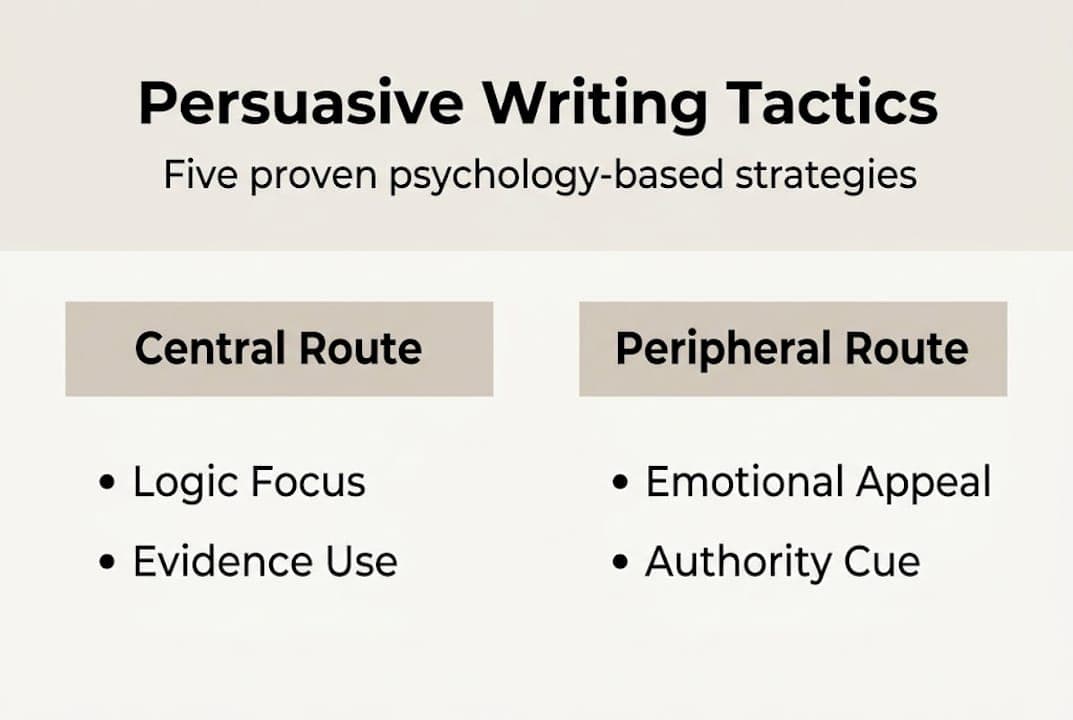
When readers are highly motivated and capable of processing information, they take the central route. They evaluate your arguments, weigh your evidence, and form lasting opinions. This is where building authority with content pays off. Strong, well-reasoned writing builds durable trust with this audience.
When readers are distracted, time-pressed, or simply not invested enough to think deeply, they default to the peripheral route. They respond to signals like expert endorsements, social proof, and visual credibility. These are the cues that make a reader trust a page before reading a single paragraph. For a deeper look at how authority signals affect search performance, authority content SEO is worth exploring.
"Central route yields durable change but requires motivation and ability; peripheral persuasion is faster but temporary. A hybrid approach is best for most marketing contexts."
Here's a quick comparison to make the distinction concrete:
| Feature | Central route | Peripheral route |
|---|---|---|
| Audience engagement | High | Low to moderate |
| Message type | Logic, data, evidence | Authority, social proof, aesthetics |
| Attitude change | Durable and resistant | Faster but fragile |
| Best use case | High-stakes decisions | Awareness, first impressions |
Knowing which route applies means reading your audience first. Look for these indicators:
Most marketing content tries to do one or the other. The real opportunity is in blending both routes strategically, which we'll get into further below.
Once you understand the persuasion routes, the next challenge is crafting messages that match your audience's mindset.

Not every reader processes information the same way. Some people are driven by emotion. They respond to stories, vivid imagery, and appeals to how something will make them feel. Others are driven by logic. They want data, comparisons, and clear reasoning. Persuasion research calls these tendencies "need for affect" (NFA) and "need for cognition" (NFC).
Here's the key insight: affective-cognitive matching enhances persuasion. Messages that align with a reader's natural processing style produce greater attitude change, and this effect is backed by neural evidence. In other words, writing an emotional story for a logic-driven reader, or dumping statistics on an emotion-driven one, actively reduces your persuasive impact.
| Audience type | Preferred message style | Key features |
|---|---|---|
| High NFA (emotion-driven) | Affective | Stories, sensory language, emotional outcomes |
| High NFC (logic-driven) | Cognitive | Data, comparisons, reasoned arguments |
| Mixed audience | Hybrid | Emotional hook + logical support |
So how do you figure out which type of audience you're writing for? Follow these steps before drafting any persuasive piece:
For a practical look at how this connects to content strategy, content personalization explained breaks down the authenticity angle well. You can also find real-world humanized content examples that show affective-cognitive matching in action.
Pro Tip: Use a quick three-question survey in your email welcome sequence to ask new subscribers whether they prefer data-driven insights or story-based advice. This single data point lets you segment your list and personalize every message that follows.
Knowing your audience's cognitive style, let's dial in how to craft statements that move them to action.
One of the most underused tactics in persuasive writing is combining attitudinal statements (what someone should believe) with behavioral prompts (what someone should do). Most content does one or the other. A blog post might make a compelling case for a belief but forget to prompt action. A landing page might push hard for a click without building the belief that makes the click feel right.
Research published in Nature Scientific Reports found that combined attitudinal-behavioral statements produce the strongest persuasion outcomes, outperforming pure attitudinal or pure behavioral messages. The mechanism is mental simulation: when readers are prompted to both think and act, they mentally rehearse the outcome, which makes the desired behavior feel more natural and achievable. This was tested across a sample of over 1,500 participants, giving the finding real statistical weight.
Here's what this looks like in practice:
The combined format works because it closes the gap between belief and action. It answers both "why should I care?" and "what do I do next?" in a single message. This is especially powerful in headlines, CTAs, and email subject lines.
For more on applying this in your broader strategy, content marketing strategies and content trends for marketers offer strong context. You can also see how AI and content marketing intersect with these techniques, and review proven content humanization examples that use this format effectively.
Pro Tip: Rewrite your top three CTAs using the combined format. Add one belief-building sentence before every action prompt. Then track click-through rates for two weeks. The improvement is often immediate and measurable.
After optimizing your message's core content, don't overlook the subtle cues that power persuasion in today's noisy landscape.
Even the best argument can be ignored when your reader is overwhelmed. And in 2026, digital overload is the default state. Readers skim, multitask, and make snap judgments about credibility before they've read a full sentence. This is where peripheral cues become essential tools.
Peripheral cues are signals that trigger trust or urgency without requiring deep thought. Robert Cialdini's principles of influence map directly onto these cues: authority, social proof, and scarcity are the three most powerful for digital content. High digital overload actually favors peripheral cues over deep arguments because readers simply don't have the bandwidth to process complex reasoning in every interaction.
Here's how to use each cue practically:
"Overused scarcity backfires if perceived as fake. Readers who spot manufactured urgency lose trust in the entire brand, not just the offer."
The ethical line here matters. Cialdini himself emphasized that these principles work best when they reflect reality. Fake countdown timers and artificial scarcity erode the trust you've built through quality content. For guidance on staying on the right side of this line, ethical AI content strategies lays out a practical framework. Avoiding the traps that undermine credibility is also covered in content marketing mistakes.
Use peripheral cues as a complement to strong arguments, not a replacement for them. When both work together, persuasion becomes both faster and more durable.
Having explored evidence-backed persuasion models and practical steps, here's how we've seen real-world results and why we recommend a blended approach.
Most marketing advice treats persuasion as a binary choice: either you write for logic or you write for emotion. Either you build a detailed argument or you lean on social proof. That framing is outdated and, frankly, it leaves a lot of persuasive power on the table.
What we've observed across high-competition content markets is that the writers and brands who win consistently are the ones who blend both approaches. They open with an emotional hook, build with logical evidence, and close with a peripheral cue that makes action feel easy. This isn't a trick. It mirrors how human decision-making actually works.
The rise of AI-generated content makes this even more important. Readers are getting better at sensing when content feels mechanical or one-note. A purely logical article reads like a product spec sheet. A purely emotional one reads like a sales pitch. The hybrid approach, as covered in our analysis of AI and content marketing results, is what creates the kind of content that feels genuinely written for a human by a human.
"Hybrid strategies that combine evidence-based arguments with ethical peripheral cues create lasting impact that neither approach achieves alone."
The practical takeaway: stop choosing between logic and emotion. Design every piece to use both, and your persuasive writing will outperform content that plays only one note.
Ready to put these principles into action? Here are tools designed to help marketers elevate content strategy with psychology-driven AI.
Applying persuasion psychology to every piece of content takes time and precision. Semihuman AI is built to help you close that gap. Whether you're refining AI-drafted copy to feel more emotionally resonant or restructuring arguments to match your audience's cognitive style, the platform gives you tools that go beyond basic editing.
With Semihuman's SEO text generator, you can produce content that's optimized for both search intent and human engagement from the start. And if you're working with AI-assisted drafts that need to feel more authentic, the ability to bypass AI detectors ensures your content reads as genuinely human-authored. For marketers who want persuasion psychology baked into their workflow, Semihuman AI is the practical next step.
The Elaboration Likelihood Model describes two main routes to persuasion: the central route for motivated audiences who engage with strong arguments, and the peripheral route for less involved readers who rely on cues like authority or social proof. Knowing which route your audience is using helps you write messages that actually land.
Affective-cognitive matching enhances persuasion by aligning your message style with the reader's natural processing preference, whether that's emotion-driven or logic-driven. The result is greater attitude change and deeper engagement compared to a one-size-fits-all approach.
Empirical research confirms that combined attitudinal-behavioral statements produce the strongest persuasion outcomes by prompting readers to both form a belief and visualize an action, which makes the desired behavior feel more natural and achievable.
In high digital overload situations or with less motivated audiences, peripheral cues dominate because readers lack the bandwidth for deep processing. Social proof, authority signals, and genuine scarcity drive faster persuasion in these contexts than detailed logical arguments.
Yes. Research confirms that persuasive texts shift preferences in the short term, with stronger effects observed in younger audiences. Combining that short-term shift with durable central-route arguments is what turns temporary interest into lasting loyalty.


Start
Humanizing
for Free!
Humanize