
Loading...

TL;DR:
- Originality involves genuine ideas, analysis, and transparent attribution, not just avoiding plagiarism scores.
- Plagiarism detectors have moderate accuracy and often fail to identify AI-generated or paraphrased content.
- Focusing on contribution and ethical AI disclosure fosters authentic scholarship in the AI age.
Academic originality sounds straightforward until you realize that some AI-generated essays score 98-99% originality on leading detectors, while genuinely human-written work by non-native speakers can trigger false positives. The gap between "passing" a plagiarism check and actually producing original scholarship is wider than most students expect. This guide cuts through the confusion, explaining what originality really means, how detection tools work and where they fail, and what practical steps you can take to build submissions that are both authentically yours and fully compliant with academic standards.
| Point | Details |
|---|---|
| Originality means more | Passing a detector doesn't guarantee genuine originality; unique contribution matters most. |
| Detection tools aren't perfect | Plagiarism and AI detectors have moderate accuracy and may miss or wrongly flag content. |
| Smart strategies boost compliance | Combining synthesis, unique insights, and proper citation minimizes plagiarism risks. |
| AI use requires transparency | Disclose and contextualize any AI assistance to ensure ethical compliance and clarity. |
Originality in academic writing is not just about avoiding copied sentences. It means making a genuine intellectual contribution: bringing a new perspective, synthesizing sources in a novel way, or advancing an argument that wasn't there before. Plagiarism, by contrast, is presenting someone else's ideas or words as your own, whether intentional or not. Self-plagiarism is a less obvious cousin: reusing substantial portions of your own previous work without disclosing that reuse to your institution or journal.
A common misconception is that paraphrasing automatically makes content original. It doesn't. Changing a few words while keeping the same sentence structure and ideas is still a form of plagiarism, and most modern detectors are built to catch it. Another misconception is that a high originality score equals authentic scholarship. A score is a technical measurement, not a judgment of intellectual value.
The importance of content originality goes beyond passing a software check. Academic integrity is the foundation of knowledge production. When you submit work that is genuinely yours, you contribute to a shared intellectual record that others can build on.
The main plagiarism types you need to know include:
"Originality is not the absence of influence. It's the presence of a distinct voice, a reasoned argument, and a transparent process."
Prevention comes down to three fundamentals: proper citation of every source, original analysis that goes beyond summarizing, and awareness training so you recognize gray areas before they become problems.
Plagiarism detectors are more sophisticated than simple text-matching engines, but they are far from infallible. Modern tools use a combination of algorithms to compare submitted text against databases of published work, websites, and previously submitted papers. Many rely on techniques like BERT (a language model that understands context) and cosine similarity (a mathematical measure of how closely two texts resemble each other).

The numbers tell a sobering story. BERT with cosine similarity achieves about 71% accuracy and a 74% F1-score on direct copying and paraphrasing detection, while online detection tools average around 60% accuracy. That means roughly one in three cases is either missed or wrongly flagged.
| Tool | Accuracy | Key strength | Key weakness |
|---|---|---|---|
| Turnitin | 61% (AI detection) | Large database | False positives on human text |
| Originality.ai | 69% (AI detection) | Fast scanning | Misses subtle paraphrase |
| BERT + cosine | 71% (research) | Context-aware | Computationally intensive |
| Online tools avg. | ~60% | Accessible | Low precision overall |
AI-generated content creates a particularly tricky problem. Because large language models produce statistically common word sequences, their output often looks "fresh" to detectors that rely on database matching. AI detection accuracy sits at moderate levels, with ChatGPT-generated texts scoring 98-99% originality on some platforms, while human-written work by non-native English speakers can be flagged as AI-produced.
Understanding AI writing risks means recognizing that a clean detector report is not proof of genuine authorship. Equally, a flagged report is not proof of cheating. Both outcomes require human judgment to interpret correctly. Institutions that rely solely on automated scores without ethical AI strategies for evaluation risk punishing honest students and missing actual misconduct.
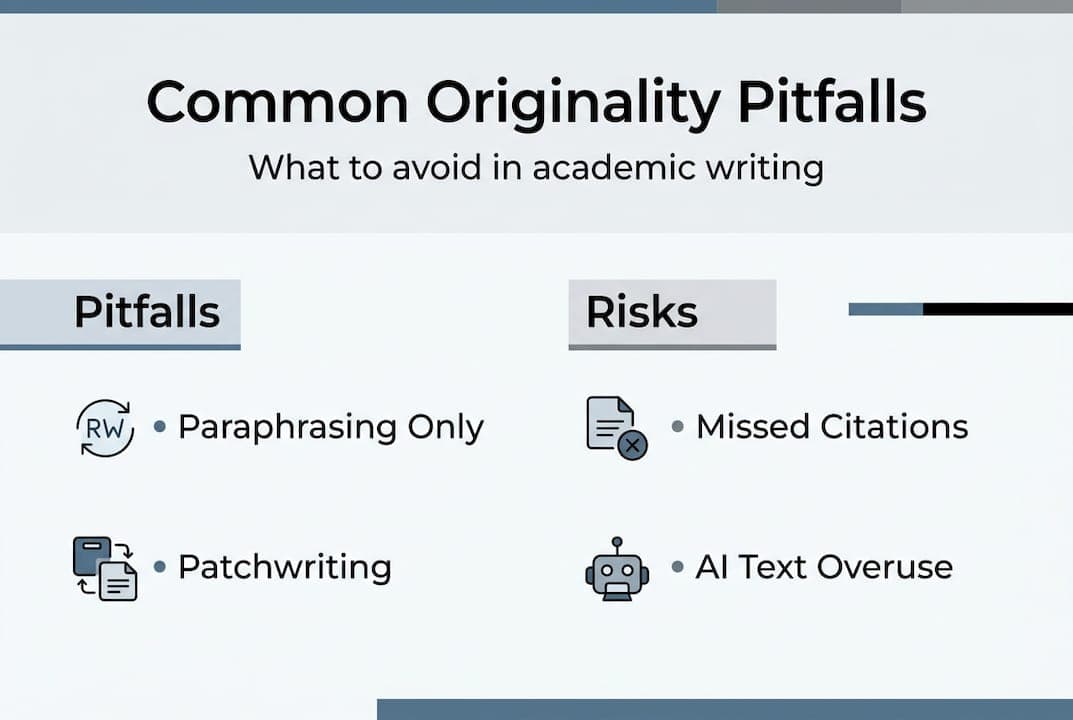
Even students with good intentions fall into traps that undermine originality. The most common is patchwriting: taking a source's sentence, swapping a few words for synonyms, and presenting the result as your own analysis. It feels like paraphrasing, but it's actually one of the most reliably flagged behaviors in modern detectors.
Here are the four most frequent originality pitfalls, ranked by how often they appear in academic misconduct cases:
The AI angle deserves special attention. Research shows that 84.9% of AI-generated texts receive 100% originality scores on standard detectors, meaning the tools simply cannot tell the difference. This creates a false sense of security. A perfect originality score on AI content does not mean the work reflects your thinking, your research, or your voice.
Hybrid human-AI texts, where a student writes a draft and then uses AI to polish it, fall into a gray zone that detectors handle inconsistently. The problem with avoiding content duplication in this context is that the issue isn't always duplication of existing text. It's duplication of thought patterns without original contribution.
Pro Tip: After paraphrasing any source, ask yourself: "What do I actually think about this?" Add one sentence of your own analysis or critique before moving on. That habit alone separates synthesis from patchwriting.
The most reliable path to genuine originality is moving beyond summary and paraphrase into analysis, critique, and synthesis. Here's how that looks in practice:
| Strategy | What it means | Why it works |
|---|---|---|
| Personal analysis | Explain what a source's findings mean for your argument | Adds unique intellectual contribution |
| Cross-source synthesis | Connect two unrelated studies to form a new insight | Creates original perspective |
| Unique thesis framing | Position your argument against existing debates | Signals scholarly engagement |
| Transparent AI disclosure | State clearly how and where AI assisted your work | Builds trust and meets 2026 standards |
| Self-citation | Reference your own prior work when relevant | Avoids self-plagiarism while showing continuity |
Proper attribution is non-negotiable. This means citing every source, including your own previous work. Many students don't realize that self-plagiarism prevention is as important as citing external authors. If you draw on a paper you wrote last semester, note it explicitly.
On AI disclosure: growing consensus in academia supports AI as a legitimate tool when its use is transparent. Most journals and institutions now require a methodology note explaining what AI assisted with and how the human author verified, modified, and took responsibility for the final content.
Quick strategies to spark original thinking:
Pro Tip: Check your AI publication ethics obligations before submitting. Different institutions have different disclosure requirements, and getting ahead of them protects you.
The academic world is shifting. For decades, the dominant model treated originality as a compliance problem: avoid plagiarism, pass the detector, submit the paper. That model is breaking down under the pressure of AI tools that can generate plausible, detector-passing text in seconds.
The emerging alternative is a contribution model. Under this view, the question isn't "did you copy anything?" but "what did you add to the conversation?" This shift is already visible in how leading journals evaluate submissions, moving away from pure plagiarism scores toward assessments of novelty, methodological rigor, and intellectual risk-taking.
"The future of academic authorship is not about proving you didn't use a tool. It's about proving you had something worth saying."
Research supports this direction. Shifting from plagiarism focus to originality and contribution, with AI treated as an acceptable tool when disclosed, reflects where academic standards are heading. Detectors alone cannot evaluate contribution, so hybrid evaluation combining software scores with human review is becoming the norm.
Balancing technology and authenticity in your writing process means treating AI as a drafting or editing assistant, not a substitute for your own thinking. The intellectual work of forming an argument, weighing evidence, and reaching a conclusion must remain yours.
This mindset also protects you practically. When examiners ask you to defend your work orally or explain your methodology, a contribution-oriented process gives you genuine answers. A detector-gaming approach leaves you exposed.
Here's what most guides won't tell you: the obsession with originality scores is quietly training students to optimize for the wrong thing. When the goal becomes "pass the detector," the actual skill being practiced is system-gaming, not scholarship.
We've seen this pattern clearly. Students who focus on rewriting sentences to avoid flags often produce work that is technically "original" but intellectually hollow. Meanwhile, a student who genuinely wrestles with a difficult idea, cites imperfectly, and takes a real intellectual risk produces work that matters, even if a detector flags a passage.
False positives and false negatives in detection tools prove that the tools themselves don't know what originality is. They measure surface similarity. True originality, as explored in content originality frameworks, is about personal investment, transparent process, and the courage to say something that could be wrong. That's the standard worth chasing.
Putting these strategies into practice takes the right tools alongside the right mindset. Semihuman AI is built for exactly this moment, helping students and academics prepare submissions that are genuinely human in voice and fully compliant with current standards.
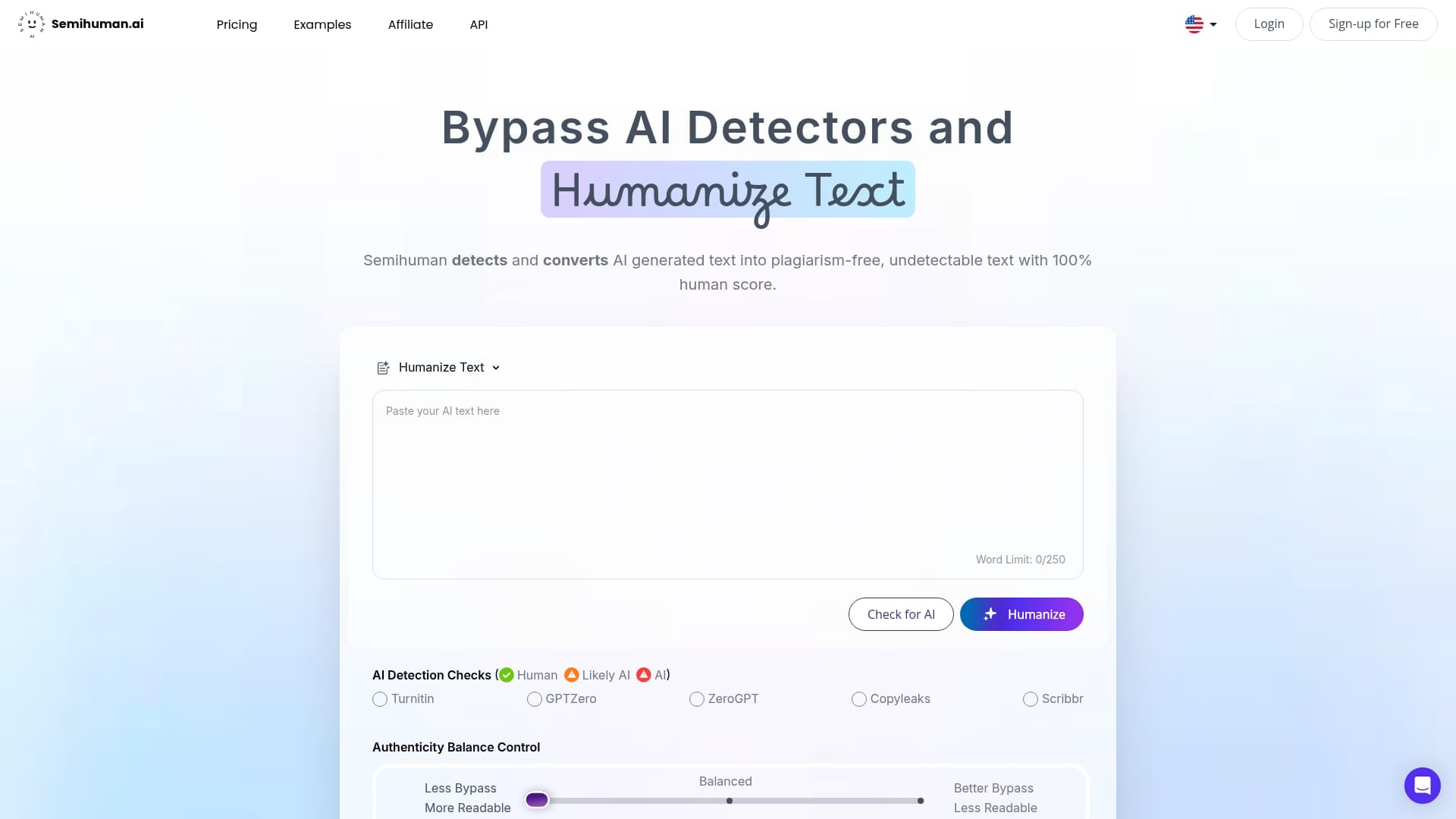
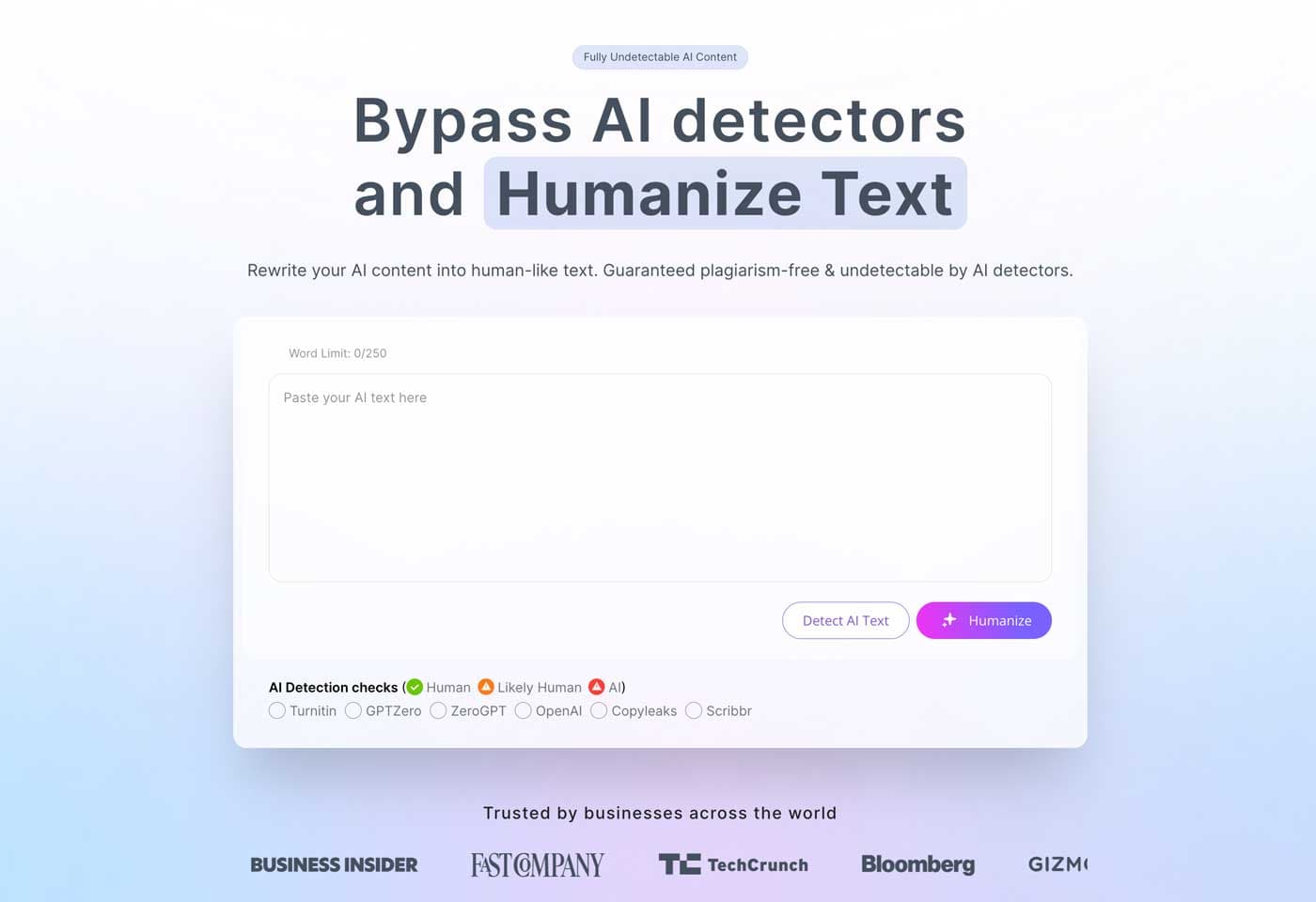
With Semihuman AI, you can transform AI-assisted drafts into authentic, natural writing that reflects your own voice without losing your argument's core. The platform's AI-proof writing tools help you refine your text before submission, while the ability to bypass AI detectors means your work is evaluated on its intellectual merit, not a software score. Whether you're polishing a thesis or preparing a journal submission, Semihuman AI gives you the confidence to submit work that's genuinely yours.
Common causes include excessive paraphrasing, patchwriting, poor citation practices, and submitting AI-generated content without meaningful transformation or added analysis.
AI content frequently passes detectors with 98-99% originality scores, but genuine originality requires meaningful intellectual contribution and transparent disclosure of how AI was used.
Self-plagiarism means reusing substantial parts of your own prior work without disclosure; proper citation practices require you to cite or summarize your previous work and explain its relevance to the current submission.
Most detectors have only moderate accuracy, with BERT-based tools reaching 71% and online tools averaging around 60%, making human judgment and hybrid evaluation essential for fair assessment.

Start
Humanizing
for Free!
Humanize