
Loading...

TL;DR:
- Original content requires human creative input and control, not just AI output generation.
- SEO and copyright standards demand adding unique insights, examples, and expressive choices.
- Substantive human edits are essential to produce truly original and valuable content.
Many content creators assume that running a topic through an AI tool produces something original by default. It does not. Both U.S. copyright law and Google's ranking systems apply specific standards that purely automated output simply cannot satisfy on its own. Misunderstanding this is not just a legal technicality. It puts your rankings, your brand reputation, and your ability to protect your work at serious risk. This article clarifies exactly what originality means across legal, SEO, and detection contexts, and shows you how to make your AI-assisted content genuinely qualify.
| Point | Details |
|---|---|
| Human touch required | Only content with genuine human creativity counts as original for copyright or SEO. |
| SEO rewards originality | Google boosts content that demonstrates unique value and penalizes low-effort AI bulk content. |
| AI as assistive tool | AI can help, but human editing, selection, and customization are essential for originality. |
| Detectors are not definitive | Passing plagiarism or AI detectors does not guarantee content is original in legal or SEO terms. |
Originality sounds straightforward until you try to define it precisely. And when AI is involved, even experienced marketers get it wrong.
From a legal standpoint, original work requires sufficient human authorship and control over expressive elements. The U.S. Copyright Office has been explicit: purely AI-generated material lacks copyright protection. That means if you prompted a model and published the output without meaningful creative intervention, you likely own nothing. A competitor could legally copy it.
From an SEO standpoint, Google's definition of originality is different but equally demanding. The search engine evaluates content through its E-E-A-T framework, which stands for Experience, Expertise, Authoritativeness, and Trustworthiness. Simply rephrasing existing content with AI does not satisfy any of those four signals. Google wants to see that a real person with real knowledge shaped the content and added something genuinely useful to the reader.
From a plagiarism standpoint, tools like Turnitin and Copyleaks check for textual similarity, not human effort. That creates a third, separate standard. You could pass a plagiarism check and still fail copyright and SEO tests simultaneously.
Here is a quick comparison across these three standards:
| Standard | What it measures | AI content status |
|---|---|---|
| Copyright | Human creative expression and control | Fails unless human shapes output |
| SEO (E-E-A-T) | Value, expertise, human oversight | Fails if low-effort or generic |
| Plagiarism tools | Textual similarity | May pass even if not truly original |
The practical takeaway: these three standards do not overlap neatly. Passing one does not mean you pass the others. Why originality matters in a real marketing context goes far beyond just avoiding a copyright notice.
"Original" in content marketing does not mean 'no one has covered this topic.' It means your creative judgment, voice, and insight are visibly present in the work.
For marketers, originality ultimately means content that is new, creative, and valuable in context. A list of facts anyone could Google is not original even if no other article uses those exact sentences.
Understanding legal and SEO definitions sets the foundation, but what turns an AI draft into something truly original?
The answer is not a better prompt. Prompts alone are insufficient for originality. Copyright and SEO value require human creative selection, arrangement, and modification after AI generation. Think of AI as a capable research assistant, not the author. The author is still you.
Here is a practical step-by-step workflow that actually works:
The key phrase in step six is "expressive choices." Copyright protection and AI elevates content marketing value when humans decide how information is presented, not just what is included. Selecting which facts matter, how to frame them, and what emotion to evoke are all expressive decisions.

Pro Tip: Focus your editing energy on structure and emphasis, not just grammar. Rearranging sections, adding a counterargument, or cutting the generic closing paragraph all count as creative choices that strengthen originality.
A quick checklist to confirm your content is sufficiently human-influenced:
If the answer is no to any of these, keep editing. Platforms like Semihuman.ai can help you enhance content originality at the structural level once your human input is in place.
Once you've shaped content with human creativity, how do platforms and detection tools judge it?
Google does not run content through a single originality meter. Instead, it evaluates patterns across the entire page and site. Google emphasizes E-E-A-T and penalizes scaled low-effort AI content as spam. That last word is important. Google is not opposed to AI-assisted writing. It is opposed to low-effort AI writing published at scale with no human editorial layer.
What does E-E-A-T look like in practice for AI-assisted content?
None of these signals come from the AI. They come from the human editing layer on top of it.
Detection tools work differently. AI detector accuracy varies by platform, with Copyleaks claiming up to 99% detection rates and Turnitin applying similar probabilistic models. But here is what most marketers miss: these tools detect patterns, not value. They flag repetitive sentence structures, predictable transitions, and low perplexity text. A human who writes in a very structured, formal way might even trigger false positives.
| Tool | What it detects | Limitation |
|---|---|---|
| Google Search | Low-value, unoriginal pages | Does not flag AI specifically |
| Copyleaks | AI text patterns and similarity | Can misclassify human writing |
| Turnitin | Similarity and AI probability | Academic focus, not marketing |
| U.S. Copyright Office | Human authorship evidence | Requires submission and review |
For those focused on avoiding content duplication, the lesson is consistent: small tweaks do not fool smart systems. Swapping synonyms or reshuffling sentences does not add value. Substantive human editing does.
Even the right process can hit tricky gray zones. Here is where output can still fail, and what to do.
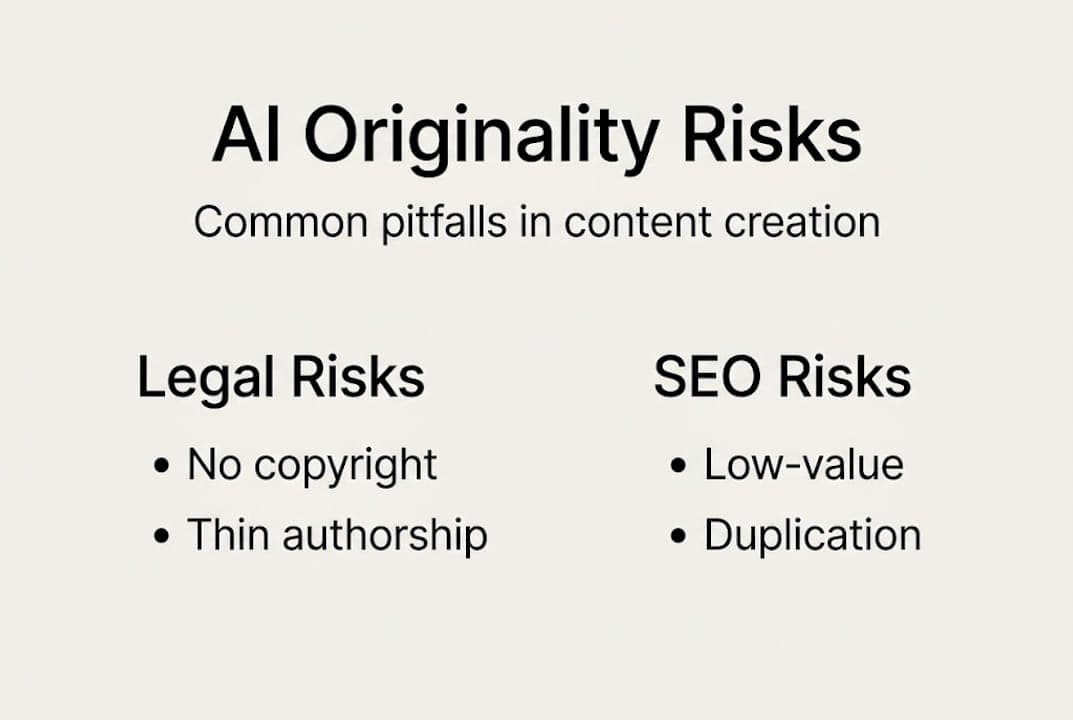
The most common misconception is that effort equals protection. A marketer might spend an hour curating 30 AI-generated product descriptions. But if the selection process involves no creative judgment beyond "these look good," that compilation may not qualify for copyright protection. AI-assisted compilations are copyrightable only if human creativity in selection and coordination meets the Feist originality threshold. Purely AI outputs remain unprotectable.
The Feist standard, set by a 1991 Supreme Court case, requires that even factual compilations reflect some minimal creative spark in how they are selected or arranged. Alphabetical order does not count. Neither does "I picked the ones the AI scored highest."
Risk areas that catch marketers off guard:
For a deeper look at common AI writing risks, these patterns are well-documented and avoidable with the right workflow.
Pro Tip: When your editorial input feels thin, ask yourself one question: "What would I say about this topic that the AI could not find online?" That answer is your originality. Add it before you publish.
Understanding balancing authenticity in AI work is an ongoing discipline, not a one-time checklist item. Treat every piece as a test of how much genuine human thinking you brought to it.
Most guides focus on the compliance question: did your content pass the test? That is the wrong question to optimize for.
When you aim for "just original enough," you produce content that technically clears the bar and immediately blends into the noise. Every marketer running AI tools through a humanizer is trying to do the same thing. The content that wins long-term is not the content that fooled a detector. It is the content that made a reader feel something, learn something, or do something.
Originality boosts SEO and trust because real originality signals real investment in the reader. Brands that consistently bring their own knowledge, perspective, and voice to AI-assisted work build reputations that no algorithm update can erase.
Stop chasing the score. Start asking what you know about this topic that nobody else has said this clearly. Put that front and center, and let the AI handle the rest of the draft work. That is the shift that separates forgettable content from content that compounds in value over time.
If you're ready to take action, here's how our platform keeps your AI-assisted content both truly original and fully effective.
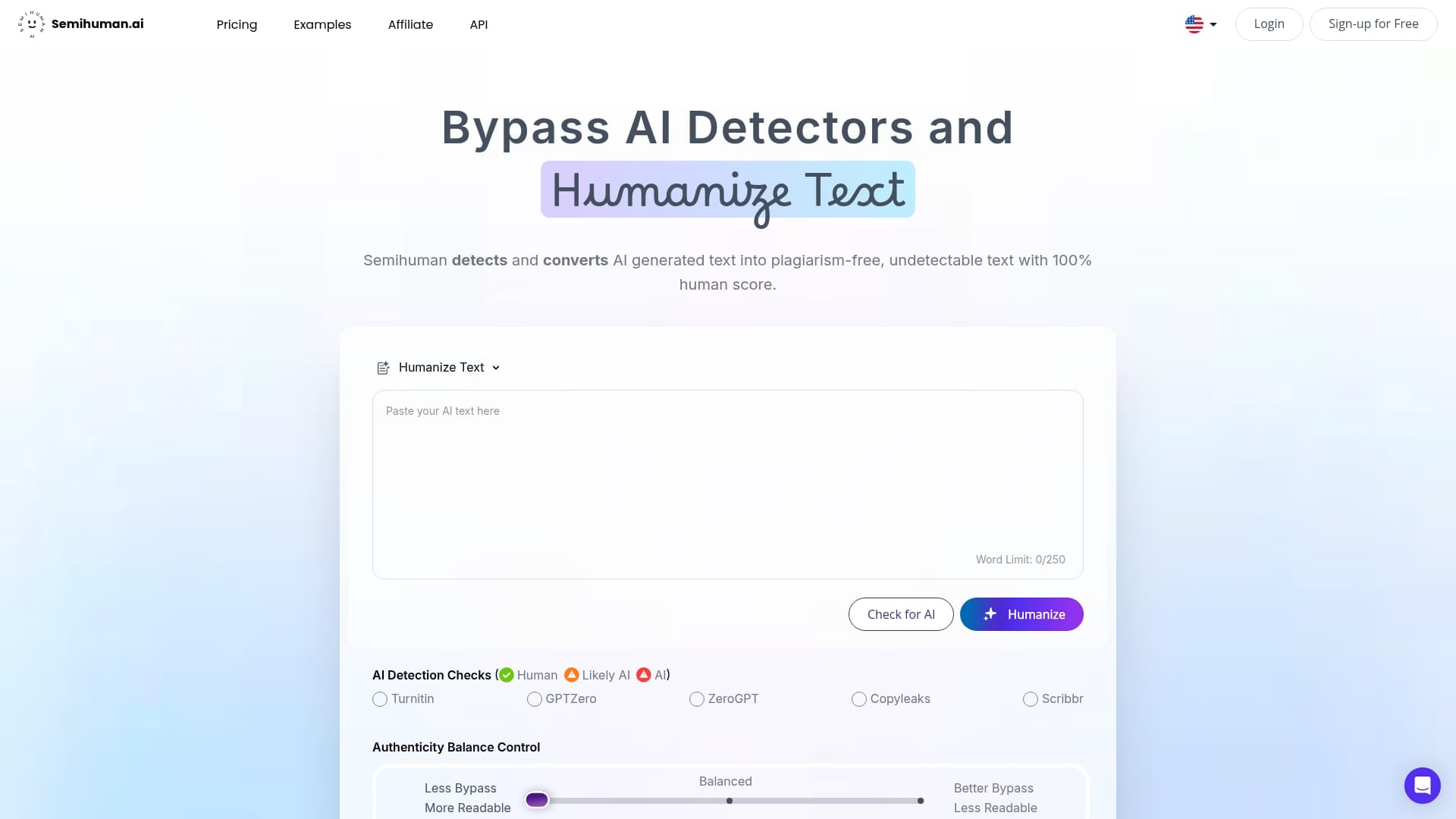
Semihuman.ai is built specifically for content creators and marketers who want AI-assisted output that holds up to scrutiny, from Google's quality systems to detection tools like Turnitin and Copyleaks. The platform restructures text, integrates keywords naturally, and strengthens the human voice in your drafts without stripping out the efficiency benefits of AI. Use the bypass AI detectors tool to refine flagged content, generate ranking-ready copy with the SEO text generator, or rework existing drafts using the AI text paraphraser. Start producing content that passes every test because it genuinely deserves to.
AI-generated content can only be copyrighted if there is enough human authorship and creative input. The U.S. Copyright Office is clear that fully automated output does not qualify for protection.
Google looks for human oversight, usefulness, and quality signals through its E-E-A-T framework, and penalizes low-effort AI content published at scale as spam.
No detector provides certainty. Tools like Copyleaks claim 99% accuracy in identifying AI text, but originality ultimately relies on substantive human edits and unique value, not just passing an algorithm.
Copyright requires substantial human creative expression and control over the output, while SEO originality focuses on demonstrated expertise, unique value, and signals that satisfy Google's E-E-A-T standards.
Marketers should layer in expressive choices, unique real-world examples, and a clear brand voice throughout every AI-edited output before publishing.


Start
Humanizing
for Free!
Humanize