
Loading...

Most American businesses are already tapping into the world of Natural Language Processing without realizing how quickly it is changing the face of communication. With over 80 percent of digital content now touched by AI-driven technologies, understanding NLP goes far beyond technical jargon. Readers who want to stay ahead will gain practical insight into how these powerful algorithms are shaping content, impacting industries, and redefining what it means to create authentic human connection online.
| Point | Details |
|---|---|
| Interdisciplinary Nature of NLP | Natural Language Processing merges linguistics, computer science, and machine learning to facilitate understanding and generation of human language by machines. |
| Advanced Techniques for Content Creation | Content creators employ sophisticated NLP approaches, such as Transformer Models, to enhance writing processes and produce engaging, context-aware content. |
| Humanizing AI-Generated Text | Techniques in NLP help detect and refine machine-generated text, making it more authentic through analysis and contextual adaptations. |
| Risks and Compliance Issues | Professionals must navigate challenges related to data privacy, algorithmic bias, and ethical content generation to develop responsible NLP strategies. |
Natural Language Processing (NLP) represents a sophisticated computational approach that bridges human communication with artificial intelligence technologies. At its core, NLP is an interdisciplinary field that combines linguistics, computer science, and machine learning to enable computers to understand, interpret, and generate human language with remarkable precision.
The fundamental goal of NLP involves mathematically and computationally modeling language aspects to create intelligent systems capable of processing text and speech. These systems range from advanced machine translation platforms to intelligent voice assistants and content generation tools. By breaking down complex linguistic structures into analyzable components, NLP algorithms can extract meaningful insights, recognize contextual nuances, and generate human-like text.
Key components of NLP in content creation include:
Professional content creators increasingly leverage advanced NLP techniques in machine learning to streamline writing processes, enhance creativity, and produce more engaging content. By integrating computational linguistics with artificial intelligence, writers can now access powerful tools that assist in drafting, editing, and optimizing written materials across various domains.
Content creators are increasingly leveraging sophisticated NLP approaches that transform how written materials are developed, analyzed, and optimized. These computational techniques enable more intelligent, context-aware content generation that goes far beyond traditional writing methods.
Pretrained language models have revolutionized text generation by training on massive text corpora, allowing for nuanced and contextually relevant content production. These advanced models can understand complex linguistic patterns, generate coherent text, and adapt to various writing styles with unprecedented accuracy. By analyzing extensive datasets, they learn intricate language structures that enable more natural and engaging content creation.
Key NLP approaches for content development include:
Creative professionals can leverage advanced AI content strategies to enhance their writing workflow, utilizing these sophisticated NLP techniques to streamline research, generate ideas, and produce high-quality written materials across multiple domains. These computational approaches not only accelerate content creation but also provide unprecedented insights into language structure and communication patterns.
Natural Language Processing provides sophisticated mechanisms for detecting and transforming AI-generated text into more authentic, human-like content. As artificial intelligence continues to advance, the ability to distinguish and refine machine-written text becomes increasingly critical for content creators seeking genuine communication.
Translational NLP approaches focus on bridging the gap between computational generation and human-like expression, emphasizing nuanced strategies that make AI-generated content feel more natural. These techniques analyze linguistic patterns, semantic structures, and contextual variations to identify and modify text that appears overtly mechanical or algorithmically generated.
Key detection and humanization techniques include:
Advanced AI content strategies enable writers to transform machine-generated text by introducing subtle linguistic nuances, breaking predictable sentence structures, and incorporating contextually appropriate variations that make content feel authentically human. By understanding and implementing these sophisticated NLP techniques, creators can produce text that seamlessly blends computational efficiency with genuine, engaging communication.

Natural Language Processing transforms critical professional domains by providing intelligent, adaptive solutions that enhance content creation, research, and strategic communication. From digital marketing to academic research, NLP technologies are revolutionizing how professionals generate, analyze, and optimize written materials.
Generative Engine Optimization represents a cutting-edge approach where digital content is strategically crafted to maximize visibility across AI-driven platforms. Marketing professionals now leverage sophisticated NLP techniques to ensure their content resonates with both human readers and algorithmic search systems, creating a nuanced communication strategy that transcends traditional optimization methods.
Key applications across professional domains include:
Content creation best practices demonstrate how NLP bridges technological efficiency with authentic communication. By integrating advanced computational linguistics, professionals across SEO, marketing, and academia can develop more sophisticated, intelligent content strategies that adapt dynamically to changing communication landscapes.
Natural Language Processing technologies, while powerful, come with significant challenges that demand careful navigation and strategic implementation. Professionals must understand the complex landscape of potential risks and compliance considerations inherent in advanced computational language systems.
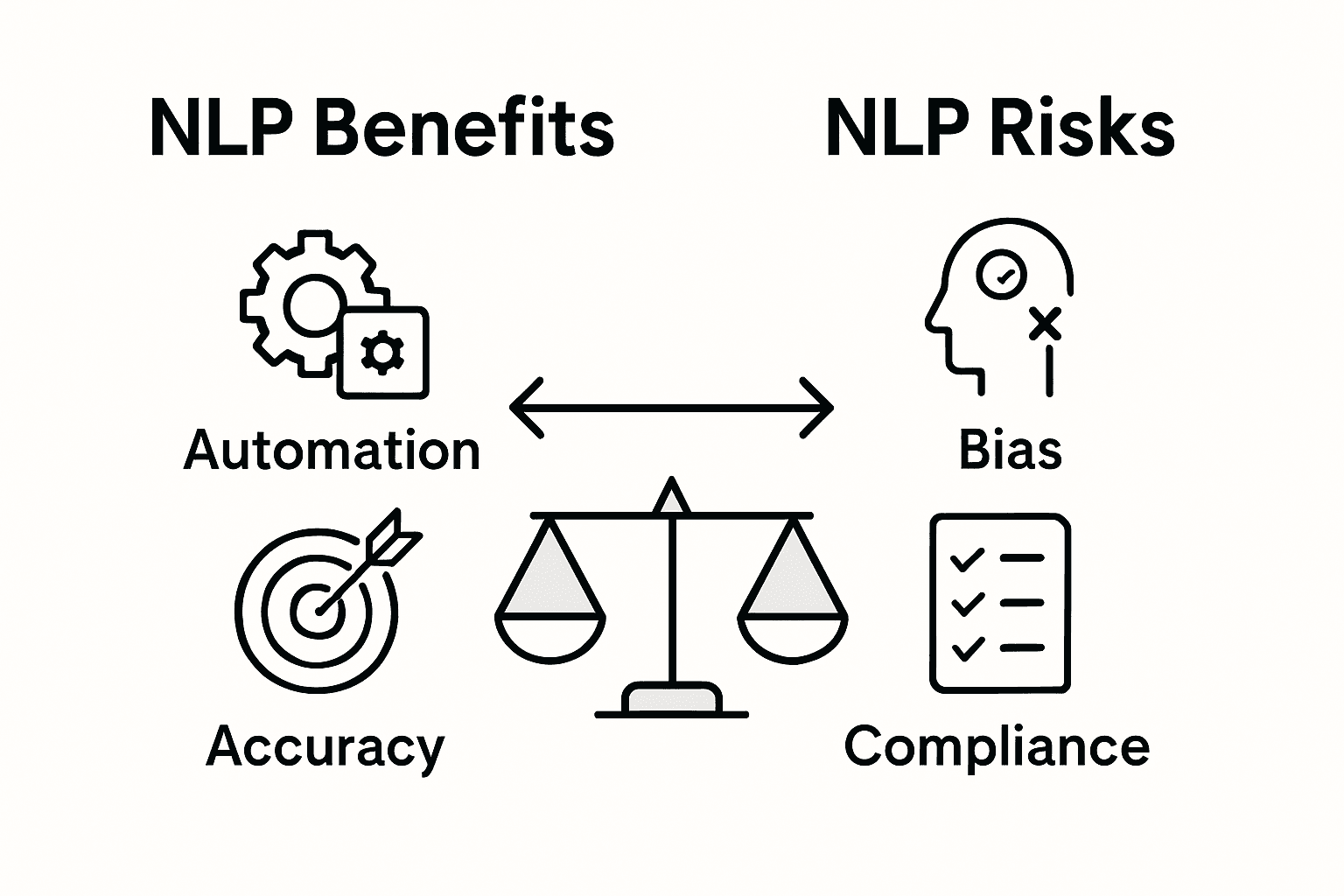
Software requirements engineering challenges reveal critical limitations in NLP technologies, particularly around text representation accuracy and linguistic ambiguity. These complexities underscore the need for rigorous validation processes and sophisticated algorithmic approaches that can effectively interpret nuanced human communication while maintaining high standards of precision and contextual understanding.
Key risks and compliance challenges include:
Why AI content gets flagged demonstrates the intricate balance between technological innovation and ethical content generation. By understanding these potential pitfalls, organizations can develop more transparent, responsible NLP strategies that prioritize accuracy, fairness, and compliance across diverse professional contexts.
Natural Language Processing unlocks powerful tools for content creators but often leaves text with mechanical tones that challenge genuine engagement and SEO goals. If you struggle with making AI-generated content flow naturally or worry about detection by AI scanners like Turnitin or GPTZero, you are not alone. The key pain points are clear: how to humanize machine-written text, ensure emotional tone calibration, and maintain contextual relevance without compromising compliance or originality.
Semihuman.ai transforms this challenge into your advantage by applying advanced NLP techniques such as text restructuring and keyword integration to produce content that reads authentically human. Our platform is designed specifically to help creators, marketers, and students avoid flags from AI detection systems, enhance SEO ranking, and reduce plagiarism concerns. By merging the science of semantic analysis with practical AI content strategies, Semihuman.ai empowers you to craft engaging and compliant writing that resonates.
Discover how you can seamlessly bridge the gap between AI efficiency and authentic communication starting today at Semihuman.ai. Explore humanizing machine-written text techniques and learn the content creation best practices that make your writing stand out.
Enhance your content’s authenticity and SEO performance now with Semihuman.ai.
Take the next step and experience the future of authentic content creation. Visit Semihuman.ai today and start humanizing your AI-generated text with expert precision.
Natural Language Processing is a field of artificial intelligence that enables computers to understand, interpret, and generate human language. It combines linguistics, computer science, and machine learning to bridge the gap between human communication and AI technologies.
NLP significantly enhances content creation by enabling intelligent systems to analyze linguistic structures, generate coherent text, and optimize written materials. It helps streamline writing processes, fosters creativity, and improves the engagement level of content.
Key components of NLP in content development include semantic analysis, syntax parsing, text generation, and sentiment analysis. These elements work together to create more understandable and engaging written content.
NLP is applied in various professional domains, including SEO content generation, academic research analysis, marketing communication, and plagiarism detection. These applications help professionals create more sophisticated and adaptive content strategies.

Start
Humanizing
for Free!
Humanize