
Loading...

TL;DR:
- Your digital footprint includes both actively shared content and automatically collected passive data.
- Managing and building a consistent, authentic online presence boosts credibility and professional opportunities.
- Regular audits and strategic content creation are essential to control and leverage your digital reputation.
You probably think your digital footprint is the stuff you actively post. But 81% of Americans feel they have little or no control over the data collected about them, and 73% believe their footprint directly affects job opportunities. The gap between what people assume is tracked and what actually gets recorded is enormous. For content creators, marketers, and academics, this gap can quietly cost you partnerships, credibility, and search visibility before you even realize there's a problem. This guide breaks down exactly what a digital footprint is, separates the data you control from the data that follows you, and gives you a clear path to audit, manage, and turn your presence into a genuine professional asset.
| Point | Details |
|---|---|
| Digital footprint defined | Your digital footprint includes both what you share and what is collected about you online. |
| Asset or liability | A well-managed footprint can boost trust and partnerships, while neglect brings risk. |
| Audit regularly | Quarterly reviews and privacy updates are essential for control and security. |
| Edge cases matter | Even deleted posts, screenshots, and archives can linger beyond your control. |
| Be proactive | Strategic and authentic footprint management leads to career and brand advantages. |
Your digital footprint is every trace you leave online, intentional or not. Most people focus on the obvious stuff: their LinkedIn bio, their Twitter posts, their published articles. That's only half the picture.
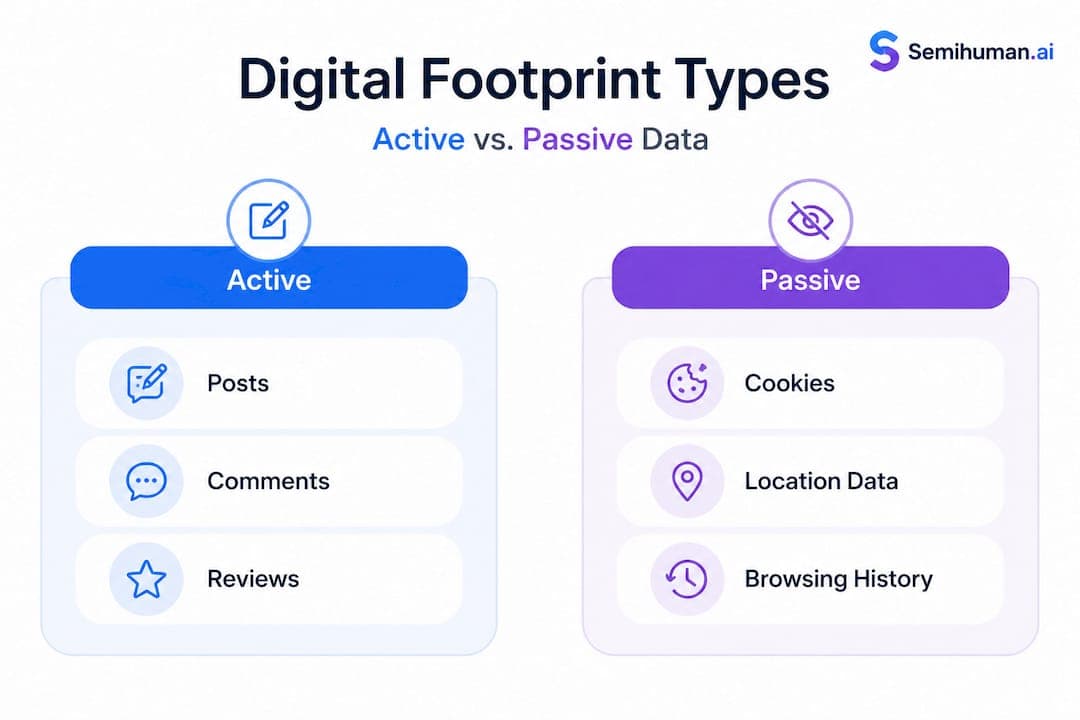
Digital footprints split into two categories: active data (content you deliberately share) and passive data (information collected automatically without your direct input). Both matter. Both follow you. And both show up when someone searches your name, vets your content, or evaluates you for a brand partnership.
| Type | What it includes | Who collects it |
|---|---|---|
| Active | Posts, comments, reviews, published articles, bios, uploaded photos | You, intentionally |
| Passive | Cookies, IP addresses, browsing history, device data, location pings | Platforms, advertisers, data brokers |
For creators and marketers, the active data shapes perception. The passive data shapes targeting, pricing, and vetting. For academics, both matter when journals, institutions, or grant committees research your credibility.
Here are the most common digital footprint sources you're probably underestimating:
Content authenticity for marketers is increasingly tied to this full ecosystem, not just your main channels. An old forum post from 2015, a negative review response you forgot about, or a quoted opinion in a small blog can all surface when someone searches your name seriously.
"Your digital footprint is not just what you meant to say. It's everything that ever got recorded under your name, your handle, or your face."
For academics especially, this extends to citation networks, co-author associations, and even commentary on preprint servers. Every thread connects to your reputation whether you intended it to or not.
Now that you know what makes up your digital footprint, let's explore why managing it matters so much.
A strong, consistent footprint builds trust fast. When a brand manager Googles a potential influencer and finds a clean trail of relevant, on-brand content going back years, that's an asset. When a collaborator searches an academic's name and finds peer-reviewed work, professional bios, and thoughtful commentary across platforms, that's credibility compounding over time.
Consistent, authentic footprints enhance trust signals for AI systems and human evaluators alike. Fragmented footprints, contradictory bios, or outdated information act as liabilities that cost real opportunities.
| Footprint behavior | Asset or liability |
|---|---|
| Consistent bio and headshots across platforms | Asset |
| Contradictory "About" descriptions on different sites | Liability |
| A coherent archive of topic-specific published work | Asset |
| Old posts taking extreme or off-brand positions | Liability |
| Claimed author pages with verified links | Asset |
| Unclaimed profiles with outdated or incorrect info | Liability |
| Active engagement in your professional community | Asset |
| Gaps of years with no searchable presence | Liability |
Real-world scenarios make this concrete. A travel content creator lost a major tourism board partnership when a social media manager discovered posts from six years earlier that contradicted the creator's current values positioning. The creator didn't even remember the posts. A marketing consultant, on the other hand, won a competitive contract simply because her consistent LinkedIn activity, a clean author archive, and aligned interviews across three podcasts made her look like the obvious, safe choice.
Authority content for trust is not just about what you publish. It's about whether everything you've ever published forms a coherent, trustworthy picture.
The same principle applies to why originality matters online: borrowed voices, recycled content, and inconsistent positioning dilute the trust signals that search engines and human evaluators both look for.
Pro Tip: Set a monthly reminder to Google your name (and your brand name) in a private browsing window. Look at the first two pages of results with fresh eyes, as if you're a client or employer seeing you for the first time. Note anything that surprises or concerns you, then act on it systematically.
According to Gitnux research, only a fraction of the 73% who know their footprint affects careers actually take structured steps to manage it. Knowing the risk and doing something about it are very different things.
If your footprint feels overwhelming or fragmented, here's how to take control, step by step.
Step-by-step digital footprint audit:
Here's the edge case most guides skip: deleting a post does not erase it. Screenshots, web archives, and cached versions can preserve content long after you remove it. The Wayback Machine at archive.org indexes millions of pages. Anyone motivated enough can find deleted content. This means your strategy can't be purely defensive. You also need to be building positive content that pushes older, less desirable material further down in search results.

Authentic SEO content tips consistently emphasize that new, authoritative content is the most effective way to displace unwanted older results.
Building content authority through consistent publishing on owned channels (your own website, your own newsletter) is far more durable than relying on third-party platforms alone.
"The professionals who manage their digital footprint most effectively are not the ones who delete the most. They're the ones who build so much credible, consistent content that the old stuff becomes irrelevant."
Pro Tip: Block off one hour every quarter on your calendar specifically for a footprint review. Treat it like a professional obligation, not an optional task. Use that time to update bios, check privacy settings, request data broker removals, and review your search results across multiple engines.
Writing for digital audiences with authenticity in mind also means structuring your content so it builds a recognizable, professional voice over time, not just optimizing individual posts in isolation.
Once your digital presence is under control, take steps to turn your footprint into a strategic advantage.
The top 5% of entrepreneurs studied in a major analysis of digital footprints share one key behavior: they build a cohesive ecosystem of proof. That means a single authoritative "About" page, consistent mentions and backlinks across relevant sources, and positioning that shows up in AI-generated answers, not just traditional search results.
AI search tools like ChatGPT, Perplexity, and Google's AI Overviews are increasingly referencing reputational ecosystems when surfacing experts and recommendations. If your digital footprint is scattered or thin, you simply won't appear. If it's consistent and authoritative, you become a default reference.
Here's what that looks like in practice:
Content trustworthiness for SEO and content creation best practices both point to the same conclusion: the creators and marketers who win long-term are those who build a reputation deliberately, not accidentally.
Small, consistent steps compound. Updating one bio per week, publishing one authoritative piece per month, and claiming one new mention per quarter adds up to a dramatically stronger professional presence within a year.
Here's an uncomfortable observation: most digital footprint guides give you a checklist and call it done. Delete old posts. Update your privacy settings. Google yourself. Fine advice. But it misses the actual leverage point.
Reactive management is not the same as strategic positioning. Scrubbing undesirable content only gets you to neutral. It doesn't get you to trusted. And in competitive environments, neutral is invisible.
The professionals who truly dominate their digital presence aren't spending their energy hiding things. They're building such a clear, consistent, and credible body of work that the noise simply stops mattering. Employers, brand partners, journal editors, and AI engines all respond to strong, coherent signals. A fragmented or sparse footprint, even a clean one, fails to generate those signals.
There's also a blindspot in the standard advice around AI. When AI engines crawl the web to answer questions or recommend experts, they look for patterns of credibility: consistent mentions across multiple credible sources, aligned content, authoritative backlinks, and active presence on professional platforms. Generic deletion strategies don't help you here. Only deliberate, ongoing content building does.
AI-aware content metrics are now part of how visibility gets determined, not just traditional SEO signals.
"The professionals who lead in digital credibility aren't playing defense. They're building such a strong, clear body of work that the past becomes irrelevant."
The real insight is this: authenticity isn't a tone. It's a pattern. It's what people see when they look at everything you've produced over time and find it coherent, credible, and genuinely useful. You can't fake that pattern retroactively. You can only build it, consistently, starting now.
Managing your digital footprint is an ongoing practice, and the content you publish is the most powerful lever you have. When your content reads as genuinely human, authoritative, and SEO-optimized, it does double duty: it improves your reputation and your discoverability simultaneously.
Semihuman.ai is built for exactly this challenge. Whether you're a marketer refining your brand voice, a content creator scaling output without sacrificing authenticity, or an academic building a professional publishing record, Semihuman.ai helps you produce content that passes both human and algorithmic scrutiny. The platform's SEO text generator helps you create optimized, natural-sounding content that reinforces your authority signals. And for content that needs to clear AI detection hurdles, the ability to bypass AI detectors ensures your work reads as authentically human. Your footprint is only as strong as the content you put into it.
Search your name in a private browsing window across multiple search engines, review your social media privacy settings, and run a reverse image search on your profile photos to see your full public trace.
Old posts can resurface years later and directly affect your reputation, job prospects, and professional partnerships, even if you've long since changed your views or position.
Not reliably. Deleting posts doesn't erase screenshots, web archives, or cached versions that may still be publicly accessible through tools like the Wayback Machine.
Quarterly audits are the minimum for professionals, covering privacy settings, search results, data broker listings, and strategic keyword alignment across your owned channels.
Absolutely. Consistent, authentic footprints boost trust signals for both search engines and AI systems, improving how often and how favorably you appear in relevant results.

Start
Humanizing
for Free!
Humanize