
Loading...

TL;DR:
- Invisible plagiarism involves hidden Unicode characters and predictable AI patterns that evade detection.
- Detection tools are often unreliable, especially with short or hybrid AI-human content, requiring manual verification.
- Combining multi-detector checks, cleaning text with a Unicode scanner, and thorough manual editing ensures content authenticity.
A single invisible character buried inside your AI-generated blog post can trigger a plagiarism flag before a human editor ever reads it. Most creators assume bypassing AI detection is just a matter of rewriting a few sentences or swapping synonyms. The reality is far more technical and unforgiving. Hidden Unicode characters, subtle structural patterns, and predictable phrasing all leave digital fingerprints that modern detectors are specifically trained to recognize. If you are creating content with AI tools and submitting it for academic, marketing, or professional purposes, understanding how invisible plagiarism works is no longer optional.
| Point | Details |
|---|---|
| Invisible triggers matter | Invisible characters and clever edits often cause AI content to be flagged for plagiarism. |
| Detector weaknesses exist | Many AI plagiarism tools can be fooled, especially with advanced paraphrase techniques. |
| Authenticity beats shortcuts | Manual verification and editing provide more reliable authenticity than solely relying on bypass hacks. |
| Multi-detector is best | Using multiple detection tools increases your chances of avoiding accidental plagiarism flags. |
Most people think of plagiarism as copying someone else's words directly. Invisible plagiarism is different. It refers to forms of content manipulation or duplication that are not visible to the naked eye but are still detectable by automated scanning systems. For content creators, marketers, and students, this is where things get complicated fast.
AI-generated text carries what experts call statistical fingerprints. Language models like GPT-4 or Claude tend to produce text with predictable token distributions, specific phrasing rhythms, and structurally uniform sentence patterns. Plagiarism and AI detection tools are now trained to recognize exactly these patterns, even when the content itself is original in topic and intent.
Beyond statistical patterns, there is a more literal form of invisible plagiarism involving hidden characters embedded in text. Invisible Unicode characters from AI can trigger plagiarism flags, and white text or symbol hacks designed to bypass detection can cause serious formatting issues or get caught during print or PDF conversion. These characters, things like zero-width spaces (U+200B), soft hyphens, or non-breaking spaces, are often copied into documents from AI interfaces without the user realizing it.
There are also common misconceptions worth addressing. Many creators assume that if their content is factually original, detectors will leave it alone. That is simply not true. Detectors do not primarily check for factual duplication. They check for linguistic and statistical patterns. Understanding the full types of plagiarism in content helps clarify this distinction.
Here are the most common invisible plagiarism triggers you should watch for:
"The assumption that invisible tricks automatically fool detectors is one of the most dangerous myths in AI content creation. Modern tools are specifically looking for exactly these patterns."
The plagiarism risks with AI text go beyond simple word matching. The whole landscape has shifted, and your content strategy needs to shift with it.
Understanding detection is just one side. After grasping what makes plagiarism invisible, it is critical to understand how detection systems try and sometimes fail to catch it.
AI detectors generally use one or a combination of three core methods. First, perplexity scoring measures how surprising or unpredictable the text is. Human writing tends to have higher perplexity because humans make unexpected word choices. AI text tends to be low-perplexity, meaning the model almost always picks the statistically "safest" next word. Second, burstiness analysis checks whether sentence length varies naturally. Humans write in bursts, alternating between short punchy sentences and long complex ones. AI often defaults to a steady, medium-length cadence. Third, watermarking and token distribution analysis examines the statistical spread of word choices across a document.

Here is how major detector types compare in their vulnerabilities:
| Detector type | Primary method | Weakness |
|---|---|---|
| GPTZero | Perplexity + burstiness | Fails on heavily edited hybrid text |
| Turnitin AI module | Token distribution patterns | Struggles with short texts under 200 words |
| Copyleaks | Neural fingerprint matching | Vulnerable to strong paraphrase attacks |
| Fast-DetectGPT | Probability curvature analysis | Can be fooled by contrastive paraphrasing |
| Winston AI | Ensemble scoring | Weaker on domain-specific technical writing |
The research backing this up is striking. A Contrastive Paraphrase Attack (CoPA) method, presented at EMNLP 2025, uses off-the-shelf large language models to generate human-like distributions by subtracting machine-like patterns, improving fooling rates by 57.72% against detectors like Fast-DetectGPT. That is not a marginal improvement. That is a fundamental challenge to the reliability of current detection infrastructure.
Edge cases are particularly revealing. Short texts under 200 words give detectors far too little data to work with, meaning results become essentially random. Hybrid edits, where a human substantially rewrites AI-generated text, also confuse detection systems because they produce mixed statistical signatures that fall between clear categories. Knowing how types of plagiarism detection differ helps you understand exactly which vulnerabilities apply to your specific content type.
Similarly, comparing tools side by side matters enormously. Checking out AI content humanizers and AI detection tools shows that no single tool catches everything, and no single humanizer solves everything.
Pro Tip: Never rely on just one detector to confirm your content is clean. Run your content through at least three different tools before final submission. The variance in results between detectors is often significant enough to change your decision entirely.
Understanding detection is just one side. Now let's focus on proven strategies that content professionals use to bypass invisible plagiarism detection without risking authenticity.
The most important starting point is cleaning your text before you do anything else. AI interfaces frequently embed invisible Unicode characters that survive copy-paste operations. Pasting your raw AI output into a plain text editor like Notepad or TextEdit before importing it anywhere removes most of these automatically. This single habit eliminates one of the biggest invisible plagiarism risks before it even becomes an issue.
Here is a step-by-step process that works reliably for professional content:
Humanizers fail on short text under 200 words, and hybrid human-AI edits can reduce their effectiveness significantly. This means you should not rely solely on automated humanization, especially for short-form content like social media captions, email subject lines, or brief product descriptions.
The data table below shows which techniques are most effective across different content lengths:
| Content length | Best bypass method | Reliability |
|---|---|---|
| Under 200 words | Full manual rewrite | High |
| 200 to 600 words | Humanizer + manual edit | Medium-high |
| 600 to 1500 words | Humanizer + multi-detector check | Medium |
| Over 1500 words | Full workflow + Unicode check | High |
Beyond mechanical fixes, building authentic content requires something more intentional. Reviewing a solid content authenticity checklist gives you a structured framework for this. Adding personal examples, specific data points, first-person opinions, and deliberate stylistic quirks all raise the human signal in your content. Knowing how to avoid content duplication naturally also prevents structural repetition that detectors pick up easily.
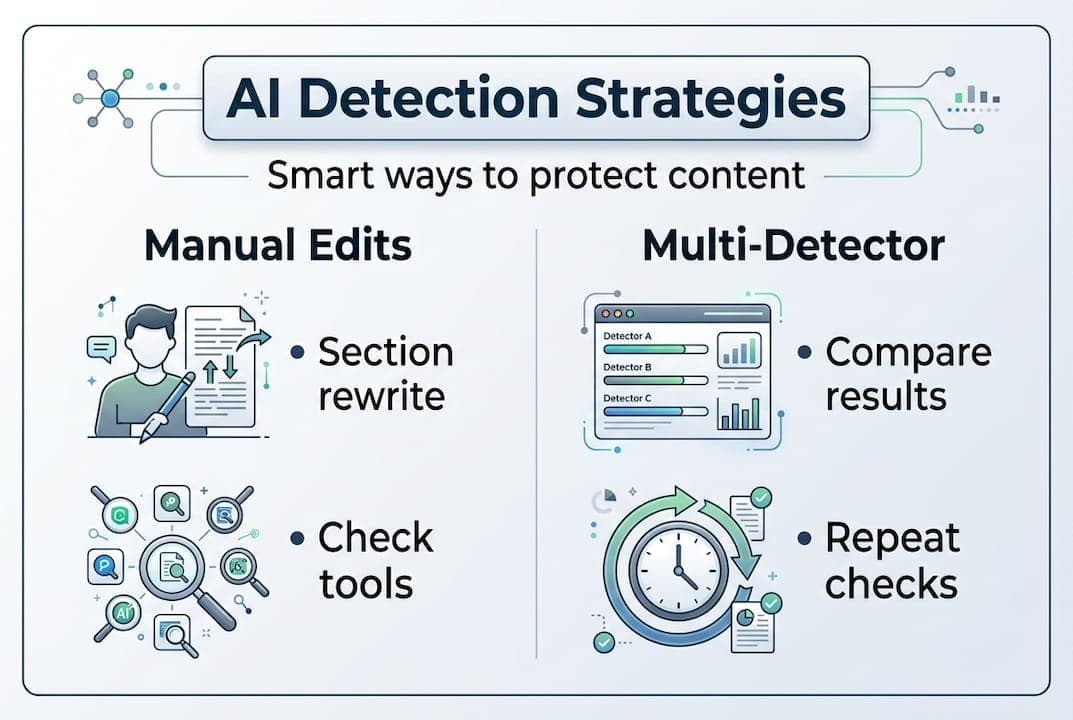
Pro Tip: If you are working on longer content, break it into sections and humanize each section independently rather than feeding the entire document at once. Detectors analyze documents holistically, but humanizers work better at the paragraph level. This also helps you maintain consistent voice across the full piece.
The conversation around balancing authenticity in AI content is growing, and creators who build these practices now will have a significant edge as detection tools continue to improve throughout 2026 and beyond.
Once you have bypassed initial detection, how can you ensure your content stays authentic and verifiable? Here is what matters most.
The single biggest mistake creators make is running their content through one detector, seeing a green result, and calling it done. Detection tools vary wildly in their methods, training data, and sensitivity thresholds. A piece that clears GPTZero may still flag strongly on Turnitin's AI module. A piece that passes Copyleaks may fail on Winston AI. Using one tool gives you one data point, which is not enough to draw any reliable conclusion.
Academic research reinforces this point sharply. Studies show detectors are only 61-69% accurate on hybrid AI-human text, making them significantly less reliable than the marketing claims suggest. Most platforms advertise 99% detection accuracy. The gap between marketing copy and peer-reviewed performance data is enormous. Relying on any single tool's clean result is genuinely risky.
Here is a practical checklist for multi-detector verification that actually works:
Manual editing is not a workaround or a fallback. It is the most reliable method available right now. No automated humanizer, no paraphrase attack, and no character trick replaces the authenticity signal that comes from a genuinely thoughtful human edit. This is especially true for academic writing humanization where the stakes are highest.
The AI-driven plagiarism issues facing content teams today are real and growing. As institutional and platform-level detection becomes more sophisticated, the window for purely automated solutions is narrowing. The creators who build manual review into their standard workflow now are the ones who will maintain credibility and output quality as the landscape evolves.
Key insight: Most tools do not deliver the claimed 99% bypass rate in real-world hybrid content scenarios. Building your process around manual verification protects you from betting your credibility on a marketing promise.
Here is what most articles about AI detection bypass will not tell you directly. The entire category of "guaranteed bypass solutions" is built on a foundation that shifts constantly. Every time a new paraphrase attack method improves fooling rates by 57%, detection researchers respond by updating their models. It is a technical arms race with no permanent winners.
The creators who consistently produce content that survives scrutiny are not the ones who found the best hack. They are the ones who treat AI as a drafting tool rather than a finished content machine. Humanizer effectiveness varies enormously depending on the input, the platform, and the specific detector being used. Chasing perfect bypass rates is less sustainable than building genuine writing habits around your AI drafts.
The honest position is this: invisible plagiarism detection is a real and growing problem, but the solution is not purely technical. Authentic content, meaning content that reflects real knowledge, genuine perspective, and deliberate editorial choices, is the most durable long-term strategy. Tools and techniques support that goal. They do not replace it.
If you are ready to ensure your AI content stands up to modern detection, here are relevant resources to explore.
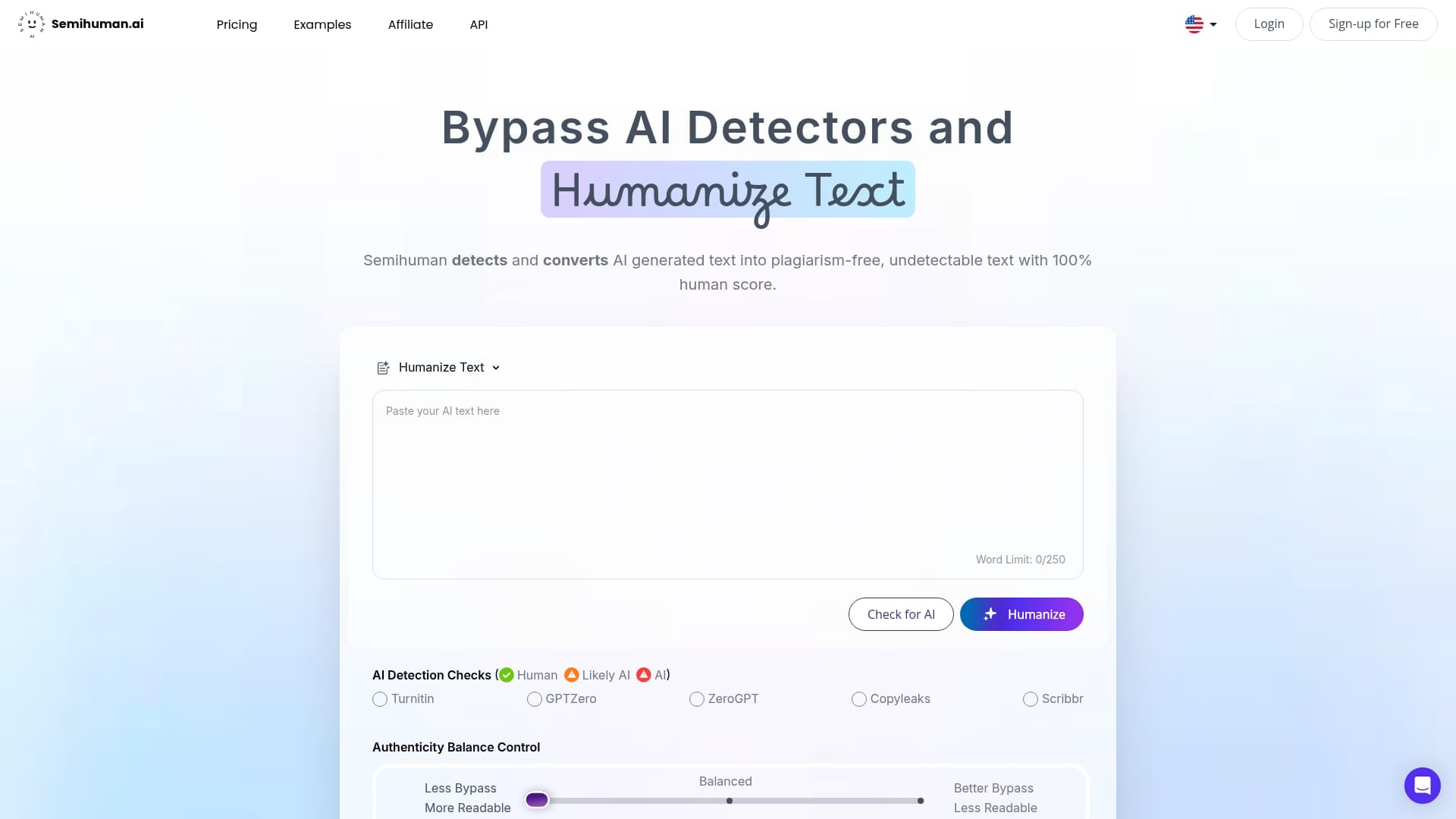
Semihuman.ai brings together the tools you need to handle every part of this process in one place. Whether you need to bypass AI detectors across platforms like Turnitin, GPTZero, and Copyleaks, generate optimized content with the SEO text generator, or restructure your drafts with the AI text paraphraser, the platform is designed specifically for creators, marketers, and students who need reliable, authentic results. Every feature is built around the goal of producing content that reads as genuinely human-authored, not just algorithmically shuffled. Stop guessing whether your content will pass and start knowing it will.
Invisible plagiarism refers to undetectable copying or manipulation within AI text, often involving hidden Unicode characters or subtle statistical patterns that trigger automated detection systems without being visible to readers.
Not always. Humanizers fail on short text under 200 words, and hybrid human-AI edits significantly reduce their effectiveness, making manual editing and multi-detector verification essential for reliable results.
Most detectors are only 61-69% accurate on hybrids, meaning they frequently misclassify hybrid AI-human content, so manual review remains the most dependable verification method.
Sometimes, but using invisible characters is risky because they trigger plagiarism flags in many modern scanners and can also cause formatting problems during document conversion or printing.
Run your content through multiple plagiarism detectors, compare the AI probability scores across each one, and prioritize manual edits on any flagged sections for genuinely reliable content authenticity.
Start
Humanizing
for Free!
Humanize