
Loading...

TL;DR:
- Readability metrics help improve SEO and engagement but do not guarantee natural, authentic content.
- Combining multiple tools and human editing is essential for creating convincing and AI-proof articles.
- Incorporating human touches like voice, real examples, and varied sentence structures makes content more memorable.
AI-generated content is everywhere in 2026, and readers can feel it. That flat, repetitive tone. The oddly perfect sentence structure. The total absence of personality. If you're using AI to speed up your content workflow, you already know the struggle: getting output that actually sounds like a person wrote it, ranks well on search engines, and doesn't trip plagiarism or AI detection tools. This guide walks you through the exact tools, processes, and strategies to close that gap, so your articles connect with real readers and perform where it counts.
| Point | Details |
|---|---|
| Readability fuels engagement | Readable articles are more likely to perform well and retain visitors. |
| Use multiple tools | Combining readability analyzers gives the best accuracy and SEO results. |
| Balance human edits | Editing for voice, clarity, and flow helps AI-generated content pass as authentic. |
| Metrics are not absolute | Rely on readability scores as guides, but always consider context and audience. |
Readability is simply how easy your text is to read and understand. But that one-sentence definition hides a lot of complexity. A piece of content can score perfectly on a readability test and still feel robotic, confusing, or off-brand. Understanding what readability actually measures, and where it falls short, is the first step to writing articles that work.
The most common readability metrics are:
Each metric captures something real, but none of them tells the whole story. FK scores are stable across tools but vary by specialty, which means a grade 9 score in a medical article reads very differently than a grade 9 score in a lifestyle blog. Use these as guides, not verdicts.
Why does readability matter for SEO and engagement? Google's ranking systems reward content that satisfies user intent and keeps readers on the page. Short paragraphs, clear sentences, and logical structure reduce bounce rates and increase time on page, both of which send positive signals to search algorithms. You can explore content metrics for marketers to see exactly which signals move the needle.
Readability also matters for AI and plagiarism detection. Detectors like GPTZero and Copyleaks look for patterns in sentence structure, vocabulary variation, and flow. AI-generated text tends to be too consistent, too clean. Human writing has natural variation, the occasional short fragment, a longer winding sentence, a word choice that's slightly unexpected. That variation is what makes content feel real.
Here's a quick reference for readability targets by content type:
| Content type | FK grade level | Reading ease target |
|---|---|---|
| Blog posts | 7 to 9 | 60 to 70 |
| Email marketing | 6 to 8 | 65 to 75 |
| Technical documentation | 10 to 14 | 30 to 50 |
| Social media captions | 5 to 7 | 70 to 80 |
"Readability is not a fixed standard. The same score carries different weight depending on the subject matter, the audience's expertise, and the platform where content appears."
Pairing readability with strong visuals versus text engagement strategies further boosts how audiences absorb and share your content.
Now that we know the stakes, let's get practical. What tools should you use and how do you get the most out of them?
Here's a comparison of the most popular readability and writing tools available right now:
| Tool | Readability score | Writing suggestions | SEO integration | AI detection |
|---|---|---|---|---|
| Hemingway Editor | Yes (grade level) | Yes (highlights issues) | No | No |
| Grammarly | Yes | Yes (tone, clarity) | Limited | Yes (premium) |
| Yoast SEO | Yes (FK) | Yes (passive voice, etc.) | Yes | No |
| SEMrush Writing Assistant | Yes | Yes | Yes | Limited |
| Semihuman.ai | Indirect | Yes (humanization) | Yes | Yes (bypass) |
Each tool fills a different gap. Hemingway is great for catching dense sentences and passive voice in real time. Grammarly catches grammar issues and flags awkward phrasing. Yoast integrates directly into WordPress and gives you live FK feedback as you write. SEMrush ties readability to keyword performance, which is useful for SEO-focused content.
For content creators working with AI output, the must-have tools in your stack are:
Pro Tip: Never rely on just one readability tool. Combining readability tools gives you a more accurate picture of how your content will land across different readers and detectors. Set custom thresholds based on your niche, not generic defaults.
AI and plagiarism detectors evaluate readability cues indirectly. They look at burstiness (variation in sentence length), perplexity (unpredictability of word choices), and structural patterns. Content that scores well on readability tools but lacks natural variation will still flag as AI-generated. That's why editing for tone and flow matters as much as hitting a target score. Check out these authentic writing tips and copywriting tips to sharpen your editing instincts.

With the right tools in hand, here's how you bring everything together into a readable, authentic article.
Plan with a clear audience and search intent. Before you write a single word, know who you're writing for and what they're searching for. Use keyword research to map the article to a specific query. Define the knowledge level of your reader so you can pitch the language correctly from the start.
Draft in a conversational, concise style. Write like you're explaining something to a smart colleague, not writing a textbook. Use short sentences. Cut jargon unless your audience expects it. Active voice moves faster and feels more direct.
Use AI tools, but always edit for tone and flow. AI drafts are a starting point, not a finished product. After generating content, read it out loud. Anywhere you stumble is a place to rewrite. Add transitions, vary sentence length, and inject your brand's voice into the structure.
Optimize headers, paragraphs, and visuals for clarity. Break up long sections with subheadings. Keep paragraphs to three or four sentences. Use images, tables, or callout boxes to give readers visual breathing room. Following humanized SEO best practices helps you structure content that both humans and search engines respond to.
Run final readability and authenticity checks. Use your tool stack to score the draft. Check FK grade level, passive voice percentage, and sentence length variation. Then run it through an AI detector. If it flags, go back and humanize the flagged sections. Readability affects both SEO and human perception of authenticity, so treat both as equal priorities.
Pro Tip: Aim for a Flesch-Kincaid Grade Level of 8 to 9 for broad audiences. Articles written at this level see up to 40% more engagement compared to content written at a college reading level.
For deeper guidance on connecting with your readers, explore authentic content for SEO and writing for digital audiences.
Even with the right steps, cracks can show. Here's how to catch and fix problems before publishing.
The most common issues content creators run into are:
AI-generated content can sound unnatural without careful post-editing, even when it scores well on automated tools. The fix is simple: read it out loud. Your ear catches what your eye misses.
"Readability is not an absolute; adapt your approach for the subject and audience."
Easy fixes that work every time: diversify your sentence lengths deliberately, add a real-world example in every major section, and cut any sentence you wouldn't say in a normal conversation. For a deeper look at what goes wrong in content workflows, the guides on content marketing mistakes and AI writing risks are worth bookmarking.
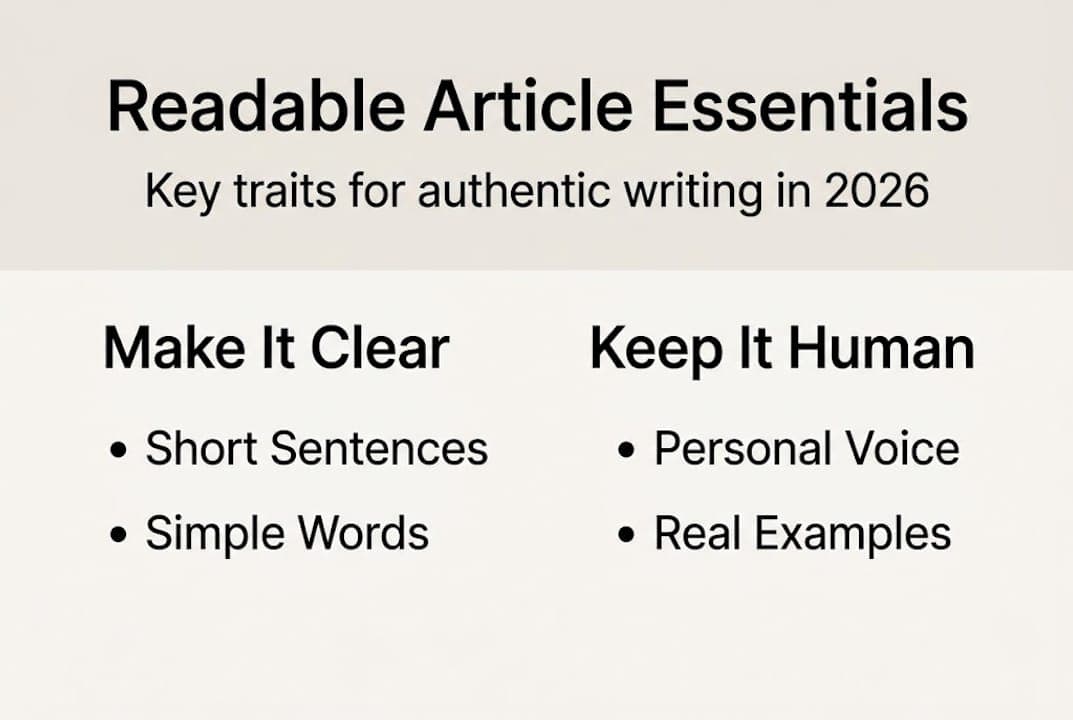
Here's the part most readability guides skip entirely. Metrics and tools are starting points. They are not the final judges of quality. A piece of content can pass every automated check and still leave readers cold.
What actually makes writing memorable is voice, narrative, and the small imperfections that signal a real person was behind the keyboard. A slightly unexpected word choice. A sentence that breaks the pattern. An example pulled from lived experience rather than a generic scenario. These are the things that AI-written content types still struggle to replicate convincingly.
The best editors we know read drafts as humans first, bots second. They ask: does this feel true? Does it sound like someone who actually knows this topic? Does it make me want to keep reading? Those questions matter more than any FK score.
Even as AI detectors grow more sophisticated, human storytelling stays ahead. Empathy, context, and genuine expertise leave fingerprints that no algorithm fully mimics. The goal isn't to trick a detector. It's to write something worth reading, and let the metrics confirm what your instincts already know.
You now have the framework. But applying it consistently across every article, especially when you're working at scale, is where most creators hit a wall.
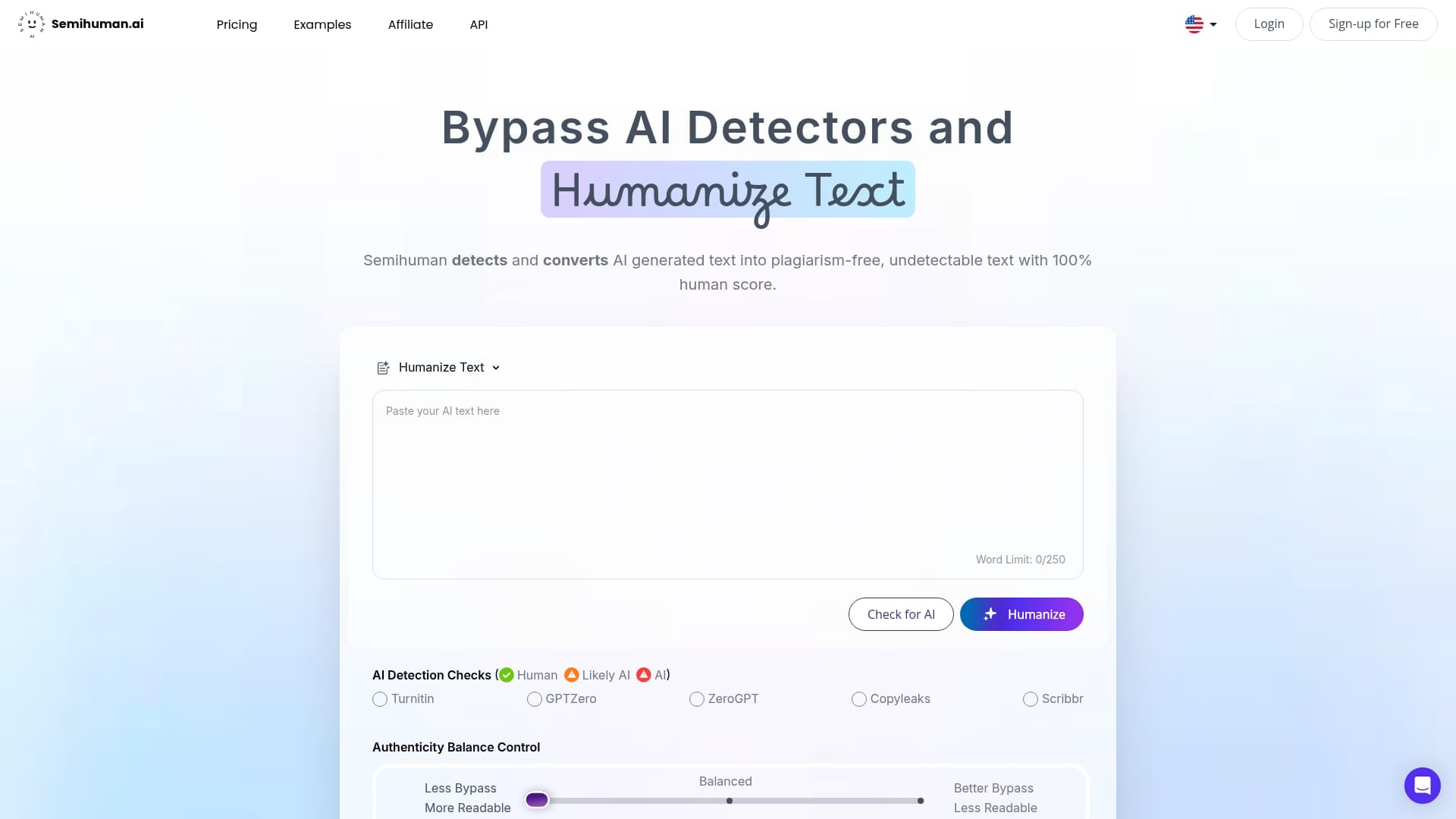
Semihuman.ai is built for exactly this challenge. The platform helps you bypass any AI detector while preserving the meaning and quality of your content. Need to rewrite a flat AI draft into something that flows naturally? The AI text paraphraser handles that with precision. And if you need content that ranks, the SEO text generator combines keyword integration with human-like structure from the start. Try it on your next article and see the difference a genuinely human voice makes.
A Flesch-Kincaid Grade Level of 8 to 9 is ideal for most online audiences, balancing accessibility with enough depth to feel authoritative.
Hemingway and Grammarly are both strong options, but combining readability tools gives you a more complete and accurate picture than relying on any single platform.
Edit for voice, vary sentence length, and add real examples from your experience. AI content requires careful post-editing to eliminate the repetitive patterns that detectors and readers both notice.
Not always. Readability is a guide, not a rule. Match your score to your audience's knowledge level and the purpose of the piece rather than chasing a universal target.


Start
Humanizing
for Free!
Humanize