
Loading...

Standing out in a world filled with AI-generated content can feel impossible for even the most dedicated content marketers and SEO professionals. Audiences crave authentic voices, but machine-written text often comes across as repetitive and lacking the rich nuance that real writers provide. By learning to detect robotic features in AI-generated text and applying proven strategies to humanize your content, you set the foundation for genuine engagement and lasting compliance.
| Essential Insight | Clarification |
|---|---|
| 1. Identify Robotic Features | Recognize repetitive phrasing and low complexity in text to spot AI-generated content. |
| 2. Transform with Human Touch | Restructure AI text, adding emotion and conversational flow for authenticity. |
| 3. Personalize for Audience | Tailor language and examples to connect with your specific readers effectively. |
| 4. Verify with Detection Tools | Use multiple verification tools to ensure content authenticity while applying human judgment. |
Detecting robotic features in AI-generated text requires a systematic approach to understanding how machine-written content differs from authentic human writing. By learning to recognize specific linguistic patterns, you can quickly identify text that lacks genuine human nuance.
To effectively evaluate AI-generated text, focus on several key detection strategies:
Researchers have found that systematic assessment of linguistic features can reveal the robotic nature of AI-generated content. This involves examining syntax patterns, semantic coherence, and overall linguistic variety to distinguish machine-written text from human-authored writing.
The most effective assessment involves a multi-dimensional approach that considers language complexity, emotional depth, and contextual adaptability. Pay close attention to how the text handles nuanced topics, uses metaphors, and demonstrates genuine understanding beyond surface-level information retrieval.
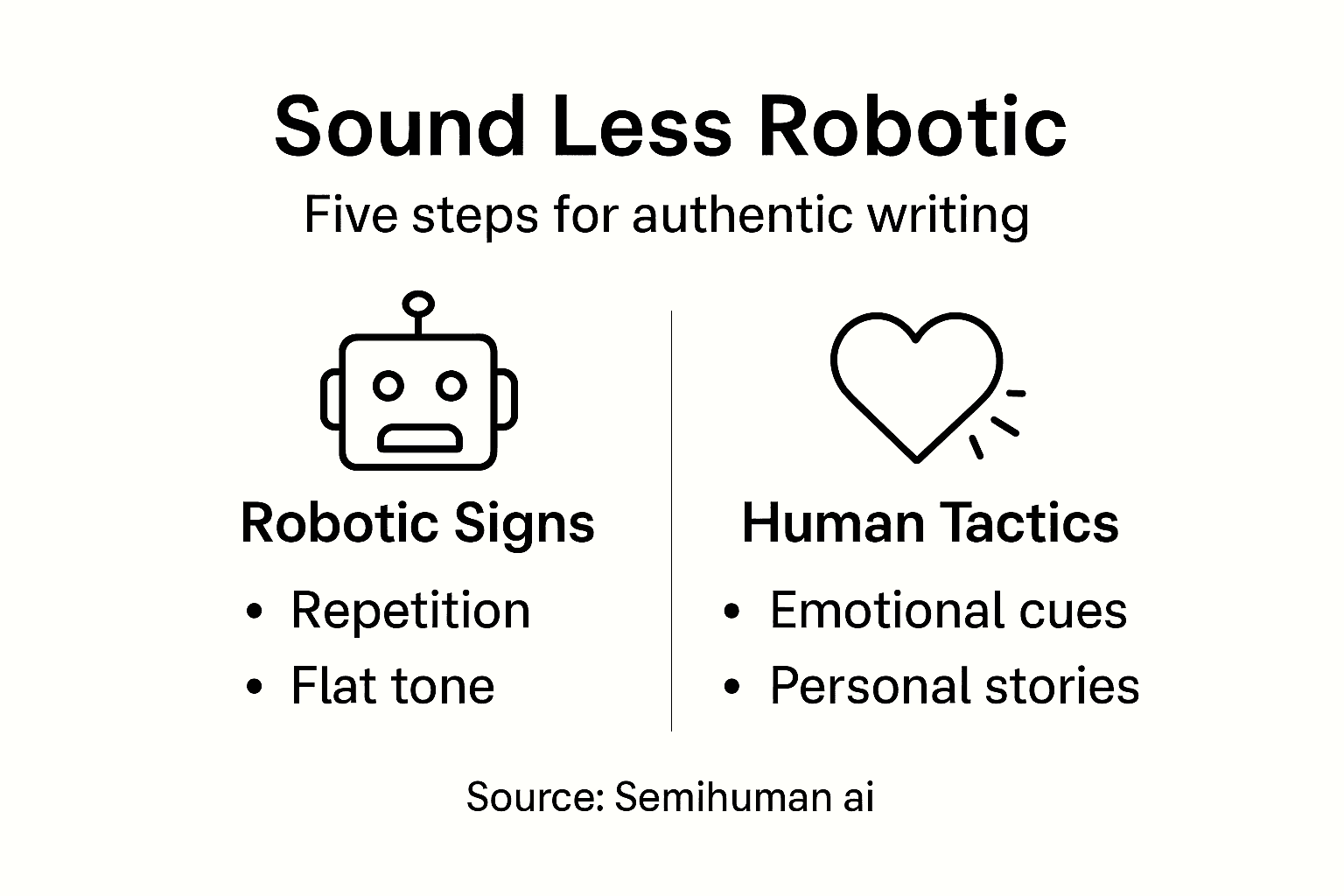
Here's a concise summary of robotic versus human writing characteristics:
| Characteristic | Robotic AI Text | Human Writing |
|---|---|---|
| Sentence Structure | Highly repetitive | Varied and dynamic |
| Emotional Expression | Minimal or absent | Depth and nuance |
| Contextual Adaptation | Surface-level responses | Deep contextual awareness |
| Use of Metaphors | Rarely present | Common and creative |
Pro tip: Create a personal checklist of robotic writing indicators to quickly evaluate AI-generated text and improve your detection skills.
Transforming AI-generated text into a naturally flowing, authentic piece requires strategic restructuring and careful human intervention. Your goal is to breathe life into machine-produced content by infusing it with genuine human communication patterns and emotional nuance.
Collaborative human-AI frameworks emphasize creating a balanced workflow that transforms robotic drafts into engaging writing. Here are key strategies to achieve this:
Pay special attention to paragraph flow and logical progression. Each paragraph should build upon the previous one, creating a sense of narrative momentum that feels organic and intentional. This means carefully reviewing and restructuring AI-generated text to eliminate abrupt transitions and mechanical language.
The key is to treat AI-generated text as a first draft—a foundation that requires your creative touch to truly come alive. Approach the editing process as a collaborative effort where you guide the content toward more authentic expression.
Authentic writing isn't about perfection, but about capturing the genuine human experience in your words.
Pro tip: Read your edited text aloud to identify and eliminate any remaining robotic speech patterns that might slip through your initial review.

Transforming robotic AI text into a vibrant, authentic piece requires more than simple editing—it demands a deep understanding of human communication nuances. Your mission is to breathe genuine emotion and personality into machine-generated content, making it feel like a real conversation.
Academic writing benefits from diverse linguistic strategies that go beyond mechanical reproduction. Here are powerful techniques to inject natural expression:
The art of humanizing text lies in understanding that authentic communication is never perfectly linear. Your goal is to create a dynamic narrative that sounds like it emerged from genuine human thought processes, not algorithmic generation.
Authentic expression isn't about eliminating imperfections, but about capturing the beautiful complexity of human communication.
Pay special attention to the rhythm and flow of your language. Professional writers know that true authenticity comes from understanding the subtle music of human speech—the pauses, the unexpected turns, the moments of genuine connection.
Pro tip: Record yourself speaking naturally about the topic and use that recording as a reference for capturing authentic language patterns in your writing.
Contextual personalization transforms generic AI-generated content into a tailored, engaging experience that speaks directly to your specific audience. Your goal is to craft content that feels like it was written exclusively for your reader, not churned out by an algorithm.
AI-powered personalization dynamically adapts content to match individual user contexts and interests. Here are strategic techniques to achieve this:
The magic of personalization lies in making your reader feel uniquely understood. This means going beyond surface-level modifications and diving deep into the psychological landscape of your target audience.
Truly personalized content doesn't just inform—it creates an intimate conversation that feels like it was crafted just for you.
Remember that personalization is an art of subtlety. You're not rewriting the entire piece for each reader, but strategically adjusting language, examples, and emotional resonance to create a sense of individual connection.
Pro tip: Create user personas with specific backgrounds and challenges to guide your personalization strategy and make your content feel more targeted and authentic.
Ensuring your content passes AI detection scrutiny requires a strategic, multi-layered approach that goes beyond simple screening. Your mission is to understand and navigate the complex landscape of authenticity verification tools while maintaining the integrity of your writing.
Academic integrity tools reveal nuanced detection challenges across different AI-generated content types. Here are critical strategies for effective verification:
Detection tools are not infallible. They represent a technological checkpoint, not an absolute judgment of authenticity. Some platforms struggle with nuanced AI-generated text, especially when content has been carefully humanized or paraphrased.
Authentic writing is about capturing genuine human thought, not just evading detection algorithms.
Effective verification involves a balanced approach that combines technological tools with your unique writing expertise. Think of detection tools as helpful assistants, not ultimate arbiters of your content's quality.
Compare key AI authenticity detection tools and their strengths:
| Tool Type | Best Use Case | Limitation | Human Factor Needed |
|---|---|---|---|
| Automated Scanner | Quick content screening | May miss nuanced edits | Manual review recommended |
| Cross-check Tools | Verifying multiple sources | Conflicting results possible | Judgment for clarity |
| Manual Review | Deep authenticity check | Time-intensive process | Essential for accuracy |
Pro tip: Always maintain a human touch in your writing and treat AI detection tools as collaborative partners, not final judges of your work.
Struggling to transform robotic AI-generated text into authentic, engaging content that resonates with your audience? The article "How to Sound Less Robotic Naturally for Authentic Content" highlights key challenges like repetitive phrasing, lack of emotional depth, and poor contextual adaptation. These common pain points can make your writing feel mechanical and fail to connect with readers or pass AI detection tools.
At Semihuman.ai, we specialize in addressing these exact challenges by humanizing your AI-produced text with advanced features such as text restructuring, natural language enhancement, and detection evasion. Our platform empowers creators, marketers, and students to craft genuine content that not only improves SEO rankings but also bypasses AI detectors like Turnitin, GPTZero, and Copyleaks. Incorporate AI text humanizing tools today and experience the difference of content that sounds like it was written by you.
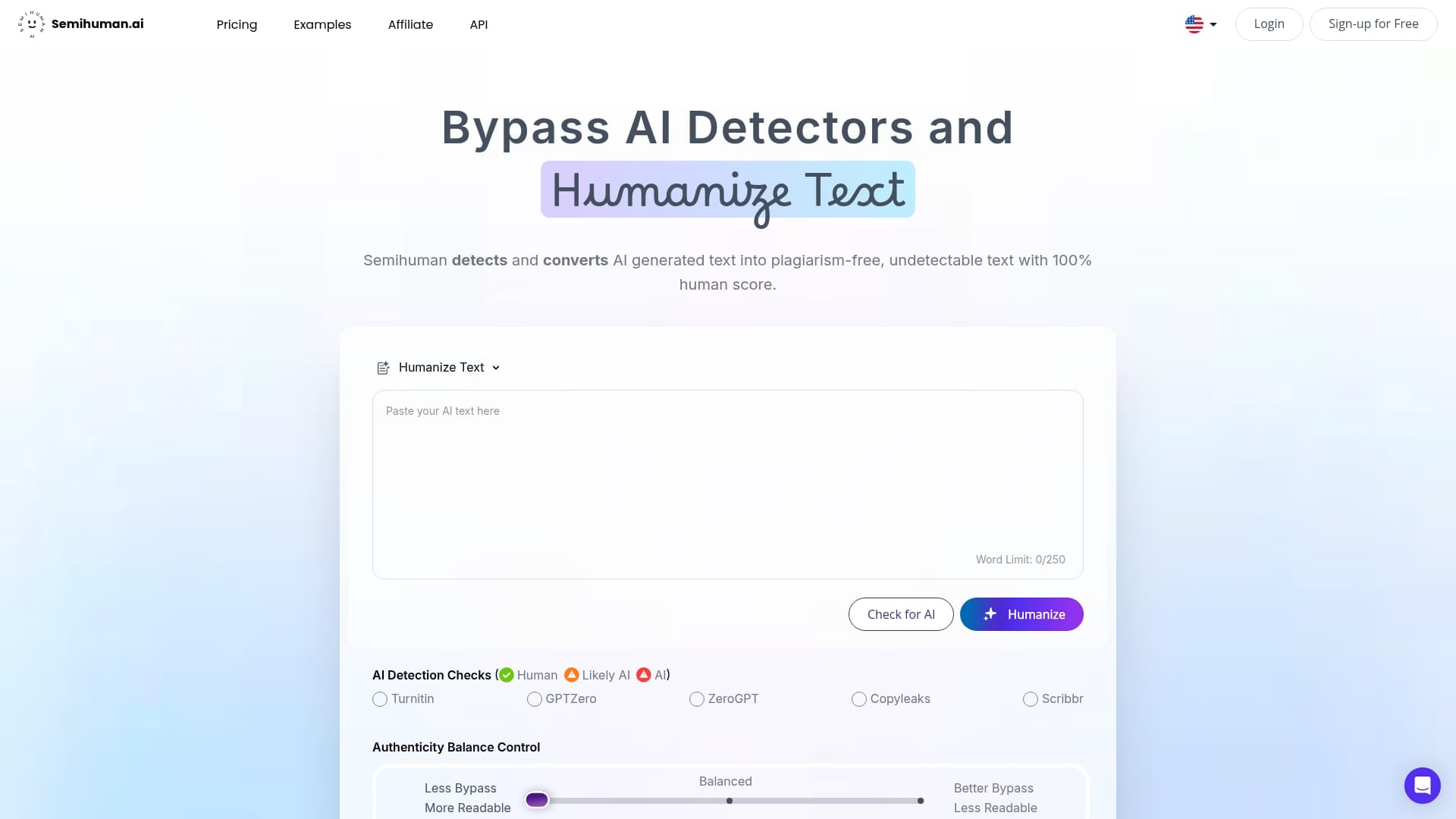
Ready to stop sounding robotic and start connecting with your audience authentically? Visit Semihuman.ai now to transform your AI content into naturally human-like writing with ease. Don’t let mechanical text hold you back — take control of your content's voice today.
To identify robotic features, look for repetitive phrasing, simplistic vocabulary, and a lack of contextual variation. Focus on these indicators as you evaluate the text to quickly spot mechanical writing.
To make AI-generated content sound more human, vary sentence length and add emotional context. Try mixing short, punchy sentences with longer, more complex structures.
You can incorporate personal insights by adding subjective observations and reflective commentary to the text. Consider sharing personal anecdotes or insights related to the topic to enhance relatability.
Effective techniques for personalizing content include understanding your audience's interests and adjusting terminology based on their expertise. Tailor examples and stories specifically to your target demographic to create a more engaging experience.
You can verify the authenticity of your content by running it through multiple detection tools and conducting a manual review. Compare results from different platforms to ensure a more accurate assessment of your content's authenticity.
If your content receives a false positive, review it for mechanical language or robotic phrases, and enhance the human touch. Focus on rephrasing awkward sentences and enriching emotional depth to improve authenticity.

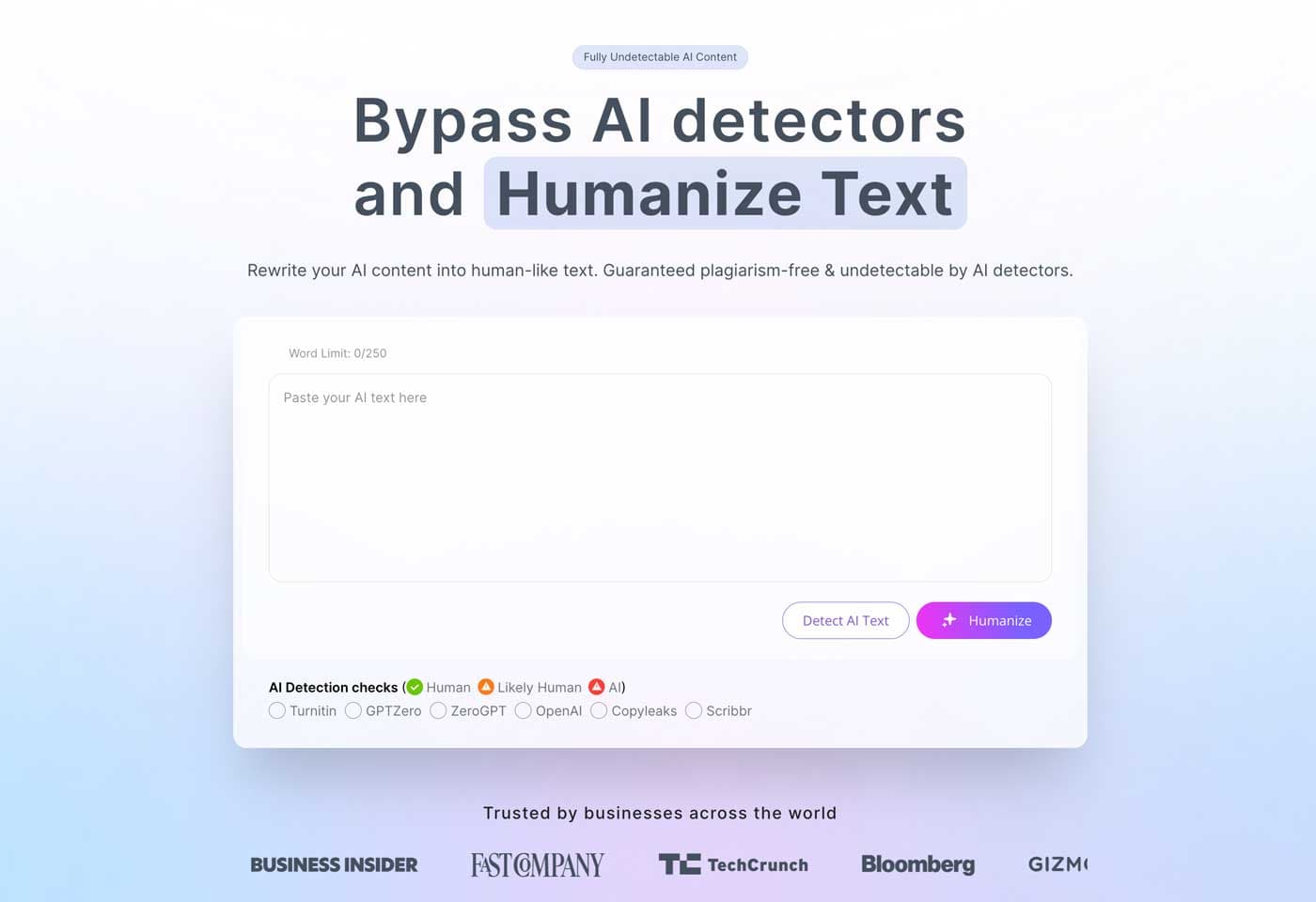

Start
Humanizing
for Free!
Humanize