
Loading...

Most American publishers now rely on advanced AI tools, but research shows that over 60 percent of readers can spot artificial writing when key text patterns appear. The difference between human and AI-generated content has become a hot issue as authenticity shapes both trust and search rankings. If you want your American audience to recognize your content as genuinely human, learning to identify and correct those subtle machine markers is more crucial than ever.
| Key Point | Explanation |
|---|---|
| 1. Identify AI Writing Traits | Look for uniform sentence structures and repetitive phrasing to spot AI-generated text. |
| 2. Restructure for Human Nuance | Vary sentence lengths and vocabulary to create a natural narrative flow in your writing. |
| 3. Integrate Keywords Naturally | Use keywords contextually without forcing them into sentences to maintain conversational tone. |
| 4. Personalize Your Writing Style | Incorporate personal language and emotional depth to make writing sound genuine and authentic. |
| 5. Verify with Detection Tools | Test your content across multiple detection platforms for a more accurate assessment of authenticity. |
Assessing your existing content for potential AI generation requires a strategic approach that goes beyond surface-level examination. Your goal is to identify subtle linguistic patterns that might reveal artificial origin. Stylometric analysis reveals distinctive characteristics that can help you distinguish between human and AI-generated text.
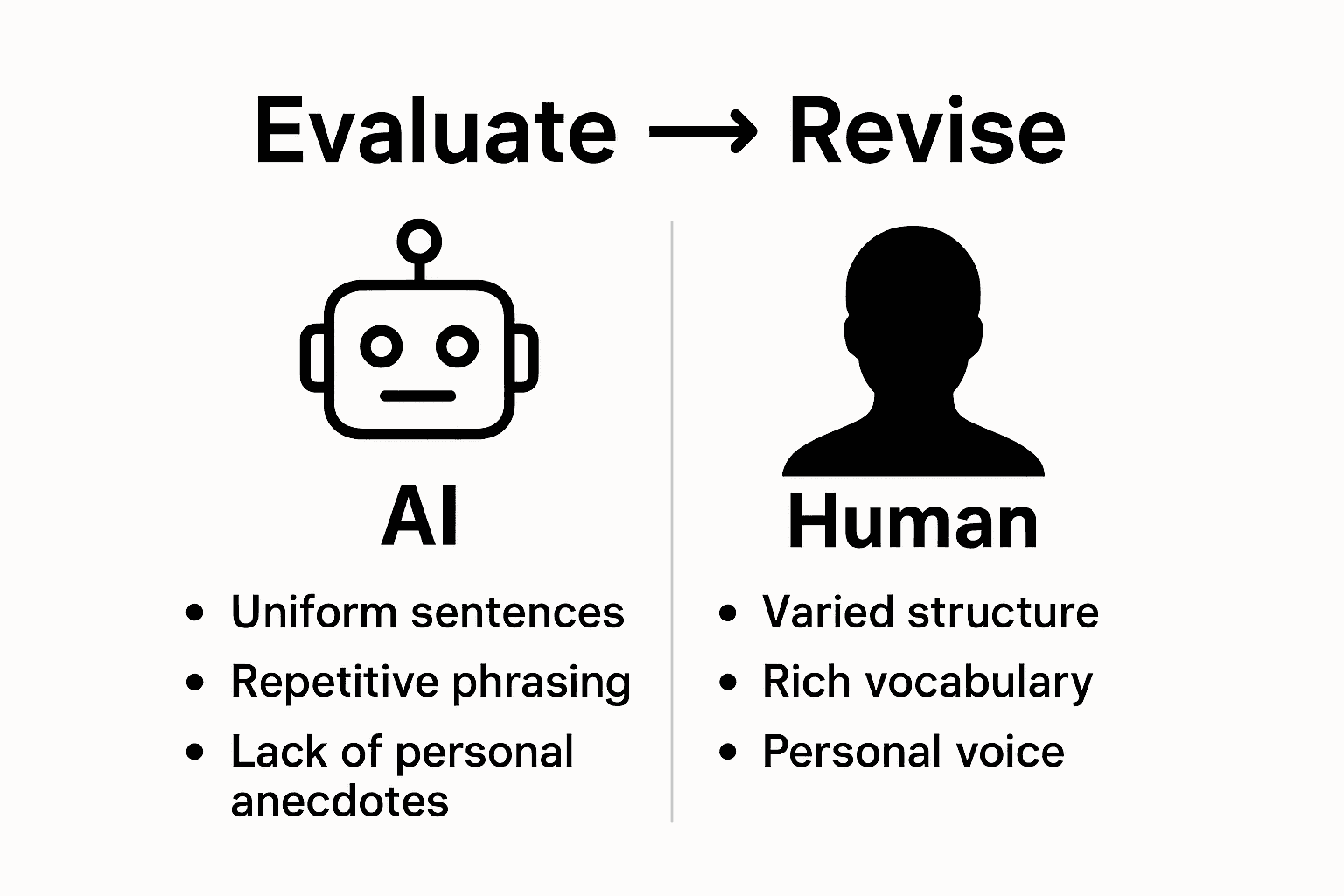
Start by examining your text for several telltale signs. Look for overly uniform sentence structures, repetitive phrasing, and an absence of genuine personal nuance. AI-generated content often displays remarkable consistency in grammatical patterns but lacks the organic variability of human writing. Pay attention to vocabulary choices that seem slightly off or too formal for the context. Watch for paragraphs that sound technically accurate but emotionally flat.
Careful scrutiny involves multiple layers of assessment. Read the text aloud to detect unnatural rhythm or awkward constructions. Check for generic statements that could apply to almost any scenario. Linguistic research indicates nuanced differences between human and AI outputs, suggesting that careful reading can reveal synthetic text generation.
Pro tip: Create a checklist of AI writing traits before reviewing your content, and score each document objectively to develop a systematic assessment approach.
Here's a comparison of common AI-generated text markers versus hallmarks of human writing:
| Characteristic | AI-Generated Content | Human-Written Content |
|---|---|---|
| Sentence Structure | Consistently uniform | Varied and dynamic |
| Vocabulary Usage | Formal or oddly chosen words | Context-aware and nuanced |
| Emotional Tone | Emotionally flat | Genuine emotional resonance |
| Rhythm & Flow | Regular, sometimes monotonous | Natural, irregular pacing |
| Personal Perspective | Absent or generic | Distinct personal viewpoint |
Restructuring AI-generated text to sound authentically human requires strategic modifications that go beyond surface level edits. Your objective is to transform mechanical writing into natural narrative flow by introducing organic variability and contextual nuance. Rhetorical Structure Theory provides insights into text coherence that can help you understand how humans naturally construct language.
Begin by breaking down uniform sentence structures and introducing intentional variations. Mix short and long sentences to create a more dynamic rhythm. Replace generic vocabulary with specific, contextually rich language that reflects personal experience. Add subtle imperfections like occasional conversational interjections or mild grammatical variations that mimic human speech patterns. Advanced detection methods analyze text modification tendencies to distinguish between AI and human writing, so focus on creating genuine stylistic diversity.
Careful restructuring means thinking like a human writer. Inject personal perspective through anecdotal references or subjective interpretations. Vary paragraph length and introduce deliberate asymmetry in your text structure. Use transitional phrases that sound naturally conversational rather than algorithmically precise. Read your text aloud and listen for mechanical cadences that need softening.

Pro tip: Create a personal editing checklist that targets specific AI writing markers, such as overly formal language, perfect grammatical structure, and lack of emotional nuance.
Integrating keywords naturally requires a sophisticated approach that goes beyond mechanical placement. Your goal is to weave keywords seamlessly into your text so they feel organic and contextually relevant. Dynamic information retrieval techniques can help improve contextual keyword integration by ensuring that each term adds genuine value to your content.
Start by understanding the linguistic nuances that distinguish human writing. Research on language patterns reveals specific approaches to authentic keyword placement that make your text sound more natural. Avoid cramming keywords into sentences unnaturally. Instead, think about how you would naturally discuss a topic with a friend. Use synonyms and related phrases that capture the essence of your target keywords. Create context around each keyword by explaining its significance or sharing a brief anecdote that makes the term feel like a natural part of the conversation.

Consider the rhythm and flow of your writing. Keywords should emerge organically within sentences that sound conversational and engaging. Read your text aloud to check for awkward phrasing. If a keyword feels forced when you speak it, rework the sentence. Pay attention to semantic connections that make your language feel authentic. Vary your keyword usage by incorporating different grammatical forms and contextual variations that reflect genuine human communication.
Pro tip: Create a keyword integration checklist that includes reading your text aloud, checking for natural flow, and ensuring each keyword serves a genuine communicative purpose.
Personalizing your writing style requires understanding the subtle nuances that distinguish authentic human communication from mechanical text generation. Research on linguistic traits reveals complex cognitive processes underlying textual composition that can help you craft more genuine writing. Your goal is to develop a unique voice that sounds naturally conversational and uniquely yours.
Start by analyzing your personal communication patterns. Think about how you speak with friends or colleagues. Do you use specific phrases or have a particular rhythm to your language? Advanced text modification analysis shows how humans uniquely adapt their writing style by introducing subtle variations and personal quirks. Incorporate elements of your spoken language into your writing style. This might mean using occasional colloquialisms, varying sentence length, or adding personal asides that reflect your authentic thought process.
Authentic personalization goes beyond simple word choice. Consider the emotional undertones of your writing. Humans communicate with subtle emotional cues that AI often misses. Inject personal perspectives, use metaphors that reflect your unique experiences, and allow your individual perspective to shine through. Read your text aloud and ask yourself if it sounds like something you would actually say. Pay attention to the natural ebb and flow of your language emotional resonance that makes writing feel genuinely human.
Pro tip: Create a personal style guide that captures your unique linguistic fingerprint by recording phrases you frequently use, noting your natural sentence rhythms, and identifying the emotional qualities that make your communication distinctly yours.
Verifying content authenticity requires a strategic approach to navigating AI detection technologies. Research on AI text detection tools reveals complex evaluation methodologies that can help you assess the human like quality of your content. Your primary goal is to understand how detection systems analyze and classify generated text.
Start by testing your content across multiple detection platforms to gain comprehensive insights. Advanced studies have investigated various detection tools capabilities and uncovered their unique strengths and limitations. Most detection tools analyze linguistic patterns semantic structures and statistical probabilities to determine content origin. Run your text through different systems and look for consistent indicators. Pay attention to the confidence scores and understand that no single tool provides absolute certainty. Some platforms might flag certain sections while others might clear the entire document.
Careful interpretation is key when working with detection tools. Each platform uses different algorithms and machine learning models to assess content authenticity. Cross reference results from multiple sources to get a more balanced perspective. Be prepared to make iterative adjustments based on feedback. Remember that detection technologies are constantly evolving and what works today might change tomorrow. Treat these tools as guides rather than absolute arbiters of content authenticity.
Pro tip: Develop a systematic approach by creating a detection tool comparison spreadsheet that tracks different platforms performance accuracy and specific feedback for your content.
For quick reference, here's a summary of recommended steps to achieve more human-like content:
| Step | Primary Focus | Key Strategy |
|---|---|---|
| Assess for AI Traits | Identify machine-like patterns | Stylometric and linguistic analysis |
| Restructure for Human Patterns | Improve narrative variability | Intentional sentence and style changes |
| Integrate Keywords Authentically | Enhance contextual relevance | Natural placement and flow |
| Personalize Tone and Style | Develop unique voice | Incorporate personal language habits |
| Verify using Detection Tools | Validate human-like quality | Use multiple detection platforms |
The challenge of transforming AI-generated content into genuinely human-like writing is more than technical. As the article details, issues like uniform sentence structures, emotionally flat tones, and unnatural keyword placement can raise red flags with AI detection tools. If you want to overcome these pain points and ensure your content resonates with true human nuance and passes stringent detection systems such as Turnitin or GPTZero, your solution lies in intelligent content humanization.
Semihuman.ai specializes in tackling exactly these concerns by offering AI-powered tools designed to restructure your text, integrate keywords naturally, and personalize tone to mirror authentic human communication. By focusing on nuanced language patterns and emotional resonance, Semihuman.ai helps you ditch mechanical cadences and create engaging content that feels uniquely yours. Whether you are a content creator aiming to boost SEO or a student striving for originality in academic writing, our platform supports your goals with precision and ease.
Enhance your writing with expert guidance and cutting-edge technology. Start now and experience the difference at Semihuman.ai.
Looking for advanced keyword integration or content restructuring tips? Discover more ways to refine your content on the Landing Page.
Ready to make your AI-generated content indistinguishable from human writing
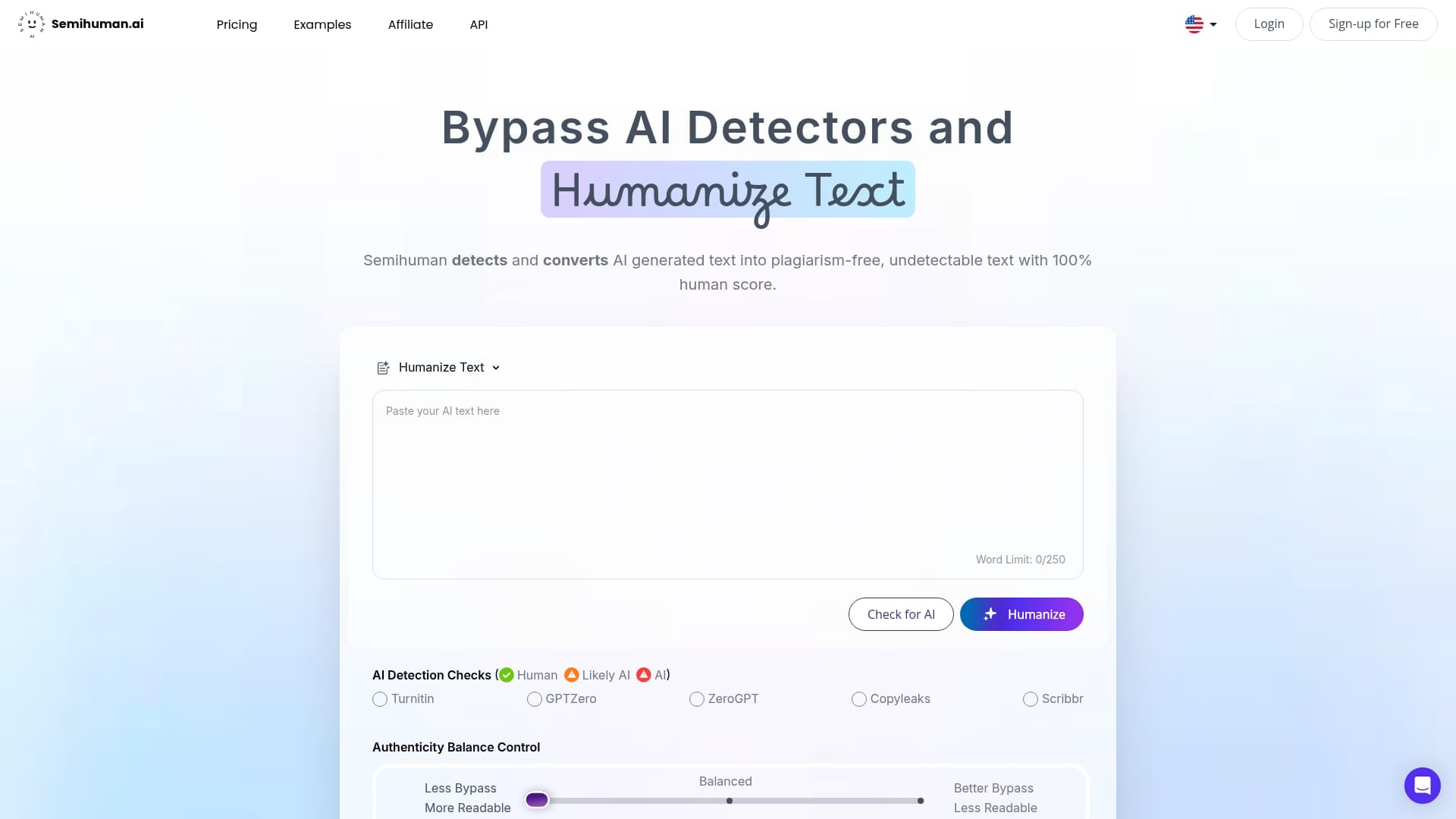
Take control of your text authenticity today with Semihuman.ai and unlock the full potential of your writing by visiting Semihuman.ai. Do not let detection tools limit your creativity or success any longer.
To assess your content for AI traits, examine it for uniform sentence structures, repetitive phrasing, and an absence of genuine personal nuance. Use a checklist of common AI writing markers to score each document and identify areas for improvement.
To restructure AI-generated text, mix short and long sentences to create dynamic rhythm and replace generic vocabulary with contextually rich language. Aim for a more natural narrative flow by incorporating personal anecdotes and varying paragraph lengths to enhance readability.
To integrate keywords authentically, avoid cramming them into sentences and instead, use synonyms and related phrases that fit the context. Create engaging sentences with keywords that feel like a natural part of the conversation, and read your text aloud to ensure the flow sounds conversational.
To personalize your writing, analyze your communication patterns and incorporate elements like colloquialisms and personal asides that reflect your authentic voice. Focus on emotional undertones and read your text aloud to ensure it captures your unique linguistic style.
To verify content authenticity, test your writing across multiple detection platforms to gather comprehensive insights. Look at the confidence scores and be prepared to make adjustments based on feedback while using the tools to guide improvement rather than serve as absolute measures.
Focus on five key steps: assess existing content for AI traits, restructure text for human patterns, integrate keywords authentically, personalize tone and language style, and verify authenticity using detection tools. Consistently apply these strategies to enhance the human-like quality of your writing.



Start
Humanizing
for Free!
Humanize