
Loading...

TL;DR:
- Effective academic writing combines clear structure, authentic voice, and proper citation to demonstrate original thinking. Planning, drafting, and revising systematically help build genuine skills and produce human-sounding work that withstands AI detection. Using ethical strategies like varied sentences, personal perspective, and thorough process records ensures authenticity and academic integrity.
Your professor flags your essay. The plagiarism detector lights up. But you wrote every word yourself. This scenario plays out constantly for students navigating AI detection tools, citation requirements, and increasingly high expectations for originality. The frustration is real, and it's growing. Strong academic writing is not just about avoiding errors. It's about demonstrating human touch in academic writing through structure, clarity, and a voice that is unmistakably yours. This guide walks you through every proven method to elevate your skills, protect your authenticity, and write with confidence.
| Point | Details |
|---|---|
| Build strong structure | Consistent organization and evidence-based arguments are the foundation of effective academic writing. |
| Plan and revise | Outlining, drafting, and iterative revision predict higher-quality, more authentic work. |
| Cite all sources | Proper quoting and referencing are essential for both integrity and originality. |
| Humanize your text | Manual revision, sentence variety, and personal voice help you remain authentic and avoid AI misclassification. |
| Leverage diverse feedback | Peer, rubric, and AI feedback each strengthen your writing in unique ways. |
Great academic writing starts with understanding what the form actually demands. Academic writing requires structure, evidence-based arguments, precise language, and clear organization to communicate complex ideas effectively. That is not just an ideal, it is the baseline expectation at most colleges and universities.
Structure means more than having an introduction and a conclusion. Every paragraph needs a topic sentence that signals the main point, followed by evidence, then analysis. Your thesis statement is the backbone of the entire paper. Without a clear thesis, even well-written sentences feel scattered and purposeful writing falls apart.
Style is where many students stumble. Key mechanics include correct grammar, punctuation, active voice preference over passive, avoiding nominalizations, and consistent style adherence such as APA or MLA. A nominalization, for those new to the term, is when you turn a verb into a noun phrase. For example, writing "the investigation of" instead of simply "we investigated." Nominalizations make prose heavy and impersonal.
Here is a quick comparison of strong versus weak academic style choices:
| Element | Weak example | Strong example |
|---|---|---|
| Voice | It was found that results varied. | Results varied across conditions. |
| Thesis | This paper is about climate change. | Urban heat islands amplify climate inequity in low-income neighborhoods. |
| Nominalization | The implementation of the plan... | The team implemented the plan... |
| Citation style | (Smith, year unknown) | (Smith, 2023, p. 14) |
| Sentence length | Short. Very short. Too short always. | A mix of shorter punchy points and longer, evidence-rich sentences that develop the argument. |
Common pitfalls to watch for in your own drafts:
You can also explore content originality overview for a broader look at how originality signals credibility across writing contexts.
Pro Tip: Before you submit any academic work, run it through a personal style checklist that covers thesis clarity, citation formatting, verb tense consistency, and sentence variety. This habit alone will catch the majority of structural errors before your instructor does.
With the mechanics in place, your next step is effective planning and drafting, the backbone of authentic writing. Many students skip directly to typing a first draft, which typically results in disorganized arguments and ideas that contradict each other by the third paragraph.
Start with an outline. Not just a bullet list of topics, but a true argument map. Write your thesis at the top, then list the two or three main supporting points below it. Under each supporting point, note the specific evidence you plan to use and the source you will cite. This structure ensures that every paragraph you eventually write has a purpose and a place.
To improve skills, focus on planning, clear writing, grammar practice, proofreading, and seeking feedback from writing centers. This is a well-established framework in composition research, not a casual suggestion.

Research also confirms that the process itself predicts quality. Process features like planning, re-reading, and elaboration predict high-quality essays with a Random Forest model accuracy of 80%. In other words, how you write is nearly as important as what you write. Students who skip planning consistently produce weaker essays, even when they know the material well.
Here is a practical drafting sequence that works for most academic papers:
Pro Tip: Before drafting, spend ten minutes mapping your main argument and the specific evidence that supports each claim. Students who do this produce noticeably more focused and coherent essays.
The iterative nature of drafting also builds authentic voice. Each revision forces you to make active choices about word selection and sentence construction, and those choices are what make writing sound genuinely human rather than generated.
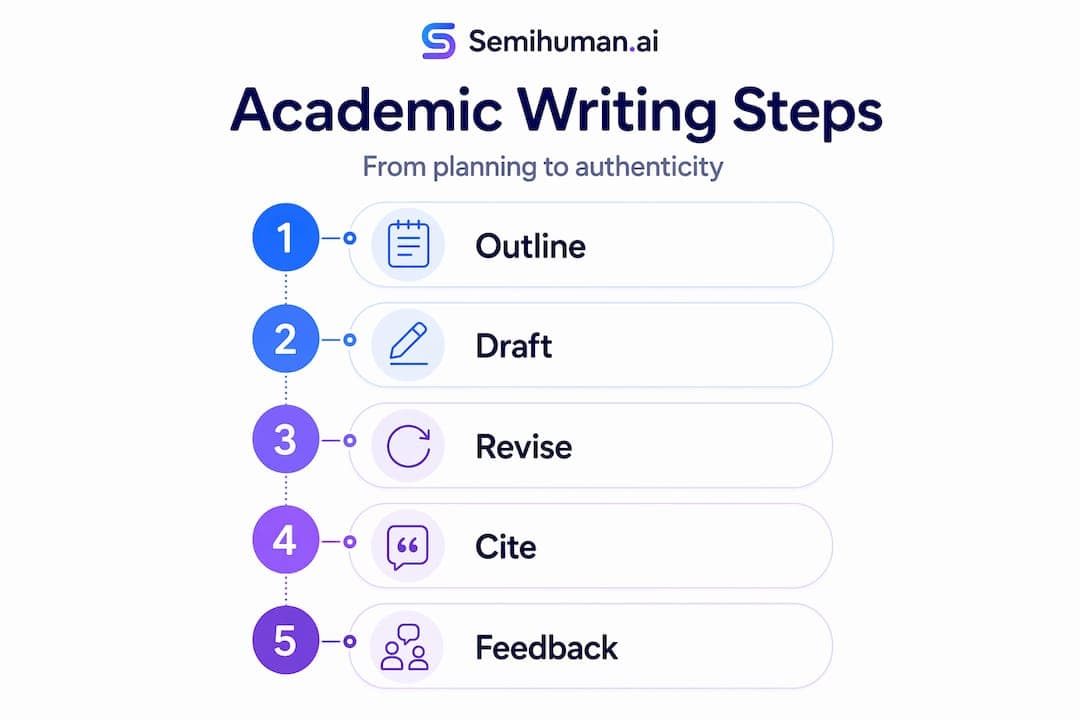
Once you have a draft, ensuring authentic use of sources and full attribution becomes critical. Plagiarism is not always intentional. Many students run into trouble because they misunderstand the rules around paraphrasing and summarizing.
Authenticity is enhanced by proper quoting, paraphrasing, summarizing sources, and citing all non-original ideas to avoid plagiarism. That last part is key. Many students believe that only direct quotes require citations. In reality, if the idea came from someone else, it needs a citation, even if you rewrote it entirely in your own words.
Here is how to decide which approach to use:
Understanding the key types of plagiarism can save you from violations you did not even know you were committing.
A practical habit that prevents citation errors is tracking your sources while you research, not after. Paste every source URL or reference into a working document before you even read the article. This way, you always have the citation ready when you use the idea.
"Every idea that did not originate in your own mind must be cited, regardless of how thoroughly you have rewritten it. Attribution is not just a technicality. It is the foundation of academic honesty."
The blockquote above captures what most academic integrity policies actually mean. Authenticity in academic writing is not just about word choice. It is about intellectual honesty in how you engage with sources.
As you polish your work, focus on the nuanced task of ensuring your writing retains a credible human voice, especially if you have used AI tools at any stage of your process. Detection algorithms look for patterns: uniform sentence length, absence of hedging language, overly smooth transitions, and a lack of personal perspective.
Ethical strategies to humanize text include varying sentence lengths dramatically, adding hedging and qualifiers inconsistently, injecting personal voice, using active voice variably, and revising manually. Let's break each of these down practically:
For deeper guidance, explore humanizing text techniques and authentic content tips to see these strategies applied across different writing contexts.
Pro Tip: Read your completed draft aloud before submitting. Your ear will catch unnatural phrasing and robotic rhythm that your eye skips right over. If a sentence trips you up verbally, rewrite it.
These strategies matter beyond detection. Real readers, professors, thesis committees, and future employers, can tell the difference between writing that sounds like a person and writing that sounds like an output. Your voice is a professional asset.
With a finished draft, hone your work through thoughtful, multi-pronged feedback. No single round of revision is ever enough. The most skilled academic writers submit work that has been through multiple hands and many revision cycles.
Rubric plus exemplar feedback improves argumentative structure and rebuttals more efficiently than in-text comments alone. This means that reviewing a rubric alongside a model essay before you revise is more effective than simply reading your instructor's margin notes. If your professor provides a rubric, treat it as a checklist. Every criterion should be explicitly met in your final draft.
Here is a structured feedback cycle that produces the best results:
For targeted advice on strengthening your prose, review writing improvement tips or study examples of authentic text to see what polished, humanized writing looks like in practice.
Pro Tip: Save every draft version, from your outline to your final submission. If you are ever accused of using AI, your revision history is your best defense. Authentic human writing shows a messy, evolving process that AI generation simply does not.
Here is the uncomfortable truth that most writing guides skip: the students who rely on quick fixes are building a debt they will eventually have to pay. Swapping in AI-generated text, paraphrasing tools, or essay mills might solve a short-term deadline problem, but it does nothing to build the skill that every advanced course, job application, and professional communication will demand.
Technology and academic integrity are not in opposition. But technology works best as a scaffold for a process you are genuinely engaging with, not a replacement for that process.
Detection tools are also not infallible. They produce false positives. A student with documented outlines, draft history, and revision notes has a defensible record of authentic work. A student who submits a polished single draft with no process evidence has nothing to show when questioned, even if the work is entirely their own.
Genuine student voice is the one thing no detection algorithm can replicate or invalidate. It grows through practice, failure, revision, and honest engagement with ideas. The strategies in this guide are not shortcuts. They are investments that pay compound returns over time. Every essay you write carefully becomes the foundation for the next one. That is how real writers develop, and it is how students become scholars.
Developing authentic academic writing is a process, and having the right tools makes that process faster and more effective. Whether you are polishing a draft for submission or working to make AI-assisted writing genuinely your own, smart tools can bridge the gap between a good draft and great work.
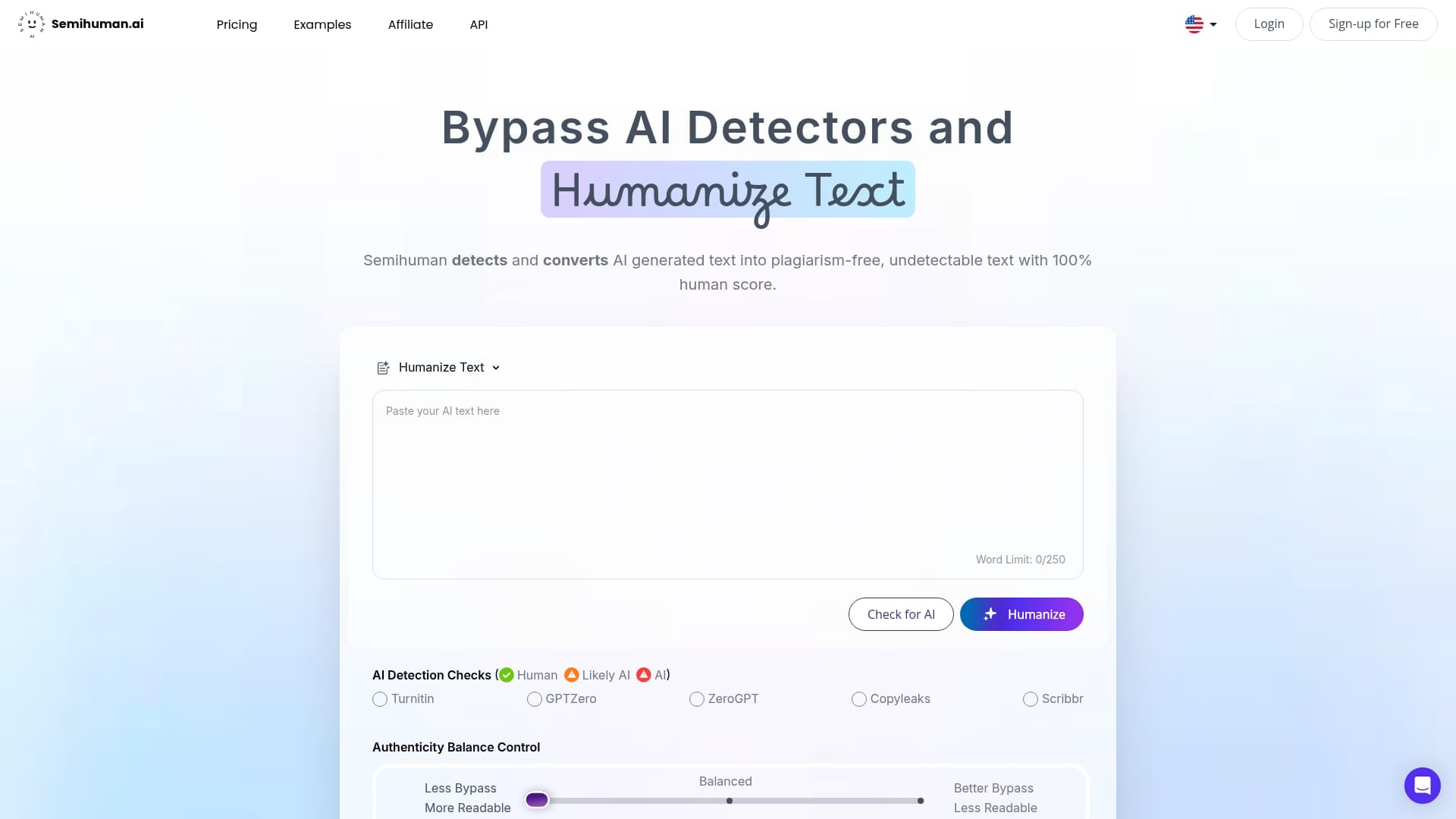
Semihuman AI is built for exactly this kind of challenge. The platform helps you transform drafts into writing that sounds credibly human, passing detection tools while genuinely improving the quality and voice of your content. From restructuring sentences to refining style, the AI writing enhancement tools at Semihuman give you precise control over how your writing reads. Try it and experience the difference that authentic, well-crafted text makes in your academic results.
Humanize your writing by varying sentence length, using your unique voice, and revising drafts multiple times. Ethical humanization strategies such as adding hedging language and manual revision are consistently the most reliable approach.
Yes, planning and drafting are strong predictors of higher-quality essays according to academic research. Process features like planning and elaboration predict essay quality with up to 80% accuracy in machine learning models.
Keep outlines, drafts, and feedback records throughout your writing process. AI detection in research papers guidance consistently recommends starting with personal outlines and revising extensively, which creates an authentic paper trail that AI generation alone cannot produce.
Yes, when used as a support for revision and content development, AI feedback can ethically improve your work. AI feedback and organization data shows statistically significant improvements in both structure and content quality.
Common mistakes include poor structure, incorrect citations, excessive passive voice, and unoriginal wording. Following stylistic mechanics of academic writing guidelines, including active voice preference and consistent citation style, directly addresses these issues.



Start
Humanizing
for Free!
Humanize