
Loading...

TL;DR:
- Publishing AI-generated content without proper editing and value addition risks penalties and damages brand credibility.
- Ensuring high E-E-A-T signals through author expertise, citations, and real-world insights is essential to pass quality assessments and avoid drops in rankings.
You built a content workflow around AI tools, published at scale, and then your organic traffic dropped 40% in two weeks. Sound familiar? This exact scenario plays out for marketers every day. AI writing tools are incredible for speed and volume, but publishing that output without a disciplined editing and value-adding process puts your site at serious risk. Search engines and quality raters are increasingly sophisticated at spotting low-quality, auto-generated content, and the fallout goes beyond rankings. It hits your brand credibility too. Here's how to protect everything you've built.
| Point | Details |
|---|---|
| Quality over quantity | AI and human thin content alike get penalized, so focus on depth and value. |
| Use E-E-A-T framework | Experience, expertise, authoritativeness, and trustworthiness protect your content from penalties. |
| Edit with purpose | Active human oversight and brand authority matter more than tricking detectors. |
| Monitor and adapt | Regularly check your content for AI signatures and signals to stay penalty-proof. |
| Invest in credibility | Showcase real experience and trust factors to future-proof your AI content. |
An AI content penalty isn't a single strike from a mysterious algorithm. It's the cumulative result of your content failing to meet quality thresholds that search engines and human quality raters apply continuously. Understanding how this works changes how you approach every piece you publish.
Google's quality rater guidelines flag content based on a combination of signals: publishing velocity spikes, thin or repetitive page structures, low originality, and lack of trustworthy signals. Scaled abuse triggers penalties when sites push 50 or more thin pages per week, produce site-wide quality drops, or rely on paraphrased spam. The keyword here is scaled abuse, not simply using AI tools.
Here's what typically triggers a flag:
What many marketers miss is that human-written thin content is also penalized. This isn't an AI problem. It's a quality problem. AI just makes it much easier to create bad content at scale.
| Content type | Penalty risk | Primary reason |
|---|---|---|
| AI output, unedited | Very high | Thin, low originality |
| AI output, lightly paraphrased | High | Still lacks unique value |
| AI output, heavily edited + cited | Low | Adds real-world context |
| Human-written, thin | Medium | Lacks depth and trust signals |
| Human-written, expert-sourced | Very low | Strong E-E-A-T signals |
If you want a full SEO checklist for AI content, that resource covers the technical side in detail. And if you're specifically concerned about detection tools, reviewing AI detection avoidance strategies will give you a deeper foundation before moving to the next step.
E-E-A-T stands for Experience, Expertise, Authoritativeness, and Trustworthiness. Google's quality raters use this framework to assess whether a page genuinely helps users or simply fills space. For AI-assisted content, building E-E-A-T isn't optional. It's your primary defense.
According to best practices for 2026, demonstrating Experience means including case studies and first-person language like "we tested this" or "our clients saw X." Expertise means showcasing credentials and addressing nuances that only someone deeply familiar with the topic would know. Authoritativeness comes from author bios, external citations, and a track record across your site. Trustworthiness requires fact-checking every claim, sourcing data, and keeping content updated as the landscape changes.
Here's what that looks like in practice before you hit publish:
| Low E-E-A-T content | High E-E-A-T content |
|---|---|
| No author named | Named author with credentials |
| No citations | Multiple relevant citations |
| Generic examples | Specific case studies or test results |
| No update history | Last updated date visible |
| No personal perspective | First-hand experience included |
Pro Tip: When building trust with AI content, the easiest quick win is adding a specific, named expert to each post. Even a one-paragraph author bio with a relevant professional title dramatically improves how quality raters perceive the page.
The balance between automation and originality is real. Understanding how AI and human creativity interact will help you strike the right ratio for your workflow.
Editing AI content for quality isn't a pass-through step. It's a complete reworking that transforms a functional draft into something genuinely useful. Here's a repeatable process that actually works.
1. Start with a structural audit. Before editing a single sentence, ask: Does this piece answer the reader's actual question in the first 150 words? If not, restructure the opening. Answer-first writing is not just good UX. Structuring for AEO (answer-first, CITABLE framework, schema) alongside E-E-A-T significantly boosts visibility in AI-generated overviews and featured snippets.
2. Replace generic claims with specific ones. Every time the AI draft says "many businesses" or "some experts believe," replace that with a named source, a real statistic, or a specific example from your own client data or industry experience.
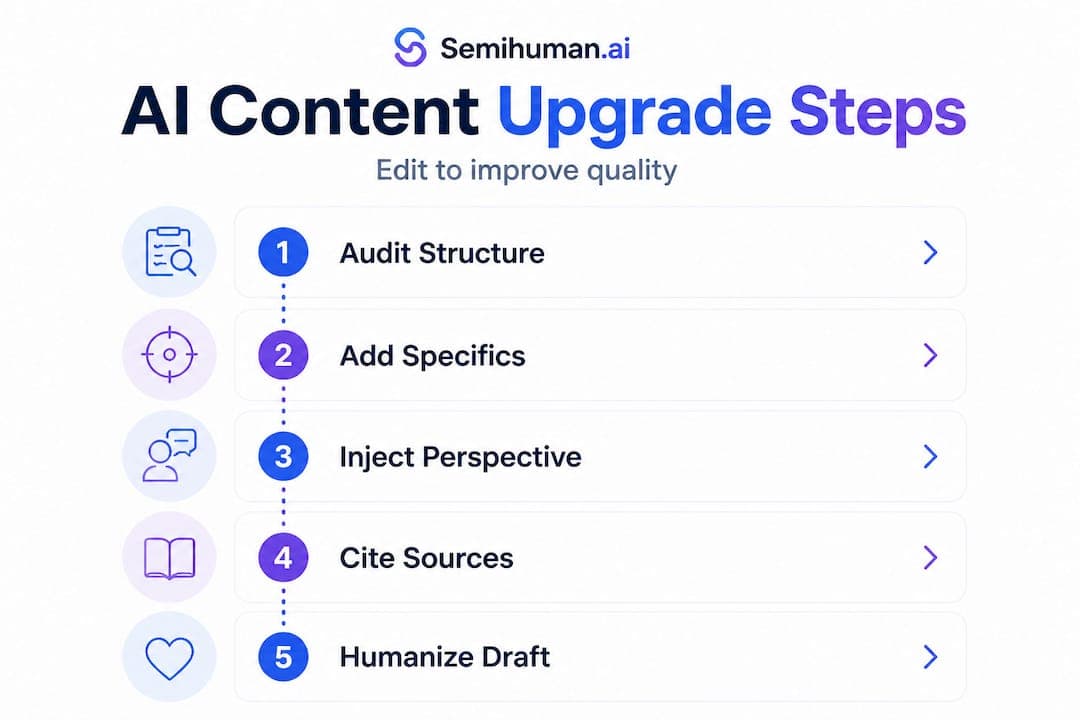
3. Add first-person or brand-specific perspective. Insert at least two to three sentences per major section that reflect your company's direct experience. This is the single most effective way to add originality that AI detectors and quality raters can't dismiss.
4. Check boosting email authenticity principles. The same rules that apply to content apply to AI-assisted email: personalization signals, brand voice, and specificity separate trustworthy output from spam-flagged content.
5. Integrate schema markup and citations. Add FAQ schema, how-to schema, or article schema wherever relevant. This supports structured data visibility and signals to search engines that the content is organized and authoritative.
6. Run the draft through an AI detection tool before publishing. This isn't about gaming the system. It's quality control. If a tool flags your content as heavily AI-generated, that's a sign the editing pass wasn't deep enough. Tools like GPTZero and Copyleaks can reveal where the draft still sounds formulaic.
7. Solve for overcoming AI automation issues. Automation creates consistency, but it also creates sameness. Each piece needs a unique hook, a specific angle, and at least one insight your audience won't find on five other sites.
Pro Tip: Conduct a short recorded interview with a subject matter expert or a real customer, then pull two or three direct quotes into your content. This creates genuine first-hand material that no AI tool can replicate and that quality raters will score highly. Track the impact using AI metrics for SEO to measure what's working over time.
You can follow every best practice and still publish content that underperforms if you skip the testing and monitoring phase. This is where most workflows fall apart.
"Some sources emphasize no AI penalty if content is helpful. But quality rater guidelines clearly warn that majority AI main content without value risks the lowest rating scores. The consensus: human oversight combined with genuine value addition is what keeps your content safe."
Top testing tools to use before publishing:
Monitoring signals that flag a problem:
| Common mistake | Why it fails | Better approach |
|---|---|---|
| Publishing AI output same-day | No editing or value layer | Build in a 48-hour review cycle |
| Only running spell-check | Doesn't address thin content | Full structural and factual audit |
| Ignoring update schedules | Content decays fast | Set a 90-day content review calendar |
| Using one AI tool's output verbatim | Detectably formulaic | Blend multiple sources and add original data |
What to do if you're flagged:
First, don't panic and don't delete. Identify which pages saw the drop and audit them against the E-E-A-T checklist from the previous section. Rewrite the weakest sections with real examples, add or improve author bios, and update citations. Once revised, request re-indexing through Google Search Console. Recovery typically takes four to eight weeks, but high-quality revisions do work.

Explore how balancing tech and authenticity plays into long-term recovery strategies. And if you're thinking about the broader picture of search ranking, humanizing content for rankings walks through exactly how the quality signals connect to real position improvements.
Here's an uncomfortable truth most marketing blogs won't say out loud: chasing AI detection scores is the wrong game entirely. The sites that consistently avoid penalties aren't the ones running their drafts through the most detection tools. They're the ones producing content that a real human would genuinely recommend to another real human.
This sounds simple. It's actually the hardest thing to operationalize at scale.
The consensus across every credible source is that human oversight combined with genuine value addition is what keeps content penalty-free. Not volume. Not speed. Not technical workarounds. Shortcuts like bulk paraphrasing or token "human review" (a two-minute read before publish) are already outpaced by the sophistication of quality rater training and algorithmic updates. They buy you weeks, not months.
What actually works long-term is building a content operation where AI handles research synthesis and first drafts while human editors add the irreplaceable stuff: real opinions, first-person experience, named examples, and honest analysis. Every piece of content should reflect something your brand actually knows or has done, not just what a language model can predict.
One approach we consistently recommend is treating case studies as living documents rather than static posts. Update them quarterly with new data. Reference them across other content as proof of real-world experience. This creates a network of genuinely original content that gets stronger over time. That's the kind of signal that makes content truly penalty-proof, and it's why elevating marketing with AI is a long game, not a quick win.
Publishing AI-assisted content confidently requires more than good intentions. You need a system that flags problems before they cost you rankings.
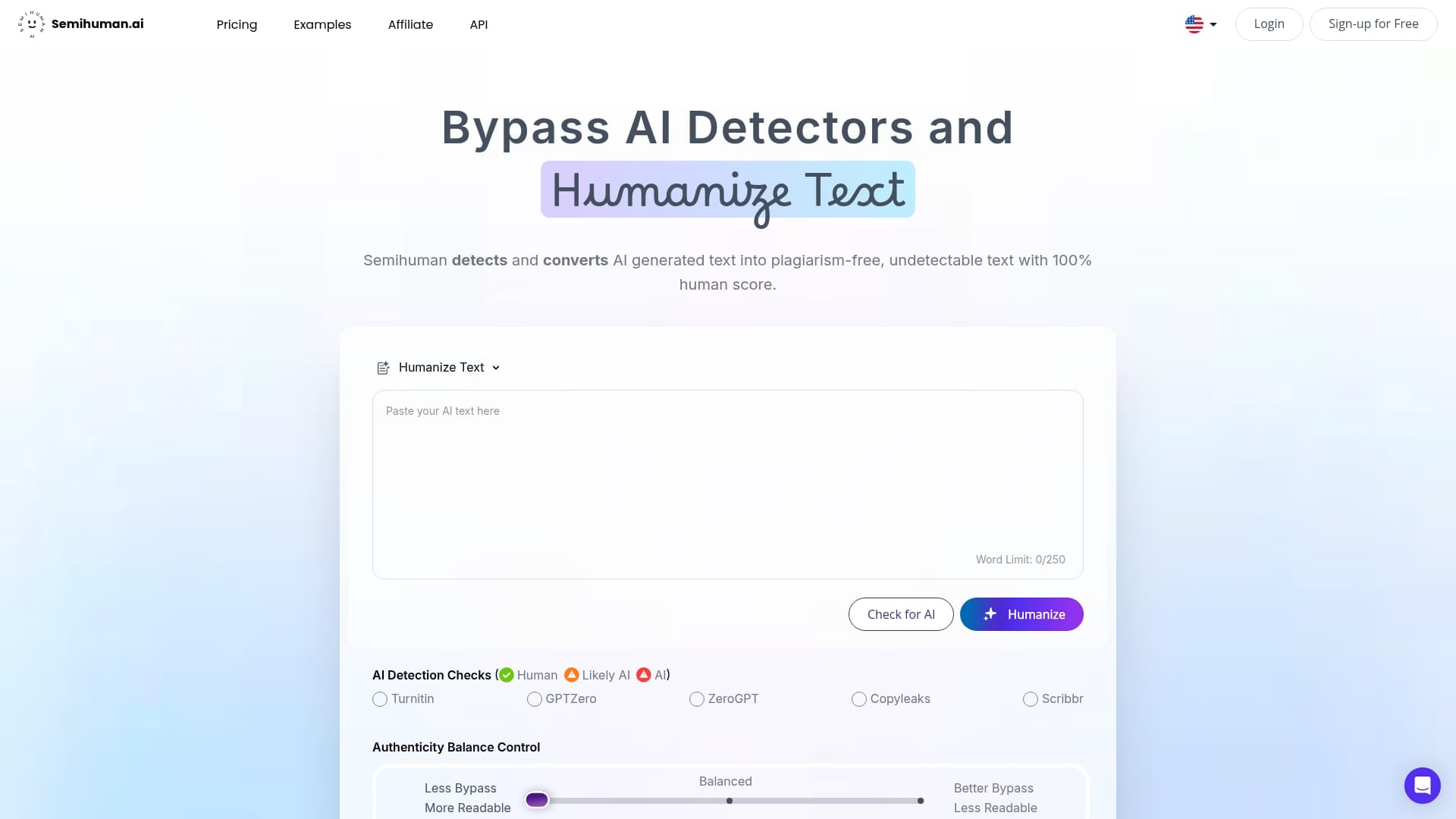
Semihuman is purpose-built for exactly this workflow. The platform combines AI detection testing, E-E-A-T-aligned text restructuring, and humanization tools so your content clears both algorithmic and human review. Use the SEO text generator to build out drafts that are already structured for search visibility. Run your content through tools designed to bypass AI detectors before publishing. And for teams that need to produce content at scale without sacrificing authenticity, AI proof writing gives you the layer of polish that separates forgettable output from content that actually ranks and converts.
An AI content penalty occurs when search engines identify and demote low-quality, automatically-generated content based on signals like thinness, rapid volume, and lack of originality. Scaled abuse of 50+ thin pages per week is a direct trigger for these penalties.
No. Paraphrasing alone doesn't add real value or satisfy E-E-A-T requirements. Reviewers and raters look for genuine experience, expertise, and trustworthiness, which paraphrasing cannot manufacture.
Run your content through AI detection tools like GPTZero or Originality.ai and monitor Google Search Console for manual actions or index drops. Quality rater guidelines warn that majority AI content without demonstrable value risks the lowest rating scores.
Not on its own. Human review only protects you when the reviewer actively adds real-world expertise, specific examples, and verifiable claims. Human oversight plus value addition is the combination that avoids penalties, not review alone.
No. Human-written thin content is also penalized under the same quality guidelines. The issue has never been the tool used to write the content. It's always been the quality of what gets published.


Start
Humanizing
for Free!
Humanize