
Loading...

More than 90 percent of American content marketers now rely on artificial intelligence for at least part of their workflow. This rapid adoption is transforming digital publishing, but it also brings a new challenge—making AI-generated text sound truly human. As search engines get smarter at detecting robotic language, mastering advanced humanization techniques is becoming the key for American professionals who want to improve authenticity, audience engagement, and search rankings.
| Point | Details |
|---|---|
| Embrace AI as a Collaborative Tool | Content creators should view AI as a partner to enhance creativity, utilizing its strengths while maintaining their unique voice. |
| Focus on Humanization Techniques | Employ advanced methods to add emotional depth and authenticity to AI-generated content, ensuring it resonates with readers. |
| Adhere to SEO Best Practices | Develop content that satisfies Google's E-E-A-T guidelines by embedding authenticity and emotional engagement throughout. |
| Implement Rigorous Review Processes | Establish thorough validation protocols to identify and correct potential AI-generated artifacts to maintain content integrity. |
Content writing is undergoing a radical transformation driven by artificial intelligence, reshaping how professionals create, distribute, and optimize digital narratives. As generative technologies advance, writers must adapt to an environment where human creativity and machine efficiency converge. The future of content writing will not be about replacing human authors, but about augmenting human capabilities through intelligent writing technologies.
The emerging landscape presents both exciting opportunities and significant challenges. AI technologies are now capable of generating initial drafts, suggesting structural improvements, and providing data-driven insights that can dramatically enhance content quality. However, the most successful content creators will be those who view AI as a collaborative tool rather than a replacement. Authenticity remains the critical differentiator, with human emotional intelligence, nuanced storytelling, and contextual understanding serving as irreplaceable elements that machines cannot fully replicate.
Advanced content writing will increasingly require a hybrid approach that blends technological efficiency with human creativity. Writers will need to develop new skills focused on prompt engineering, AI editing, and strategic content curation. This means learning to work alongside AI systems, understanding their capabilities and limitations, while maintaining a distinctive voice that resonates with human readers. The boundaries between human and machine-generated content are becoming increasingly blurred, creating both unprecedented opportunities and ethical considerations for content professionals.
Pro tip: Invest time in learning AI writing tools and develop a collaborative workflow that enhances your unique creative strengths rather than attempting to compete with or completely rely on AI technologies.
The rise of artificial intelligence has fundamentally transformed content creation, introducing complex challenges in generating text that feels authentically human. Advanced Natural Language Generation models are now capable of producing sophisticated content that requires strategic humanization techniques to bridge the gap between machine-generated and human-written text. These techniques go beyond simple word substitution, involving intricate strategies that simulate human communication patterns, emotional nuance, and contextual understanding.
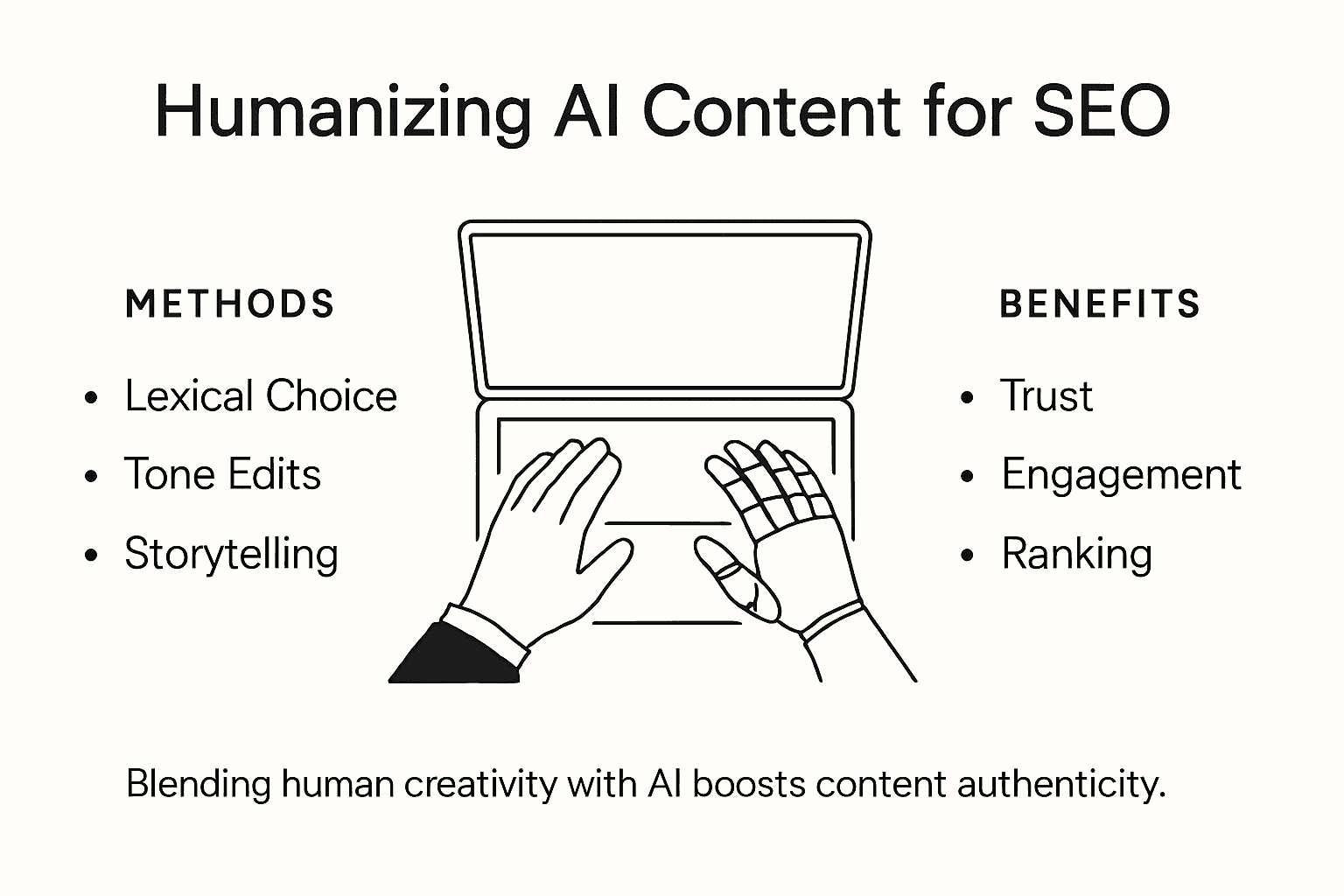
Humanization methods have emerged as a critical approach to enhancing AI-generated content. These techniques include lexical substitution, syntactic restructuring, and introducing controlled imperfections that mimic natural human writing variations. Researchers are developing sophisticated approaches to simulate human-like text generation by incorporating subtle linguistic variations, emotional context, and intentional stylistic inconsistencies. The goal is not to create perfectly uniform text, but to introduce organic variations that make AI-generated content feel more natural and engaging.
Successful content creators are now adopting a nuanced approach to AI content generation, focusing on collaborative workflows that leverage AI capabilities while maintaining human creativity. This involves using AI tools for initial drafting, research compilation, and structural suggestions, but ultimately applying human judgment to refine tone, emotional resonance, and contextual appropriateness. Techniques like style transfer and controlled imperfection introduction are becoming increasingly sophisticated, allowing writers to transform algorithmic outputs into compelling, authentic narratives that resonate with readers.
Pro tip: Develop a systematic review process for AI-generated content that involves multiple editing passes, focusing on introducing subtle variations in sentence structure, vocabulary choice, and emotional tone to enhance authenticity.
Here's a comparison of key humanization methods used to transform AI-generated content:
| Method | Main Purpose | Typical Application | Result |
|---|---|---|---|
| Lexical substitution | Add vocabulary diversity | Replacing words or phrases | More natural language feel |
| Syntactic restructuring | Vary sentence structure | Rewriting sentences | Reduced robotic patterns |
| Controlled imperfection | Simulate human-like mistakes | Minor errors introduced | Increased authenticity |
| Style transfer | Match specific tones or voices | Adjust voice to audience | Enhanced reader connection |
In the evolving digital landscape, search engine optimization demands more than algorithmic keyword manipulation. Humanizing AI-generated content has become crucial for meeting Google's stringent E-E-A-T guidelines, which prioritize Experience, Expertise, Authoritativeness, and Trustworthiness. This means content creators must transform machine-generated text into nuanced, contextually rich narratives that demonstrate genuine human insight and emotional intelligence.
The core of successful SEO now revolves around content authenticity and reader engagement. Search engines have become increasingly sophisticated in detecting and ranking content based on its perceived human quality. This requires a strategic approach that goes beyond simple keyword insertion, focusing instead on creating narratives that resonate with human readers. Techniques like incorporating personal anecdotes, using conversational language, and demonstrating deep subject matter understanding can significantly improve both search rankings and audience connection.

Successful content strategies now integrate comprehensive humanization techniques that transform algorithmic outputs into compelling, trustworthy narratives. This involves multi-stage editing processes that carefully introduce contextual nuances, emotional depth, and stylistic variations that make AI-generated content feel authentically human. Writers must develop skills in detecting and refining machine-generated text, ensuring that each piece maintains a unique voice, demonstrates genuine expertise, and provides real value to readers.
Pro tip: Create a detailed editing checklist that focuses on introducing human elements like personal perspectives, contextual examples, and conversational transitions to transform AI-generated drafts into engaging, authentic content.
The emerging landscape of AI content generation has sparked critical discussions about detection mechanisms and regulatory compliance. Regulatory frameworks like the EU AI Act are increasingly mandating transparent provenance authentication and robust detection protocols for AI-generated content, creating a complex environment where content creators must balance technological innovation with ethical transparency.
Technical vulnerabilities in current AI detection systems have created sophisticated evasion strategies that challenge traditional verification methods. Researchers have demonstrated multiple approaches to manipulate AI-generated text detection through strategic paraphrasing and minor linguistic perturbations, revealing significant weaknesses in existing algorithmic verification processes. These techniques involve nuanced modifications that can effectively mask machine-generated origins while maintaining the core informational content.
Compliance with emerging regulations requires a multifaceted approach that goes beyond simple detection evasion. Content creators must develop sophisticated strategies that prioritize authenticity, transparency, and ethical content generation. This involves implementing comprehensive review processes, introducing human-like variations, and maintaining a clear understanding of evolving legal and technological landscapes. Platforms focused on humanizing AI content are becoming critical tools in navigating these complex regulatory environments, offering advanced techniques to transform algorithmic outputs into compliant, engaging content.
Pro tip: Develop a robust documentation process that tracks the origin and modification of AI-generated content, ensuring transparency and compliance with emerging regulatory standards.
Human-centered artificial intelligence frameworks are revolutionizing content creation by establishing collaborative workflows that maximize both computational efficiency and creative intelligence. These emerging approaches recognize that effective collaboration requires understanding the unique strengths of both human creativity and AI computational power, creating synergistic processes that transcend traditional content production methods.
Successful hybrid workflows depend on strategic task allocation and adaptive interfaces that enable seamless human-AI interaction. Different content creation stages demand varying levels of human intervention, with AI excelling at tasks like initial research compilation, data analysis, and structural drafting, while humans provide critical elements of emotional nuance, contextual understanding, and creative interpretation. Organizations are developing systematic frameworks to evaluate and optimize collaboration levels, ensuring that human oversight complements AI automation, particularly in complex decision-making scenarios.
The most effective content teams are now adopting iterative collaboration models that treat AI as an intelligent assistant rather than a replacement. This involves creating feedback loops where human editors continuously refine and personalize machine-generated drafts, introducing subtle variations, emotional depth, and authentic storytelling elements. By leveraging advanced AI writing tools designed for creators, professionals can develop sophisticated workflows that dramatically improve content quality, efficiency, and originality.
Pro tip: Implement a structured review process where AI-generated content undergoes multiple human editing passes, focusing on introducing contextual nuance, emotional resonance, and unique narrative perspectives.
AI content creation introduces complex ethical and practical challenges that demand rigorous oversight and strategic mitigation strategies, requiring content professionals to develop sophisticated approaches to managing potential pitfalls. Understanding these risks is crucial for maintaining content integrity, authenticity, and professional standards in an increasingly AI-driven digital landscape.
Key risks include significant credibility challenges that arise from unchecked AI-generated content. Common mistakes in AI content creation encompass tone inconsistencies, robotic language, fact-checking negligence, and audience misalignment, which can dramatically undermine content effectiveness. Professionals must be vigilant about implementing comprehensive review processes that address these potential weaknesses, ensuring that AI-generated drafts are thoroughly vetted for accuracy, emotional resonance, and contextual appropriateness.
The following table summarizes common risks in AI-assisted content creation and effective preventive actions:
| Risk | Example Issue | Preventive Action |
|---|---|---|
| Tone inconsistency | Mixed formal and informal style | Standardize voice in editing process |
| Robotic language | Unnatural or flat wording | Add idioms and expressive phrases |
| Fact-checking negligence | Inaccurate data or claims | Verify sources before publishing |
| Audience misalignment | Irrelevant content or style | Research audience needs thoroughly |
The most critical limitations center on AI's current inability to fully replicate human nuance, emotional intelligence, and contextual understanding. While AI excels at generating structured content and processing vast amounts of information, it fundamentally lacks the subtle interpretive capabilities that humans bring to communication. Content creators can leverage advanced AI writing tools designed to support human creativity, but must remain aware that these tools are collaborative assistants, not autonomous content producers capable of truly original storytelling.
Pro tip: Develop a strict validation protocol that includes multiple human review stages, focusing on identifying and eliminating AI-generated content artifacts, ensuring authenticity, emotional depth, and genuine audience connection.
The article highlights the growing challenge content creators face in blending AI efficiency with genuine human creativity. Key pain points include maintaining authenticity, improving SEO rankings through enriched humanized content, and evading AI detection tools without compromising quality. Terms like content humanization, detection evasion, and hybrid workflows illustrate the complexity of generating engaging, trustworthy narratives that resonate with readers and search engines alike.
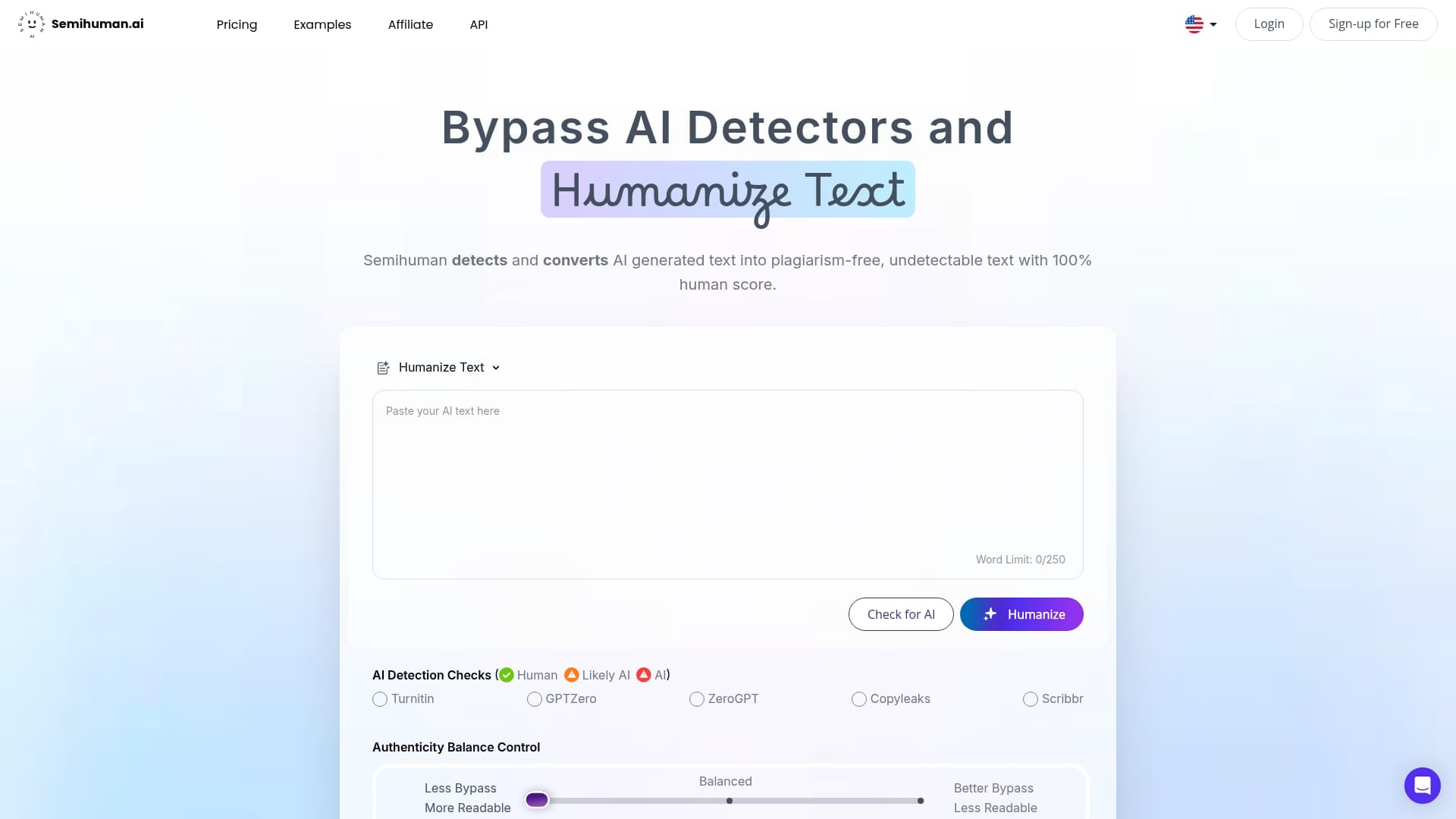
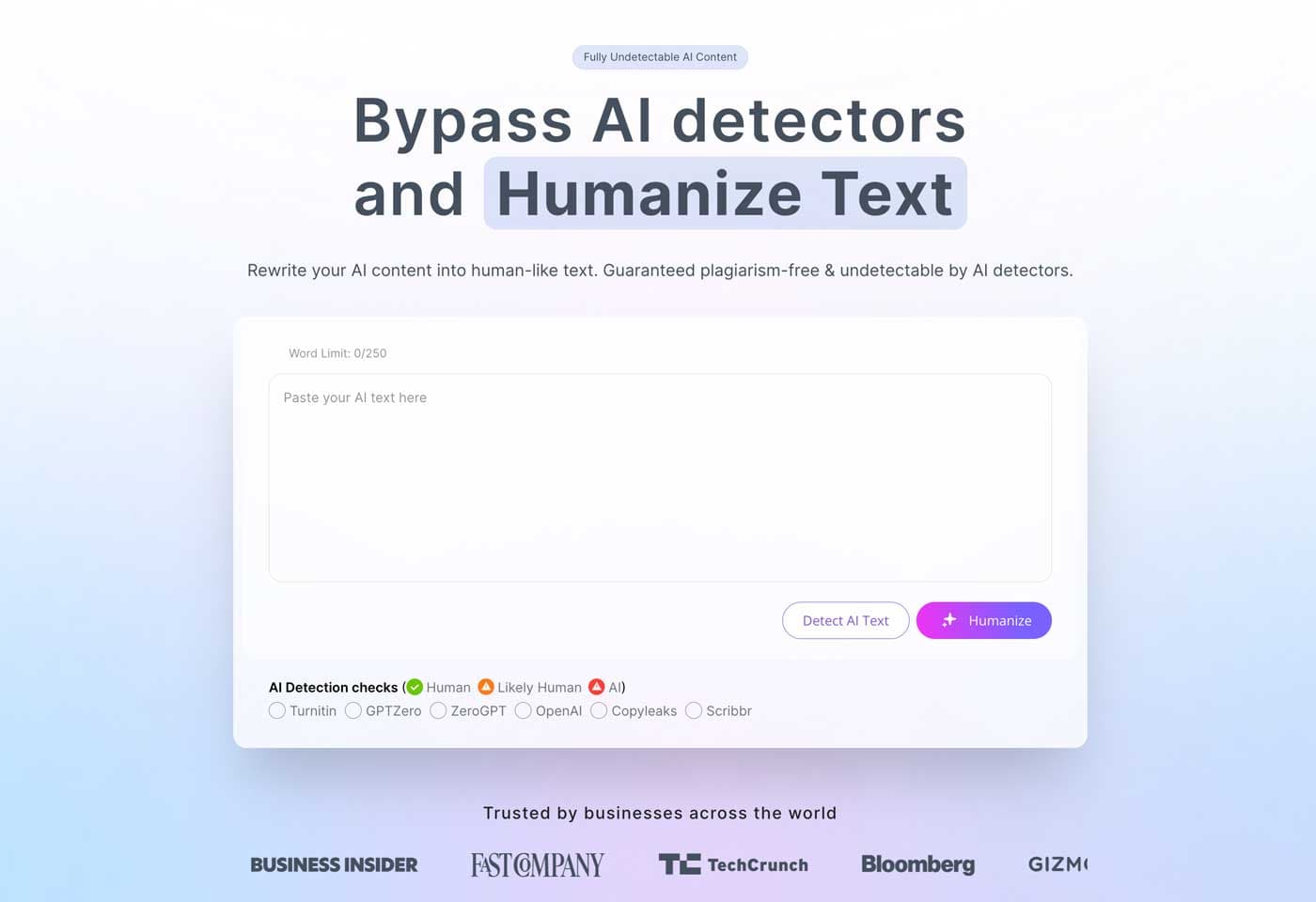
If you are grappling with these challenges, Semihuman.ai offers the perfect solution to transform AI-generated drafts into naturally human-like content. Our platform excels at text restructuring, keyword integration, and strategic detection evasion to help your content remain authentic and competitive in digital spaces. Explore how Semihuman.ai works to ensure your writing reflects true human insight while fully complying with today’s SEO demands.
Ready to enhance your content’s authenticity and outrank competitors now? Visit Semihuman.ai to start humanizing your AI-generated text and unlock the full potential of hybrid content creation. Don’t let your SEO efforts fall short — act today and experience the future of content writing firsthand.
AI is transforming content writing by enhancing productivity and creativity, enabling writers to generate initial drafts, make structural improvements, and provide data-driven insights that improve content quality. Writers now collaborate with AI tools to augment their capabilities while maintaining their unique voice.
Humanization methods include techniques such as lexical substitution, syntactic restructuring, and introducing controlled imperfections. These strategies help make AI-generated text feel more natural and engaging, by mimicking human communication patterns and emotional nuance.
Content authenticity is crucial for SEO because search engines prioritize high-quality content that resonates with readers. By humanizing AI-generated content, creators can align more closely with Google's E-E-A-T guidelines, resulting in better search rankings and improved audience connection.
Key risks include credibility challenges, tone inconsistencies, and factual inaccuracies in AI-generated content. It is important for content creators to implement thorough review processes and validation protocols to ensure authenticity and maintain professional standards.


Start
Humanizing
for Free!
Humanize