
Loading...

Most American content marketers would be surprised to learn that nearly 60 percent of high-performing campaigns in 2025 will rely on seamless collaboration between human writers and artificial intelligence. Staying ahead means more than tweaking keywords or scanning analytics. As AI detectors evolve, the real challenge is building content that feels both genuinely personal and positioned for top search engine results. This guide delivers actionable strategies to help your campaigns thrive while bypassing detection and maintaining true authenticity.
| Point | Details |
|---|---|
| Collaboration with AI | Content writers will work alongside AI, using it as a tool to enhance creativity and efficiency rather than replace it. |
| Focus on Authenticity | Successful content will prioritize authentic storytelling that resonates emotionally with the audience, moving beyond purely algorithmic generation. |
| Importance of Compliance | Creators must navigate complex regulatory frameworks while maintaining ethical standards in data usage and content originality. |
| Evolving SEO Practices | Modern SEO will emphasize genuine value and contextual relevance, requiring engagement with audience needs and cultural nuances. |
Content writing in 2025 emerges as a sophisticated dance between human creativity and artificial intelligence, where authentic storytelling takes center stage. The landscape is transforming rapidly, with writers no longer competing against AI but collaborating strategically to produce more nuanced, engaging content. Emerging trends show AI becoming a key writing partner, amplifying human potential rather than replacing creative professionals.
The new content writing paradigm demands a multifaceted approach. Writers must develop skills that transcend traditional writing, incorporating advanced research capabilities, deep audience understanding, and the ability to leverage AI tools effectively. This means moving beyond simple text generation to creating narratives that resonate emotionally, provide unique perspectives, and deliver genuine value. Successful content creators will distinguish themselves through original insights, contextual intelligence, and the capacity to craft experiences that feel authentically human.
Technology will play a critical role in this evolution, but not in the way many initially predicted. Instead of AI completely automating content creation, we're witnessing a collaborative model where technology enhances human capabilities. Writers will use advanced tools for research, optimization, and initial drafting, while maintaining ultimate creative control. The focus shifts from volume to quality, from generic information to personalized, meaningful communication that builds genuine connections with audiences.
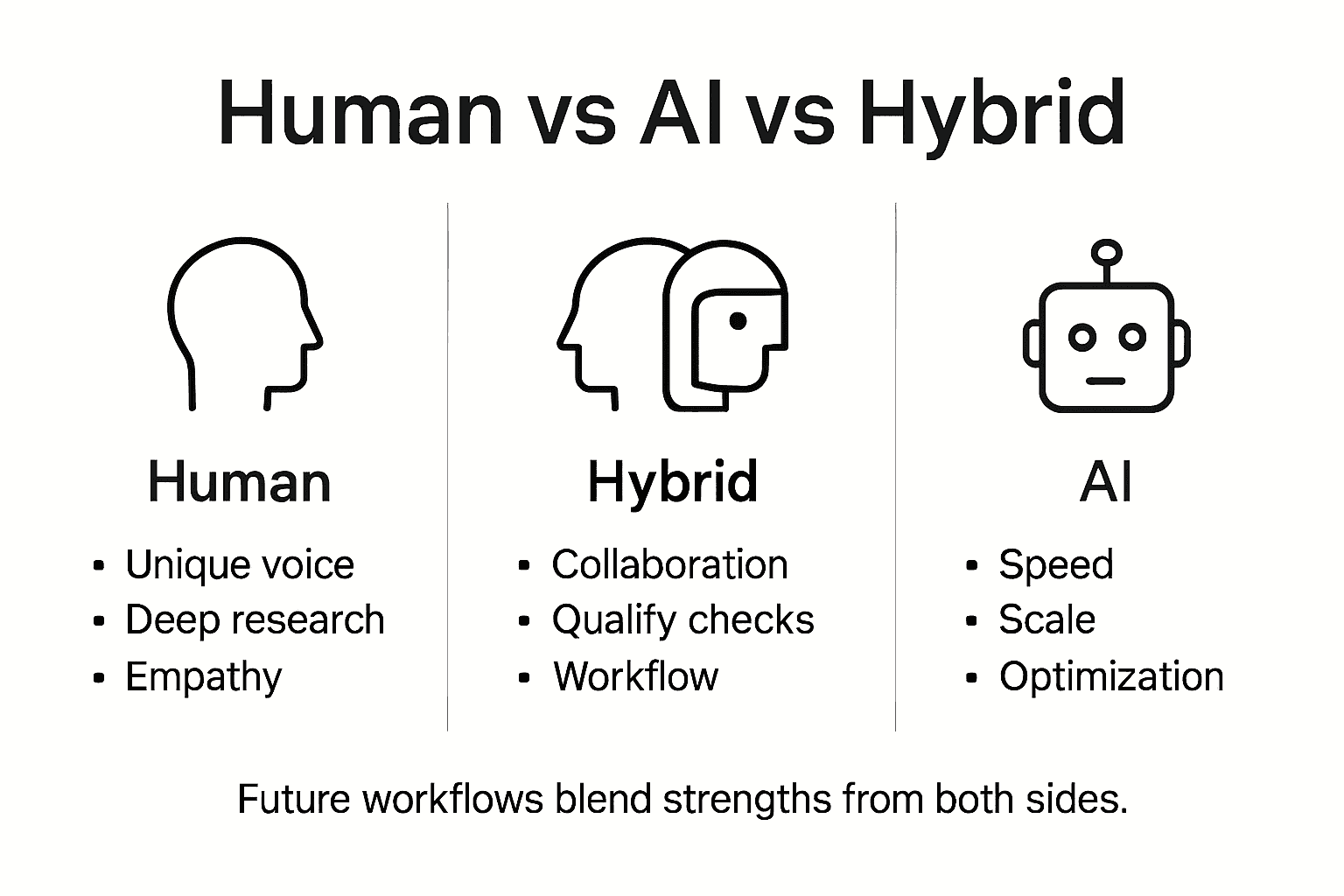
Here's a quick comparison of how AI and human writers contribute to future content creation:
| Aspect | Human Writers | Artificial Intelligence | Hybrid Collaboration |
|---|---|---|---|
| Creativity | Original insights, emotion | Pattern recognition, speed | Nuanced narratives |
| Efficiency | Time-intensive | Rapid production | Balanced productivity |
| Personalization | Deep audience understanding | Data-driven customization | Enhanced relevance |
| Quality Control | Manual review | Automated optimization | Combined oversight |
Pro tip: Invest time in developing your unique voice and perspective, as these will become your most valuable assets in an increasingly AI-influenced content landscape.
The content writing landscape in 2025 demands a strategic approach that harmonizes technological capabilities with deeply human storytelling. Content strategies are shifting toward creating personalized experiences that balance AI efficiency with genuine emotional resonance, pushing creators to develop more nuanced and intelligent content production methods.
Authenticity has emerged as the cornerstone of successful digital content. Writers must now craft narratives that transcend algorithmic generation, incorporating unique perspectives and emotional depth that cannot be replicated by artificial intelligence. This means developing contextual intelligence - the ability to understand audience needs, cultural nuances, and subtle communication dynamics that transform generic information into compelling, memorable experiences.
Search engine optimization remains critical, but the methodology has transformed dramatically. Modern SEO demands content that provides genuine value, integrates strategically placed keywords without sacrificing readability, and demonstrates substantive information gain. AI-generated content must be carefully blended with human insights to avoid potential search engine penalties, creating a delicate balance between technological efficiency and authentic storytelling.

Pro tip: Develop a content creation workflow that treats AI as a collaborative tool, not a replacement, focusing on using technology to enhance your unique creative perspective.
Recent research into AI detection technologies reveals a rapidly evolving landscape where sophisticated detection and evasion methods are locked in a constant technological arms race. AI text detectors are becoming increasingly complex, attempting to distinguish between human-generated and machine-produced content with ever-increasing precision. However, these systems are not infallible, with significant vulnerabilities that content creators can strategically navigate.
The detection evasion landscape has grown dramatically more nuanced, moving beyond simple word substitution to more advanced techniques. Advanced paraphrasing methods now employ sophisticated algorithms that preserve semantic meaning while systematically avoiding detection triggers. Reinforcement learning techniques like AuthorMist demonstrate remarkable capabilities in rewriting AI-generated text, essentially creating a new generation of adaptive content transformation tools that can effectively mask machine-originated text.
Understanding these detection mechanisms requires recognizing their fundamental limitations. Current AI detectors rely on statistical patterns, writing consistency, and complex machine learning models to identify artificially generated content. However, these systems struggle with contextual nuance, emotional resonance, and the subtle variations that distinguish truly authentic human writing. Content creators must focus on developing strategies that introduce genuine human elements - unexpected word choices, contextually rich examples, and writing that reflects personal experience and emotional depth.
Pro tip: Develop a multi-layered content creation approach that uses AI as a collaborative tool while intentionally introducing uniquely human elements that cannot be easily replicated by algorithms.
Strategic role-based workflows are transforming content creation, establishing a dynamic partnership where artificial intelligence and human creativity complement each other's strengths. The emerging model distinguishes between tasks best suited for AI's computational power and those requiring nuanced human intelligence, creating a synergistic approach that maximizes productivity and maintains authentic storytelling.
Successful hybrid workflows require clear delineation of responsibilities. Intelligent task allocation becomes crucial, with AI handling data gathering, initial draft generation, and technical optimization, while humans focus on strategic direction, emotional resonance, and creative refinement. This approach allows content creators to leverage AI's efficiency without sacrificing the unique perspectives and contextual understanding that only human writers can provide.
Effective collaboration demands transparent documentation and consistent quality standards, ensuring that AI-assisted content maintains brand voice and authenticity. Content teams must develop robust frameworks that treat AI as a powerful assistive tool, not a replacement. This means creating review processes that allow human editors to inject personality, verify factual accuracy, and ensure the final product reflects genuine human insight and creativity.
Pro tip: Develop a flexible content workflow that treats AI as a collaborative assistant, establishing clear checkpoints where human creativity and oversight can transform initial drafts into truly compelling narratives.
Emerging regulatory landscapes are transforming content creation compliance, introducing unprecedented challenges for digital creators navigating complex legal frameworks. The year 2025 demands a sophisticated approach to understanding and mitigating potential risks associated with AI-generated content, data protection, and intellectual property standards. Content professionals must develop a proactive strategy that balances technological innovation with stringent legal and ethical requirements.
The compliance landscape has become increasingly intricate, particularly for creators utilizing AI technologies. Regulatory frameworks now scrutinize content generation processes, requiring transparent documentation of AI involvement, potential bias mitigation, and adherence to evolving intellectual property guidelines. This means creators must implement robust verification processes that demonstrate the originality of their work, maintain clear audit trails, and ensure that AI tools are used as collaborative assistants rather than autonomous content generators.
Key compliance considerations extend beyond traditional legal boundaries, encompassing ethical AI usage, data privacy, and content authenticity. Content creators must develop comprehensive strategies that address potential risks such as unintentional plagiarism, algorithmic bias, and potential violations of intellectual property rights. This requires continuous education, staying updated with emerging regulations, and implementing sophisticated review mechanisms that validate the integrity of AI-assisted content production.
For creators, here are core compliance risks and their mitigation strategies:
| Compliance Risk | Example Challenge | Mitigation Strategy |
|---|---|---|
| Data Privacy | Handling user data | Implement strict access controls |
| Intellectual Property | Attribution uncertainty | Maintain transparent audit trails |
| Algorithmic Bias | Skewed content suggestions | Regular bias audits |
| Plagiarism Detection | Unintentional duplication | Employ originality verification |
Pro tip: Develop a comprehensive compliance checklist that includes AI tool documentation, content origin verification, and regular ethical audits to proactively manage potential legal and reputational risks.
The future of content writing demands more than just generating words quickly. As the article highlights, the challenge lies in balancing AI efficiency with authentic human storytelling that resonates emotionally and bypasses growing AI detection systems. Creators face pain points like maintaining originality, avoiding plagiarism flags, and seamlessly blending AI assistance with genuine personal insight. Terms such as "humanization," "detection evasion," and "hybrid workflows" emphasize the need for a tool tailored to preserving the natural voice that search engines and audiences crave.
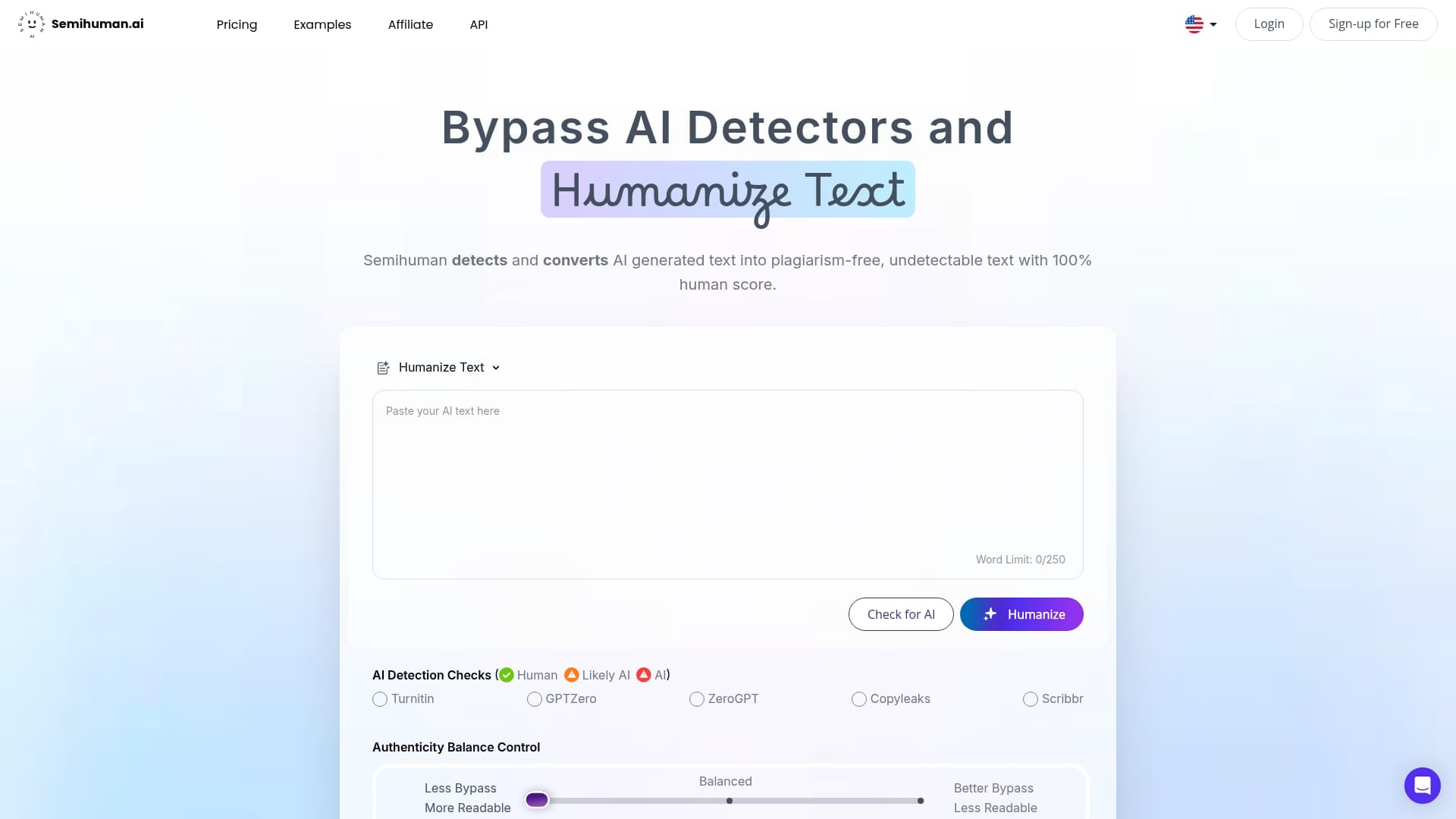
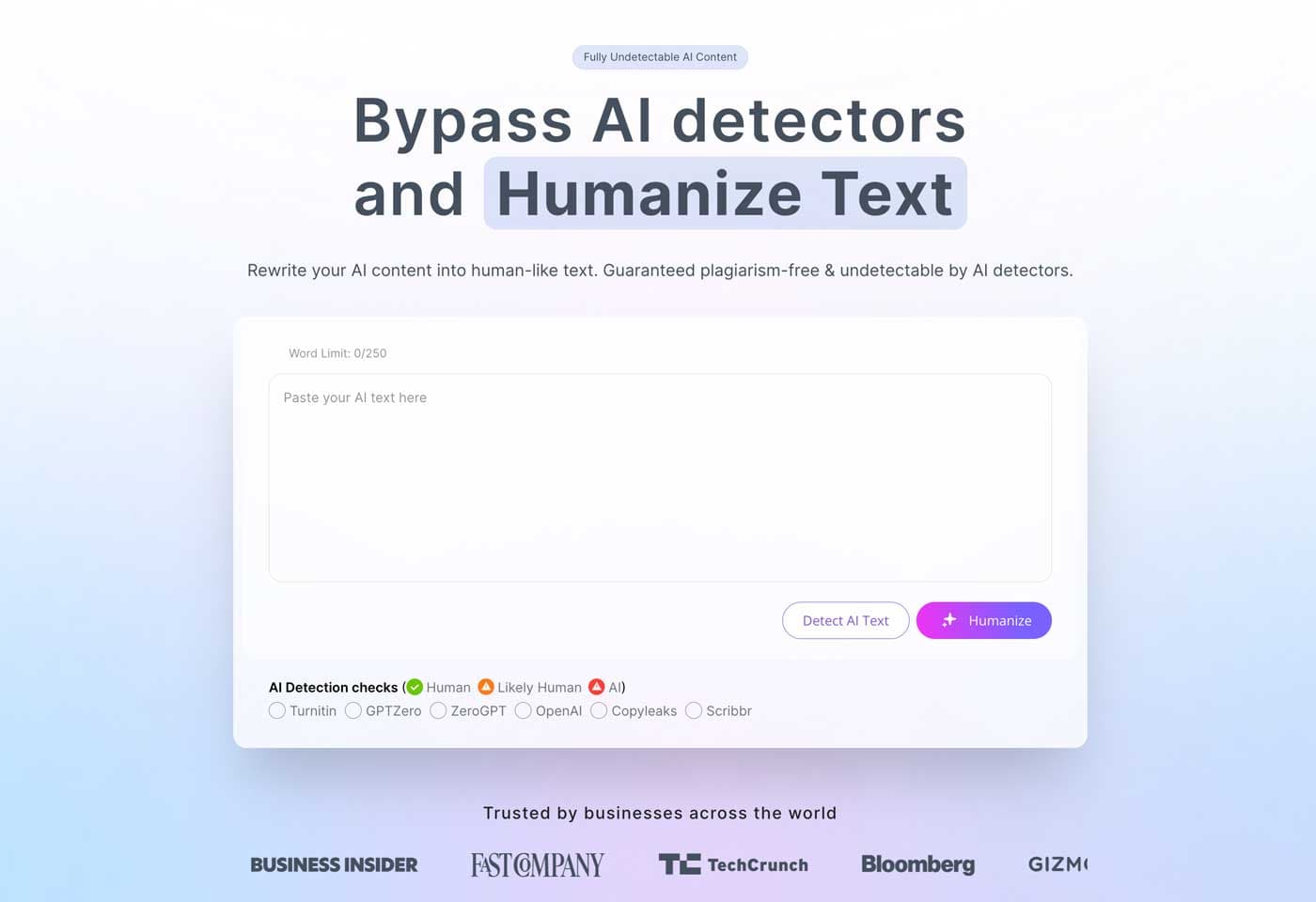
Semihuman.ai is crafted specifically to address these modern challenges. Our AI-powered platform transforms machine-generated text into fully humanized content that naturally integrates keyword strategies and passes AI detection tools like Turnitin, GPTZero, and Copyleaks. Whether you are focused on content creation, SEO optimization, or maintaining compliance with evolving digital regulations, our solutions ensure your work reflects authentic creativity and emotional depth.
Experience firsthand how simple it can be to bridge the gap between technology and true human expression with Semihuman.ai’s intuitive platform and its powerful humanization features.
Turn the battle for authenticity into your competitive advantage today.
Ready to humanize your AI content without sacrificing quality or compliance?
Explore the future of content writing with Semihuman.ai now and start crafting content that truly connects and ranks.
Content writing in 2025 will focus on the collaboration between human creativity and AI technology, aiming to create authentic storytelling that resonates emotionally with audiences.
AI will enhance content writing by serving as a tool for research, optimization, and initial drafting, enabling writers to focus on creating nuanced, high-quality narratives rather than generating text alone.
Writers will need to cultivate advanced research abilities, a deep understanding of their audience, and proficiency in using AI tools effectively while maintaining their unique voice and perspective.
Writers can ensure authenticity by incorporating personal experiences, emotional resonance, and unique perspectives that AI cannot replicate, thereby producing compelling and genuine narratives.



Start
Humanizing
for Free!
Humanize