
Loading...

Content creators face a tricky challenge every day: knowing when they are stating a fact versus sharing an opinion. This confusion can damage your credibility, mislead your audience, and undermine trust in your brand. Many writers blend facts and opinions without realizing it, creating content that feels uncertain or biased. Understanding how to clearly distinguish between verifiable statements and subjective judgments is essential for producing authentic, trustworthy content. This guide will walk you through clear definitions, practical identification methods, nuanced scenarios, and actionable strategies to master this critical skill and elevate your writing.
| Point | Details |
|---|---|
| Objective facts versus subjective opinions | Facts are verifiable statements backed by evidence, while opinions express personal beliefs or judgments. |
| Language cues reveal the difference | Neutral verbs and specific data signal facts, whereas evaluative adjectives and modal phrases indicate opinions. |
| Context matters in edge cases | Modifiers and bias can blur lines, requiring careful analysis to avoid confusion. |
| Balance builds credibility and engagement | Integrating verifiable facts with informed opinions creates authentic, persuasive content. |
| Clear labeling prevents misinformation | Distinguishing and marking opinions protects your reputation and audience trust. |
Knowing the difference between facts and opinions starts with understanding their core definitions. Facts are verifiable statements using objective language/04%3A_Responding_to_a_Text/4.03%3A_Distinguishing_Between_Fact_and_Opinion), neutral verbs, and specific data that can be proven true or false through evidence. Opinions, on the other hand, are subjective statements expressing beliefs, feelings, or judgments that cannot be objectively verified. The language you use reveals whether you are presenting a fact or an opinion, and recognizing these cues is the first step toward authentic writing.
Facts rely on neutral, descriptive verbs like "is," "shows," "indicates," or "measures." They include specific numbers, dates, names, or other concrete details that anyone can verify through research or observation. For example, "The global content marketing industry reached $42 billion in 2026" is a fact because you can confirm the figure through reliable sources. Opinions, however, use evaluative adjectives and adverbs such as "best," "worst," "should," "amazing," or "terrible." They often include phrases like "I believe," "in my view," or "it seems," signaling personal judgment rather than objective reality.
Understanding these linguistic markers helps you quickly identify whether a statement is factual or opinion-based. When you see words like "alarming," "impressive," or "unfortunate," you are likely reading an opinion. When you encounter phrases such as "research demonstrates" followed by specific data, you are dealing with a fact. This distinction matters because mixing the two without clarity can confuse your readers and weaken your content originality for marketers. Recognizing language cues allows you to write with precision and transparency.
Pro Tip: Create a quick reference list of neutral verbs and evaluative words. Keep it handy while writing to catch subjective language before it slips into your factual claims.
Here are common language patterns that distinguish facts from opinions:
For more guidance on identifying objective versus subjective language, check out this fact or opinion guide that breaks down the mechanics further.
Once you understand the definitions and language cues, you need practical methods to analyze your content systematically. Identifying objective versus subjective language, spotting neutral versus evaluative verbs, and recognizing qualifiers like "I believe" or "alarming" as opinion markers are core mechanics. Methodologies such as language analysis, evidence verification, and context evaluation give you structured frameworks to distinguish facts from opinions reliably. One powerful approach is the ESCAPE framework, which stands for Evidence, Source, Context, Audience, Purpose, and Execution.
The ESCAPE framework provides a comprehensive checklist for evaluating any statement. Start by examining the Evidence: does the claim cite data, research, or verifiable sources? Next, assess the Source: is it credible, authoritative, and unbiased? Then consider the Context: does the statement fit within a larger body of knowledge or is it isolated? Think about the Audience: who is the content aimed at, and does that shape the language used? Evaluate the Purpose: is the goal to inform, persuade, or entertain? Finally, review the Execution: does the writing use neutral language and avoid loaded terms? Applying this framework helps you catch subtle opinion markers that might otherwise go unnoticed.
Using qualifiers and modal phrases is another key mechanic. Words like "might," "could," "possibly," "arguably," or "in my opinion" signal uncertainty or subjectivity. When you see these terms, you are reading an opinion or a hedged statement rather than a definitive fact. Similarly, intensifiers such as "extremely," "incredibly," or "absolutely" often indicate evaluative judgment. By training yourself to spot these linguistic patterns, you can quickly separate factual claims from personal viewpoints. This skill is essential for maintaining a content authenticity checklist for marketers and ensuring your audience trusts your message.

Pro Tip: When editing your drafts, highlight every adjective and adverb. Ask yourself whether each one adds objective detail or subjective judgment. Replace evaluative words with neutral alternatives or support them with evidence.
Follow these steps to systematically identify facts and opinions in your content:
The table below summarizes key markers to help you quickly distinguish facts from opinions:
| Marker Type | Fact Indicators | Opinion Indicators |
|---|---|---|
| Verbs | Neutral (is, shows, measures) | Evaluative (believe, feel, think) |
| Language | Objective, specific, data-driven | Subjective, vague, judgment-based |
| Evidence | Citable sources, verifiable data | Personal experience, anecdotal claims |
| Qualifiers | Rare or absent | Common (might, could, arguably) |
| Descriptors | Neutral adjectives | Evaluative adjectives (best, worst) |
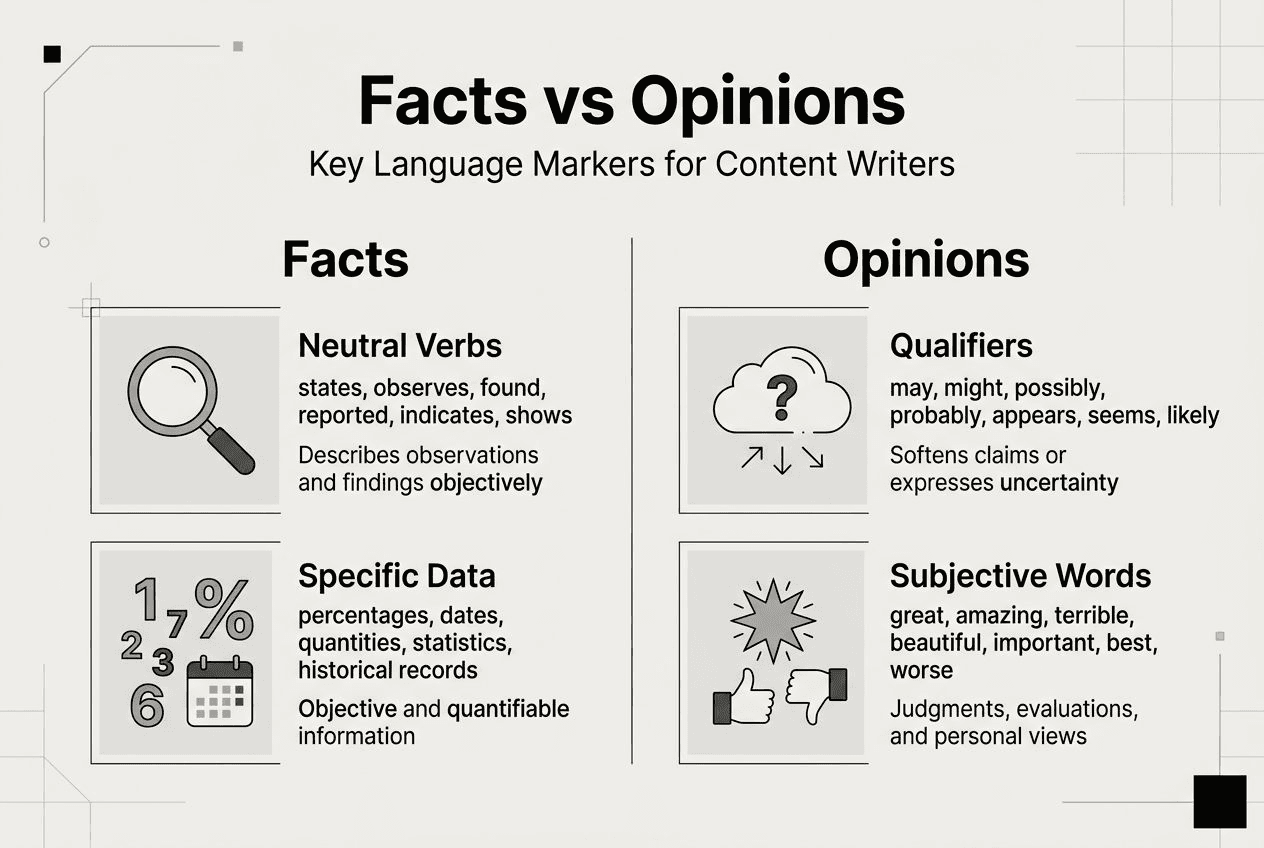
For deeper insights into verifying content accuracy, explore strategies in fact checking ai-assisted reports reliable content to ensure your writing meets high standards.
Real-world content is rarely black and white. You will encounter statements that blend factual elements with subjective interpretation, making them harder to categorize. Modifiers are context-dependent, facts can seem unbelievable due to bias, and persuasive writing often mixes fact and opinion intentionally. Understanding these nuances helps you navigate gray areas without compromising your credibility. Recognizing edge cases ensures you do not inadvertently mislead your audience or weaken your content's authenticity.
Consider the word "significant." In a scientific context, "significant" has a precise statistical meaning, making it factual. In everyday language, "significant" often expresses subjective judgment, making it an opinion. Similarly, a statement like "Climate change is accelerating" can be factual when supported by scientific data or opinion-based when used to express alarm without evidence. Context determines whether a modifier serves as objective description or subjective evaluation. You must analyze the surrounding language and verify the claim to make the right call.
Bias presents another challenge. When facts contradict your audience's beliefs, they may dismiss them as opinions or misinformation. For example, stating "Vaccination rates increased by 15% in 2026" is a verifiable fact, but readers with strong anti-vaccine views might perceive it as biased opinion. This phenomenon shows why clear citation and neutral language are critical. Presenting facts with transparency and credible sources helps overcome bias-driven skepticism. Avoid content marketing mistakes seo authenticity by ensuring your factual claims are well-documented and presented without loaded language.
Blending facts and opinions is common in persuasive writing, especially in marketing and journalism. A sentence like "Our product increased sales by 30%, making it the best choice for your business" combines a verifiable fact (30% increase) with an opinion (best choice). While this technique can be effective, it risks confusing readers if not clearly distinguished. You should separate factual claims from evaluative statements or use qualifiers to signal opinion. Transparency maintains trust and prevents your content from appearing manipulative or misleading.
Pro Tip: When writing persuasive content, structure your arguments so facts come first to establish credibility, then layer in opinions clearly marked as your perspective or recommendation.
Here are common edge cases where facts and opinions overlap:
The table below contrasts typical examples with nuanced scenarios to illustrate these complexities:
| Scenario | Typical Example | Nuanced Example |
|---|---|---|
| Clear fact | "The report contains 50 pages." | "The report is significantly longer than average." (context-dependent) |
| Clear opinion | "This is the best marketing tool." | "This tool increased ROI by 25%, making it highly effective." (fact + opinion) |
| Neutral language | "Sales increased by 20%." | "Sales surged by an impressive 20%." (fact + evaluative language) |
| Verifiable claim | "The study was published in 2026." | "The groundbreaking study was published in 2026." (fact + subjective descriptor) |
Navigating these edge cases requires critical thinking and careful editing. Always ask yourself whether your language adds objective detail or subjective judgment, and adjust accordingly to maintain authenticity.
Mastering the fact versus opinion distinction empowers you to create content that balances credibility with engagement. Balancing facts for credibility and authenticity with opinions for engagement builds trust and avoids misinformation. Facts inform your audience and establish your authority, while opinions persuade and connect emotionally. The key is integrating both transparently so readers always know when you are presenting verifiable information versus personal perspective. This approach enhances your content authenticity for marketers and strengthens your brand reputation.
Start by anchoring your content with verifiable facts. Use specific data, research findings, and credible sources to build a foundation of trust. For example, if you are writing about email marketing, cite open rates, click-through statistics, or industry benchmarks. These facts demonstrate your expertise and give readers confidence in your advice. Once you have established credibility, you can layer in informed opinions to guide your audience toward actionable insights. Phrases like "Based on this data, I recommend" or "In my experience" signal that you are transitioning from fact to opinion, maintaining transparency.
Avoid misinformation by clearly labeling opinions and backing claims with evidence. When you express a judgment, explain the reasoning and cite supporting facts. For instance, instead of saying "Email marketing is the best channel," say "Email marketing generated a 42:1 ROI in 2026, making it one of the most cost-effective channels for many businesses." This approach combines factual data with a reasoned opinion, giving readers the information they need to evaluate your claim. Transparency prevents your content from appearing biased or misleading, which is essential for long-term audience trust.
Balancing authenticity and persuasive storytelling requires finesse. Facts inform and build credibility, while opinions persuade but require evidence to avoid bias or misinformation. In marketing, you want to inspire action without manipulating your audience. Use facts to highlight benefits and outcomes, then frame your opinions as recommendations based on those facts. For example, "Our tool reduced content production time by 40% for 500+ users, so we believe it can help you achieve similar results." This structure respects your audience's intelligence and positions you as a helpful guide rather than a pushy salesperson.
Pro Tip: After drafting your content, create a two-column list. In one column, write all factual claims with their sources. In the other, list all opinions with the facts that support them. This exercise ensures every opinion is grounded in evidence.
Here are actionable strategies for applying fact and opinion distinction in your content:
For more insights on balancing facts and opinions in modern content strategies, explore content trends for marketers boost authenticity and content marketing strategies 2025 to stay ahead of evolving best practices.
Now that you understand how to distinguish facts from opinions, you can take your content to the next level with advanced AI tools designed to refine and optimize your writing. Semihuman AI specializes in transforming AI-generated text into naturally human-like, authentic content that resonates with your audience. Our platform helps you identify fact-based versus opinion-based language, ensuring your content maintains credibility while engaging readers effectively. Whether you are creating blog posts, marketing copy, or academic papers, Semihuman AI enhances originality and authenticity by fine-tuning language, integrating keywords seamlessly, and ensuring your content bypasses AI detection tools.

Our seo text generator helps you craft content that balances factual accuracy with persuasive storytelling, boosting your search rankings without sacrificing authenticity. The ai proof writing feature ensures your content reads naturally and maintains a human touch, making it harder for automated systems to flag. If you need to bypass all ai detectors, our platform restructures your text to eliminate robotic patterns while preserving your intended message. Explore these tools to elevate your content creation process, build audience trust, and achieve your marketing goals with confidence.
A fact is verifiable and objective, meaning you can prove it true or false using evidence, data, or observation. An opinion is subjective and reflects personal belief, judgment, or feeling that cannot be objectively verified. Look for neutral language and specific evidence to spot facts, and watch for evaluative words or phrases like "I believe" to identify opinions.
Yes, well-founded opinions cite verifiable facts to strengthen their claims and add credibility. This combination enhances trust and engagement when you clearly distinguish between the factual evidence and the subjective conclusion. Always use transparent language to show readers where facts end and opinions begin.
Assess the language for objectivity or subjectivity and verify the evidence behind the claim. If a statement mixes fact and opinion, separate them or use qualifiers like "based on this data" to clarify which part is verifiable. This approach avoids confusion and maintains transparency with your audience.
Clear fact versus opinion distinction builds brand credibility and audience trust by showing you respect your readers' intelligence. It avoids misleading claims that can harm your reputation, damage SEO rankings, and lead to legal or ethical issues. Transparent content fosters long-term relationships and positions your brand as a reliable authority.




Start
Humanizing
for Free!
Humanize