
Loading...

Over eighty percent of American digital marketers admit they worry about fact accuracy in AI-generated content. Building trust starts the moment you select sources for your next campaign or content piece. This guide shows how to strengthen your research process, helping you create AI-assisted articles that not only sound human but meet the toughest editorial and SEO standards.
| Key Insight | Explanation |
|---|---|
| 1. Gather Credible Sources | Compile reputable materials from academic publications and government sites for reliable fact-checking. |
| 2. Detect AI-Generated Content | Identify patterns in text that indicate AI generation, such as generic language and repetitive structures. |
| 3. Cross-Verify Claims | Validate facts by checking them against multiple authoritative sources for accuracy and reliability. |
| 4. Document Your Process | Keep detailed records of your verification steps and sources to ensure transparency and accountability. |
| 5. Check Report Consistency | Review your final findings for logical coherence and factual accuracy before finalizing the report. |
Accurate fact-checking starts with building a solid research foundation by collecting credible and diverse sources. Your goal is to compile a comprehensive set of reference materials that provide comprehensive context and verifiable information. Intelligent research technologies now support professionals in systematically identifying and retrieving relevant evidence from multiple databases and previously fact-checked claims.
Begin by targeting authoritative sources like academic publications, peer-reviewed journals, government websites, and established research institutions. Academic databases such as Google Scholar, JSTOR, and PubMed offer extensive collections of scholarly articles. Cross reference multiple sources to validate information and look for consensus among expert perspectives. When gathering digital references, prioritize recent publications within the last 3-5 years to ensure current and relevant information. Evidence retrieval systems demonstrate how structured indexing can help researchers efficiently organize and access factual statements from large text collections.
Document each source meticulously by recording the full citation, publication date, author credentials, and URL. Create a structured spreadsheet or research management tool to track your references systematically. This approach ensures you can easily backtrack, verify information, and maintain transparency in your fact-checking process.
Pro tip: Always save digital copies of your source materials in a secure backup system to prevent potential link rot or source disappearance over time.
Below is a comparison of source types commonly used in fact-checking, highlighting their credibility, typical use cases, and limitations:
| Source Type | Credibility Level | Typical Use Case | Key Limitation |
|---|---|---|---|
| Academic Journal | Very high | Scientific fact verification | May be paywalled |
| Government Publication | High | Legal or policy reference | May reflect current regime |
| News Outlet | Moderate | Current event reporting | Varying editorial bias |
| Independent Research | High | Specialized investigations | May lack peer review |
| Blog Post/Commentary | Low | Opinion analysis | Subjective, less reliable |
Recognizing AI-generated content requires a systematic approach to detecting subtle patterns and anomalies that distinguish machine-produced text from human writing. AI technologies generate claims that demand specialized identification methods, making it crucial to develop a keen eye for characteristic markers of artificial generation.

Start by examining the text for telltale signs of AI generation. Look for unusual linguistic patterns such as overly formal language, generic statements lacking specific details, and repetitive sentence structures. Analytical tools help track content provenance and verify source authenticity, enabling you to scrutinize suspicious content markers like perfect grammatical construction, lack of nuanced human perspective, and unnatural coherence. Pay special attention to statistical claims and data points that seem too perfectly constructed or lack proper contextual grounding.
Implement a multi-step verification process that cross references claims with multiple authoritative sources. Watch for potential AI hallucinations or fabricated information by checking each significant statement against verified academic publications, expert sources, and primary research documents. Compare the text against known factual databases and look for inconsistencies or statements that cannot be independently verified.
Pro tip: Create a checklist of AI generation red flags to systematically evaluate potentially artificial content before conducting deeper fact-checking.
Verifying information requires a strategic approach to cross-referencing claims with authoritative and reliable sources. Advanced fact-checking technologies now enable efficient evidence retrieval from extensive knowledge bases, allowing researchers to quickly validate complex claims through systematic source comparison.

Combine web retrieval agents with rigorous analytical techniques to ensure comprehensive verification. Target primary sources like peer reviewed academic journals, government publications, respected research institutions, and expert consensus databases. Prioritize sources that provide transparent methodological documentation and clear citation trails. Examine each claim by comparing it across multiple independent sources, looking for consistency in data, methodology, and interpretation. Pay special attention to recent publications that offer updated insights and contextual nuance.
Develop a hierarchical verification strategy that ranks sources based on their credibility, recency, and methodological rigor. Academic and scientific publications should typically receive higher credibility ratings compared to opinion pieces or secondary reporting. Document your verification process meticulously, recording the sources consulted, their publication dates, and the specific sections used to validate each claim.
Pro tip: Create a source reliability scorecard that objectively rates information sources based on verifiable credentials, publication history, and expert recognition.
Systematic documentation of fact-checking processes is critical for maintaining transparency and accountability in AI-assisted reporting. Your goal is to create a comprehensive record that traces the entire verification journey, showing exactly how each claim was evaluated and validated.
Develop an iterative documentation workflow that meticulously tracks sources, evidence, and correction pathways. Create a structured template that captures key elements for each verified claim including the original statement, source URLs, publication dates, credibility ratings, and specific evidence used to confirm or refute the information. Include a clear notation system for marking verified claims, partially verified statements, and claims that require further investigation. Highlight any discrepancies discovered during the fact-checking process and document the reasoning behind your conclusions.
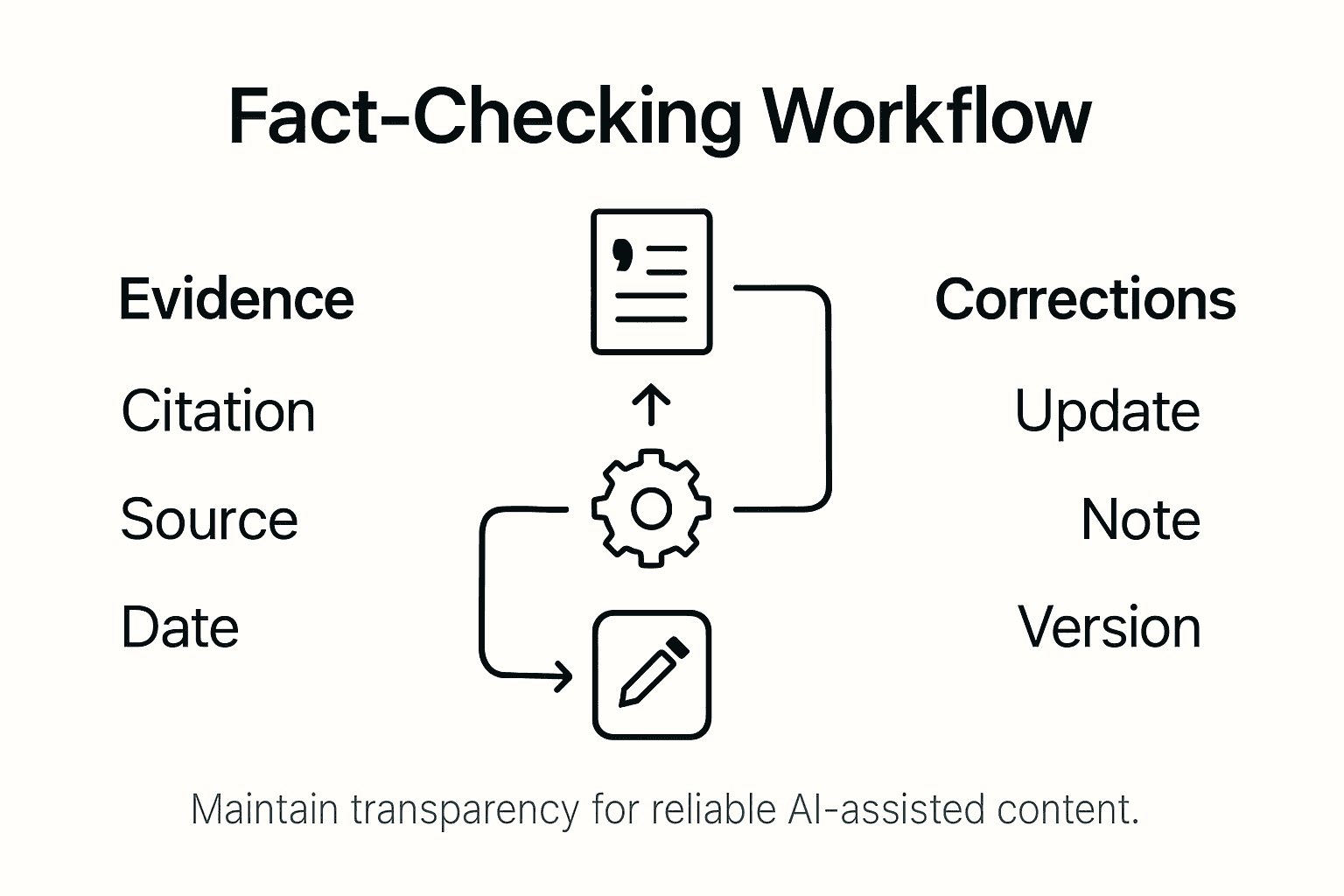
Implement a version control approach that allows you to track changes and updates to your fact-checking documentation. Use digital tools that support comprehensive logging, enabling you to maintain a transparent audit trail of your verification process. Capture not just the final result, but the entire investigative journey, including dead ends, contradictory evidence, and the specific analytical steps that led to your conclusions.
Pro tip: Maintain a separate "uncertainty log" that documents claims with insufficient evidence or complex nuances that require additional research.
Comprehensive evaluation of fact-checking reports requires rigorous multi-label classification and structured justification techniques to ensure the highest standards of reliability and accuracy. Your final validation process will scrutinize every aspect of the report to confirm its internal coherence and factual integrity.
Combine human oversight with technological safeguards to validate the overall consistency of AI-generated content. Develop a systematic review process that cross checks each claim against its supporting evidence, ensuring that explanations align perfectly with source materials. Examine the report for logical flow, eliminating any contradictory statements or unsupported assertions. Pay special attention to the relationship between your initial claims, gathered evidence, and final conclusions. Look for potential gaps in reasoning, unexplained jumps in logic, or areas where the supporting documentation fails to fully substantiate the reported findings.
Implement a comprehensive consistency check that evaluates multiple dimensions of the report. Verify that statistical claims match their referenced sources, technical language remains precise and accurate, and the overall narrative presents a coherent and well-supported argument. Create a final verification checklist that addresses potential inconsistencies, including tone variations, unexplained technical terms, and potential bias in source selection or interpretation.
Pro tip: Read your final report backward and line by line to disrupt your brain's natural pattern recognition and catch subtle inconsistencies more effectively.
This table summarizes key steps in the AI-assisted fact-checking workflow and their main objectives:
| Step | Main Objective | Core Outcome |
|---|---|---|
| Source Gathering | Build research foundation | Comprehensive reference set |
| AI Claim Identification | Detect machine-generated content | Spot potential inaccuracies |
| Source Verification | Cross-check facts with trusted sources | Validate claim authenticity |
| Evidence Documentation | Record verification process transparently | Maintain audit trail |
| Final Consistency Check | Ensure logical and factual coherence | Reliable final report |
Fact-checking AI-assisted reports demands keen identification of AI-generated claims and meticulous verification against trusted sources. The article highlights challenges like detecting AI hallucinations and maintaining transparency throughout the verification process. If you struggle with ensuring your content truly feels authentic while bypassing AI detection systems, you are not alone. Key pain points include navigating uncanny AI language patterns, documenting evidence with clarity, and validating final reports for consistency.
Semihuman.ai offers an advanced platform designed to bridge these gaps by transforming AI-generated text into naturally human-like content. Our tools help you restructure text, integrate keywords, and evade AI detection technologies such as Turnitin and GPTZero. This ensures your reports and content maintain credibility and pass stringent authenticity checks with ease. Discover how our services empower creators, researchers, and marketers to produce content that is both reliable and compelling.
ARTICLE INSIGHTS ON AI CLAIM IDENTIFICATION
DETECT AND HUMANIZE AI-GENERATED CONTENT WITH SEMIHUMAN.AI
Explore AI content authenticity at Semihuman.ai

Take control of your AI-assisted fact-checking workflow today. Visit Semihuman.ai to refine your content and ensure every claim resonates with genuine human touch. Act now to elevate your reliability and stay ahead in competitive, AI-driven environments.
To gather reliable sources, prioritize authoritative materials such as academic journals, government publications, and reputable research institutions. Use academic databases like Google Scholar and JSTOR to compile a diverse set of credible references, ensuring you cross-reference multiple sources for validation.
To identify AI-generated claims, examine text for signs like overly formal language, generic statements, and repetitive patterns. Create a checklist of potential AI markers to systematically evaluate the content and spot inaccuracies before deeper fact-checking occurs.
To verify claims, cross-check the information with multiple authoritative sources, focusing on peer-reviewed articles and respected publications. Implement a hierarchical system that ranks sources by credibility to ensure you prioritize the most reliable evidence in your fact-checking process.
When documenting evidence, create a structured template that includes the original claim, sources consulted, and specific evidence used for verification. Record findings thoroughly, noting any discrepancies and the rationale for your conclusions to maintain transparency.
To ensure consistency in your final report, conduct a comprehensive review that cross-references all claims with supporting evidence. Use a final verification checklist to examine logical flow and coherence, addressing any potential gaps or contradictions in the narrative.
In an uncertainty log, document any claims that lack adequate evidence or have complex nuances requiring further investigation. This log will help you keep track of areas needing additional research, improving the overall thoroughness of your fact-checking efforts.




Start
Humanizing
for Free!
Humanize