
Loading...

You can have a brilliant argument and still fail an essay. That sounds harsh, but it happens more than most students realize. Even well-researched, thoughtful writing falls flat when ideas are scattered, transitions are missing, or the reader can't follow your logic. Good organization demonstrates writer credibility and guides readers through your reasoning effectively. Structure isn't a formality you check off before submitting. It's the framework that makes your ideas land with the impact they deserve. This article breaks down what essay structure actually is, why it shapes your grades, and how to use it intentionally.
| Point | Details |
|---|---|
| Structure boosts clarity | Well-organized essays help readers easily follow and understand your argument. |
| Better grades with coherence | Essays with strong structure and coherence consistently earn higher marks. |
| Choose the right format | Selecting an appropriate essay structure improves logic and addresses assignment needs. |
| Research supports structure | Empirical studies confirm that structured essays outperform less organized work. |
| Feedback refines organization | Using rubrics and exemplars meaningfully strengthens your essay’s structure and quality. |
Essay structure is the organized arrangement of your writing into distinct, purposeful parts. At its most basic, it includes an introduction, body paragraphs, and a conclusion. But structure goes deeper than that. It also includes your thesis statement (the central claim your essay defends), the order in which you present evidence, and how each paragraph connects to the next.
It helps to separate structure from content and style. Content is what you say. Style is how you say it. Structure is the architecture that holds both together. Without it, even the most compelling content collapses under its own weight.
The three most common academic essay structures are:
Here's a real scenario that plays out in classrooms constantly. A student submits an essay packed with credible sources and original insight. The grader reads it and struggles to follow the argument. Ideas appear out of order. The thesis is buried in paragraph three. The conclusion introduces a new point. Despite strong content, the essay scores poorly. Poor structure leads to mark loss even when the underlying ideas are solid. Structure isn't decoration. It's the difference between an idea that lands and one that gets lost. If you're also thinking about how structure applies beyond essays, the same principles carry over to writing for digital audiences.
Once you understand what structure is, the next question is what it actually does for your writing. The answer is more significant than most students expect.

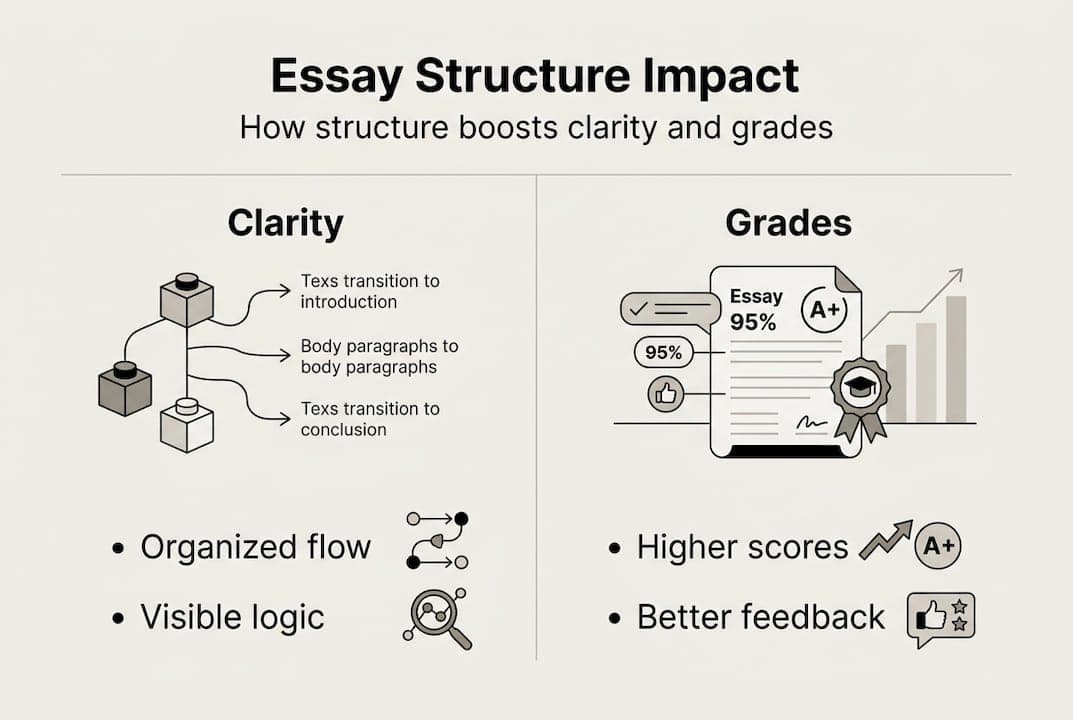
Structure makes your logic visible. When a reader moves through a well-organized essay, they don't have to work to understand your argument. The organization does that work for them. Each paragraph signals what it will cover, delivers on that promise, and connects to what comes next. That's clarity in action.
Coherence is slightly different. It refers to how ideas connect across the whole essay, not just within individual paragraphs. A coherent essay feels like one continuous thought, not a collection of loosely related points. Structure is what creates that feeling.
Here's how structure supports your argument at every level:
Coherence and structure strongly predict higher holistic essay scores, and human judgments of coherence are the most predictive factor of all.
That's not a minor finding. It means graders are responding to how your essay feels to read, not just what it says. A well-structured essay feels trustworthy. A disorganized one feels uncertain, even if the facts are correct. Good organization signals to your reader that you understand your topic well enough to explain it clearly.
Pro Tip: In longer essays, use signposting phrases like "This section argues..." or "Building on the previous point..." to visually and logically divide your argument. Graders notice this, and it improves their perception of your writing's quality.
Being aware of structure also helps you avoid AI writing risks that can make your writing feel generic or disjointed. Strong structure is one of the clearest markers of intentional, human-driven writing. You can also apply structural thinking to other formats by reviewing copywriting tips that translate well to academic contexts.
Research backs up what experienced writers and teachers already know. Structure isn't just a stylistic preference. It has measurable effects on academic performance.
One study found that rubric and exemplar feedback on essay structure significantly improves deep-level features of argumentative writing, including coherence and the ability to construct rebuttals. This matters because it shows that structural improvement isn't just surface-level polish. It changes how students think and argue.
Another study using a process-genre methodology found that teaching structure explicitly improved essay organization, content quality, vocabulary, and grammar in university-level EFL (English as a Foreign Language) students. Structure, in other words, lifts everything else.
Here's a snapshot of what the research shows:
| Intervention | Area improved | Outcome |
|---|---|---|
| Rubric + exemplar feedback | Coherence, rebuttals | Deeper argumentative skill growth |
| Process-genre instruction | Organization, content, vocabulary | Holistic essay quality improvement |
| Parallel structure training | Cohesion and coherence | Stronger logical flow and performance |
The statistic that stands out most: parallelism in essay structure correlates with academic performance at r = .582, which is a strong positive relationship in educational research. That means students who use consistent, parallel structures in their writing consistently outperform those who don't.
Three research-proven benefits of strong essay structure:
These findings also connect to broader content strategy. The same principles that make essays effective make all written communication more powerful, as explored in research on visuals versus text in marketing and AI and content marketing outcomes. If you want to apply these ideas to SEO writing, authentic SEO content tips offer a practical starting point.
Not every essay calls for the same structure. Choosing the right one for your assignment is just as important as executing it well.
| Structure | Layout | Ideal use case | Key strength |
|---|---|---|---|
| Analytical | Intro, thesis, body paragraphs, conclusion | Argumentative and critical essays | Logical flow and thesis support |
| Comparative | Block or point-by-point | Compare/contrast assignments | Clear side-by-side analysis |
| Narrative | Chronological arc with reflection | Personal statements, reflective writing | Emotional engagement and story flow |
| Problem-solution | Problem, analysis, solution, conclusion | Policy or proposal essays | Practical and persuasive framing |
Analytical structures with a clear thesis and intro-body-conclusion format ensure logical flow and are the default expectation in most academic settings. If your prompt doesn't specify a structure, this is your safest and strongest choice.
That said, structure should serve your reader's needs. Research shows that low-achieving students benefit from narrative-like structures that reduce cognitive load, while typical academic readers prefer standard informational formats. Knowing your audience matters as much as knowing your topic.
Pro Tip: When in doubt, default to the analytical format for academic writing. Read your prompt carefully for clues. Words like "analyze," "argue," or "evaluate" almost always call for a thesis-driven structure. Words like "reflect" or "describe" may open the door to narrative approaches.
Knowing which structure to use is only half the battle. Building it well requires a repeatable process.
Here are five steps that work:
Parallel structures also play a bigger role than most students realize. When your sentences and paragraphs follow consistent grammatical patterns, your writing feels more cohesive and your argument feels more controlled. It's a small habit with a measurable payoff.
The most common pitfall? Spending too much time on detail before locking in your main structure. Students often write beautifully crafted sentences in support of a point that doesn't belong in the essay at all. Outline first. Write second. Polish last.
Pro Tip: Ask a peer or instructor for feedback specifically on your essay's organization, not just its content. Most feedback defaults to grammar and word choice. Targeted structural feedback is rarer and far more valuable for long-term improvement.
For more on how visual organization supports written communication, the guide on using visual elements in writing offers useful crossover strategies.
Mastering essay structure takes practice, but you don't have to do it alone. AI-powered tools can help you outline faster, reorganize drafts more effectively, and spot coherence gaps before your grader does.

Semihuman.ai is built for exactly this kind of work. Whether you need to restructure a draft that feels disjointed, sharpen the flow between paragraphs, or make AI-assisted writing sound genuinely human, the platform gives you practical tools to get there. The SEO text generator helps you build structured, high-performing content from the ground up, while the AI text paraphraser lets you rework existing drafts for clarity and coherence without losing your original argument. If you're working on academic writing and want your structure to reflect genuine thinking, these tools make that process faster and more precise.
The most effective structure is usually the analytical format: introduction, thesis statement, body paragraphs, and conclusion. This format ensures logical flow and is the standard expectation in most academic settings.
Essays with clear organization and coherence consistently receive higher holistic grades from teachers and graders. Coherence is the single most predictive factor in human grading judgments.
Yes. Headings and signposting boost perceived organization and clarity, especially in longer essays. Use them moderately to guide your reader without making the essay feel like a report.
Feedback using rubrics and exemplars is most effective for developing organization and coherence. It targets deep-level structural skills rather than surface-level corrections.




Start
Humanizing
for Free!
Humanize