
Loading...

TL;DR:
- Enhancing AI language involves improving structure, voice, and context, not just fixing grammar or synonyms.
- A deliberate variation in sentence length, tone, and audience-specific details makes AI-generated content feel more human and authentic.
Most people think enhancing AI language means fixing grammar or swapping in better synonyms. That assumption is why so much AI content still reads like a robot wrote it. True improvement works on three layers: structure, voice, and context. Miss any one of them and the text still feels off, even if it passes a spellcheck. This guide breaks down exactly what each layer means, how to apply it systematically, and how the decisions you make as a creator directly shape the quality of what AI produces for you.
| Point | Details |
|---|---|
| Structure drives naturalness | Varied sentence lengths and logical paragraph flow are the primary signals that separate human from AI writing. |
| Voice requires deliberate injection | Conversational markers, opinion statements, and audience-matched tone must be added intentionally to AI output. |
| Context prevents generic output | Specific numbers, industry examples, and situational awareness make AI text credible and useful. |
| Data quality shapes output | Clean, curated training inputs and prompt constraints directly influence how authentic AI language sounds. |
| Phased editing beats one-pass fixes | Working through structure, voice, and flow in separate passes produces more consistent, readable results. |
If you want to understand why AI text feels monotonous, look at sentence length. Most AI models default to a comfortable mid-length cadence, roughly 18 to 22 words per sentence, repeated throughout an entire article. Humans do not write that way. We write short sentences for impact. Then we follow them with something longer and more detailed that builds on the previous idea, adds context, and moves the reader forward. That natural rhythm is the single biggest structural tell, and refining AI language starts here.
The fix is deliberate variation, not randomness. A strong structural edit targets three things:
Here is what that looks like in practice. Before: "The process of content creation involves multiple steps that must be completed in order to ensure that the output is of sufficient quality to meet the needs of the intended audience." After: "Good content takes more than one pass. You start with structure, then refine for voice, then polish for flow. Each step solves a different problem."
The second version has three sentences at different lengths. The first has one sentence that says nothing memorably. According to research on AI humanization, a readability score of 65 to 75 on the Flesch scale is the practical target for content that reads naturally to most audiences.
Pro Tip: Run your AI draft through a free readability checker before editing. Any section scoring below 60 Flesch needs structural work, not just word swaps.
Structure makes text readable. Voice makes it worth reading. This is where most AI content editing falls flat because writers treat it as the final cosmetic pass rather than a distinct layer with its own requirements.
Conversational markers are the technical term for the small signals that tell a reader a human wrote this. They include direct address ("you"), rhetorical questions, casual transitions, and stated opinions. Effective humanization targets at least three of these per 500 words, with two or more conversational transitions in that same span.
The most common voice mistakes in AI-edited content:
Pro Tip: After completing your structural edit, read the piece out loud. Every sentence that makes you pause or stumble is a voice problem. Fix those first before moving to context.
The goal is not to sound informal. It is to sound like a specific, confident person addressing a specific reader. That precision is what improving AI communication ultimately requires.
You can fix structure. You can inject voice. But if the content lacks situational awareness, readers will still sense something is off. Context is the layer that makes content feel like it was written for them, not just about a topic.
Context breaks down into three practical components:
Content with well-structured Q&A sections shows a 5 to 6 times increase in AI-referred traffic over nine months, which tells you that context-aware formatting is not just a readability choice. It has measurable reach implications.
Microsoft's research on content provenance signals highlights a shift that every content creator should understand: authenticity is increasingly tied to transparency about origin and transformation. Readers and AI systems are both getting better at detecting generic, unsituated content. Embedding real context is your best defense.
Here is something most content creators do not think about: the quality of what an AI model produces is shaped heavily by what it was trained on and how it was fine-tuned. You cannot fully compensate for weak model behavior through editing alone.

IBM's Granite 4.1 research offers a concrete example. Their team curated 4.1 million high-quality samples using a combination of LLM-as-Judge evaluation and rule-based filtering, then applied multi-stage reinforcement learning to improve instruction following. The result was a model that needed far less post-hoc correction to produce usable output.
What does that mean for you as a creator? Four practical implications:
| Prompt quality | Likely output result |
|---|---|
| Vague, no constraints | Generic, mid-length sentences, hedged language |
| Audience-specific, with format guidance | Tighter structure, more relevant examples |
| Includes voice sample and sources | Higher contextual accuracy, less post-editing needed |
Contextual safety work from OpenAI on sensitive conversations also shows that narrowly scoped memory mechanisms improve safe and appropriate responses by up to 52% in high-risk scenarios. The same principle applies to content creation: the more precisely you scope the task, the better the output.
Pro Tip: Build a prompt library for your recurring content types. A well-crafted prompt for "product feature announcement" or "B2B case study intro" pays back the time you invest in it every single time you use it.
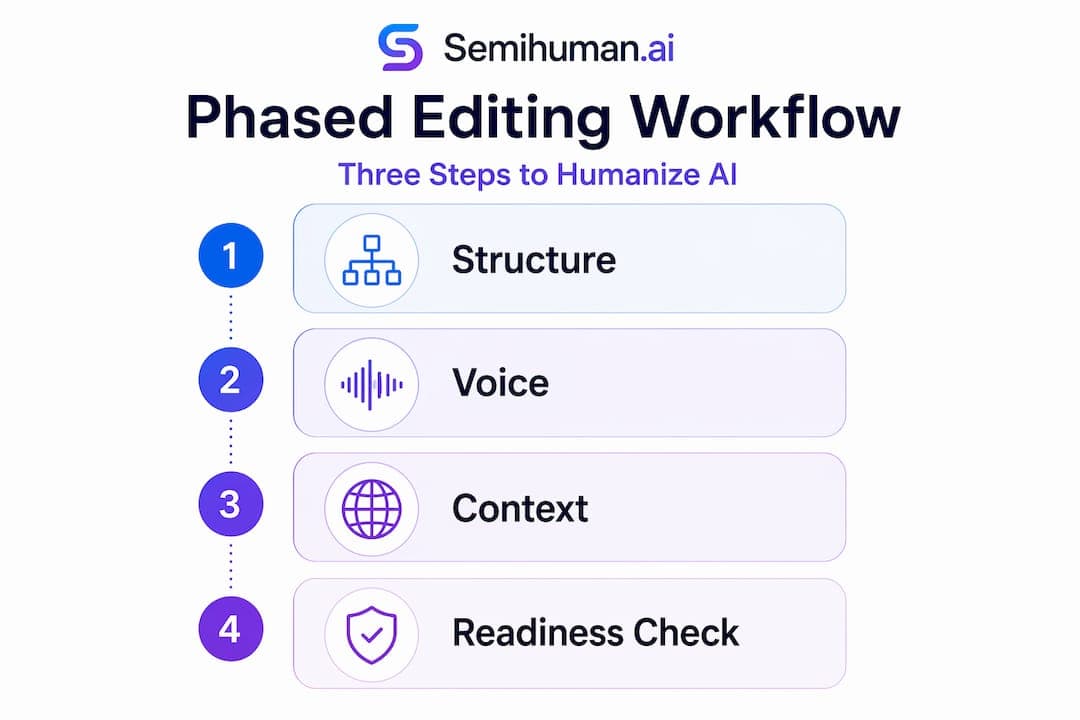
Knowing the three layers is not the same as having a system to apply them. Here is a four-phase workflow that produces consistently better results than a single editing pass.
Research on phased humanization confirms that applying these layers separately is more effective than trying to address them all in one pass. Your brain cannot optimize for sentence rhythm and brand voice simultaneously with the same precision.
The final readiness check: does the piece hit a Flesch score between 65 and 75? Does it contain at least three conversational markers per 500 words? Does every major point have a concrete example or number? If yes on all three, the draft is ready.
Pro Tip: Keep a "voice reference" document, a short excerpt of your best-performing content that nails your brand tone. Compare AI drafts to it during Phase 4 instead of working from memory.
I have reviewed a lot of AI-edited content, and the pattern that kills readability more than any other is not bad grammar. It is structural sameness. Writers who only do a surface pass, fixing awkward phrases and swapping synonyms, consistently produce content that still feels mechanical. The sentences are cleaner but the rhythm is still flat.
What I have learned from working through this is that structural editing is uncomfortable at first because it requires rewriting sentences that are technically correct. There is nothing wrong with a 20-word sentence. But when you have ten of them in a row, the writing loses all energy. Treating AI output as structural scaffolding, not as a finished draft, is the mental shift that changes everything.
The writers I have seen get the best results do not use AI to produce finished content. They use it to produce a strong first structure, then apply real editorial judgment about what to include, what to cut, and how to say it in a voice that actually matches their reader. That distinction between AI's approximation of tone and a human editor's active decision about it is where the quality gap lives.
One more thing: over-editing is a real failure mode. Adding too many personality markers, forcing informal language where it does not fit, or breaking up structure purely for variation's sake creates different problems. Balance is the goal. Preserve what the AI gets right and fix only what it gets wrong.
— Tilen
The three-layer framework described in this guide works best when you have tools built to support it. Semihuman's SEO Text Generator applies structure, voice, and context controls directly to AI-generated drafts, producing output that reads naturally and performs in search.
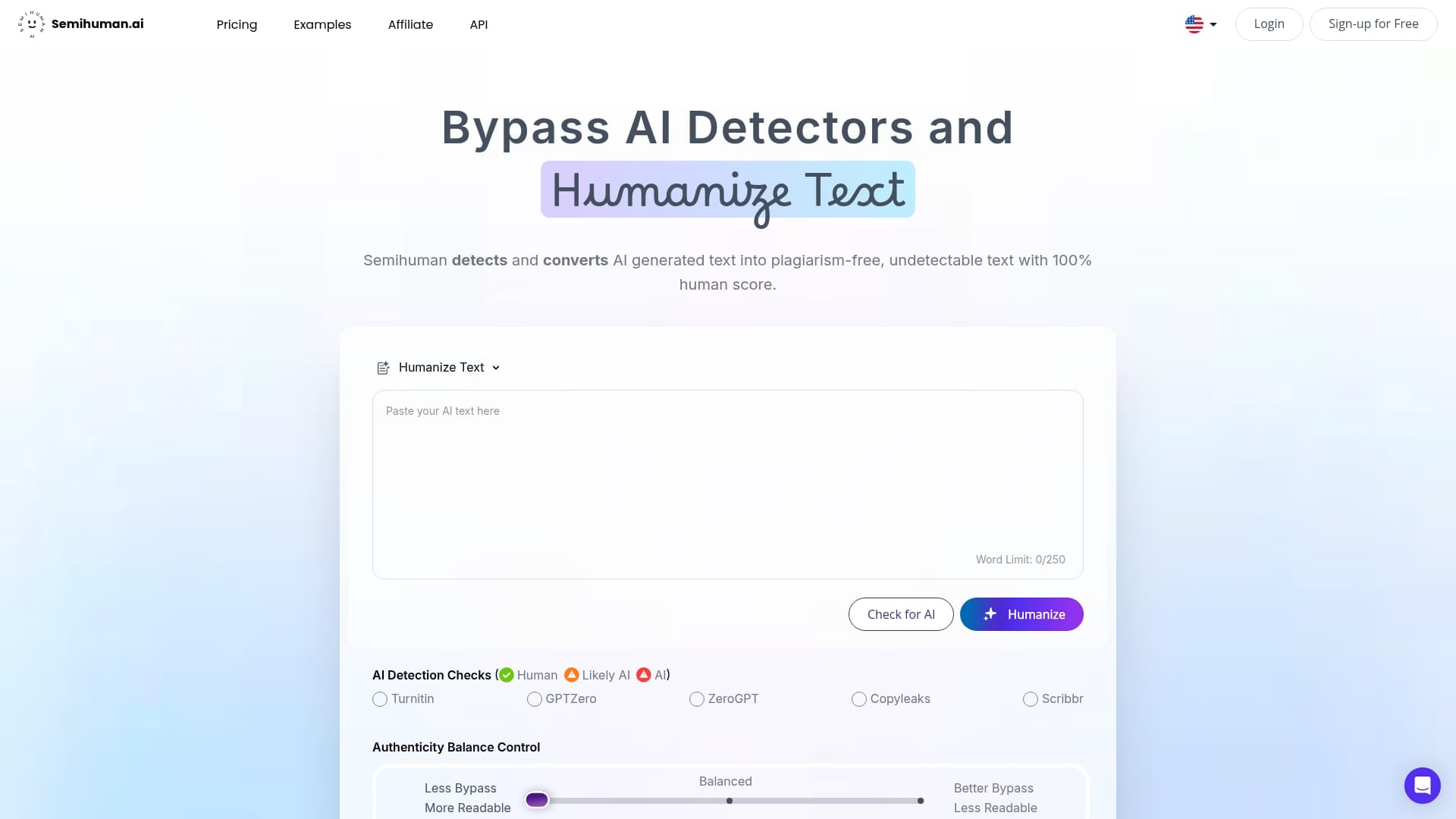
The platform handles text restructuring, keyword integration, and voice alignment in a single workflow, so you are not manually cycling through four editing phases on every piece of content. For teams producing high volumes of marketing copy, the API integration means these controls apply consistently across every output, not just the ones you have time to edit by hand. If you want to see how the principles in this guide translate into practice, Semihuman is worth exploring.
Enhancing AI language requires working across three layers: structure (sentence and paragraph variation), voice (conversational markers and tone), and context (audience-specific examples and situational fit). Fixing only grammar or vocabulary leaves the deeper mechanical feel intact.
Research on AI humanization recommends at least 3 conversational markers per 500 words, along with two or more conversational transitions. These include direct address, rhetorical questions, and stated opinions.
Yes. Supplying audience descriptions, tone samples, format constraints, and real source material in your prompt reduces output drift and generic phrasing. Better inputs mean less structural correction on the back end.
A Flesch readability score between 65 and 75 is the practical target for AI-generated content aimed at general or marketing audiences. Scores below 60 typically indicate structural problems that word-level edits will not fix.
Most editing passes address vocabulary and grammar without touching sentence rhythm or paragraph flow. Structural sameness in sentence length is the primary signal readers and detection systems recognize as AI-generated, and it requires deliberate rewriting to fix.




Start
Humanizing
for Free!
Humanize