
Loading...

TL;DR:
- Students should start with independent drafts before using AI tools for feedback and editing.
- A hybrid approach combining human effort and AI assistance enhances writing quality while maintaining authenticity.
- Transparency, documentation, and responsible AI use are key to preserving individual voice and academic integrity.
Academic writing has never been more demanding. Professors expect originality, depth, and polished mechanics, all at once, while AI tools are changing what's possible and what's permissible. Students who ignore AI miss real advantages. Students who over-rely on it risk losing their own voice and academic credibility. The good news is that a middle path exists, one where AI sharpens your writing without replacing it. This guide walks you through exactly how to use AI tools to improve your skills, protect your authenticity, and produce assignments you're genuinely proud of.
| Point | Details |
|---|---|
| Draft independently first | Strong writing skills begin with your own ideas and words before using AI support. |
| Use AI for targeted feedback | Apply AI tools after your draft to improve grammar and style, not as a shortcut for original thought. |
| Document your writing process | Keep annotated drafts and notes to demonstrate authentic authorship and learning. |
| Balance is essential | Hybrid student–AI approaches provide the best results without sacrificing creativity or academic integrity. |
Most students struggle with the same core writing problems: weak sentence mechanics, poor paragraph coherence, limited vocabulary, and the constant pressure to sound original. These aren't signs of low intelligence. They're natural gaps that develop when writing instruction doesn't keep pace with academic expectations. Add a second language into the mix and the challenge multiplies fast.
AI tools have stepped into this gap in a big way. Grammarly and QuillBot significantly improve grammar, vocabulary, and coherence, with measurable gains shown in ESL and EFL student studies. That's a real benefit, and it's worth taking seriously. You can explore more about the benefits of AI in academic writing to understand the full picture.
But the picture isn't entirely rosy. Research highlights a clear tension:
As one research synthesis put it:
"AI tools can scaffold accuracy and boost engagement, but may suppress voice and creativity if not disclosed; hybrid human-AI collaboration is optimal."
The key word there is disclosed. Transparency isn't just an ethical nicety. It's what separates students who build real skills from those who borrow them temporarily. Understanding the AI writing risks before you start is just as important as knowing the benefits. The students who navigate this well aren't the ones who avoid AI entirely. They're the ones who use it with intention and honesty.
Before you open a single AI tool, you need one thing in place: your own draft. Not a perfect draft. Not even a good one. Just your thinking on paper. This step is non-negotiable. If AI shapes your ideas before you've formed them yourself, you're not improving your writing. You're outsourcing it.

Once you have a draft, choosing the right tool matters. Different tools serve different purposes, and matching them to your assignment type makes a real difference. Grammarly and QuillBot are the most studied and proven options for academic writing mechanics. Here's a quick comparison:
| Tool | Primary function | Best for | Limitation |
|---|---|---|---|
| Grammarly | Grammar, tone, clarity | Essays, reports | Can over-correct voice |
| QuillBot | Paraphrasing, fluency | Rewriting sentences | May dilute your style |
| ChatGPT | Feedback, brainstorming | Outlining, idea testing | Needs careful prompting |
| Hemingway Editor | Readability, concision | Simplifying dense prose | No grammar correction |
When selecting a tool, think about what your assignment actually needs. A lab report needs precision and clarity. A personal essay needs voice and flow. Explore the full range of types of AI writing tools to find what fits your workflow.
Here are the key principles to follow before you start:
Pro Tip: Keep a simple writing log. After each AI-assisted session, write two or three sentences in your own words summarizing what you changed and why. This builds genuine skill and gives you evidence of your process if questions arise. You can also review AI literacy best practices to stay ahead of evolving expectations.
Now that you're equipped with the right tools, here's how to apply them effectively, step by step.
The results of this approach are striking. AI-assisted writing reduces writing time by 56 to 70% and improves quality measurably, especially for non-native English speakers. Using chain-of-thought (CoT) prompting, where you ask AI to reason through feedback step by step, produces noticeably higher quality suggestions than simple requests.
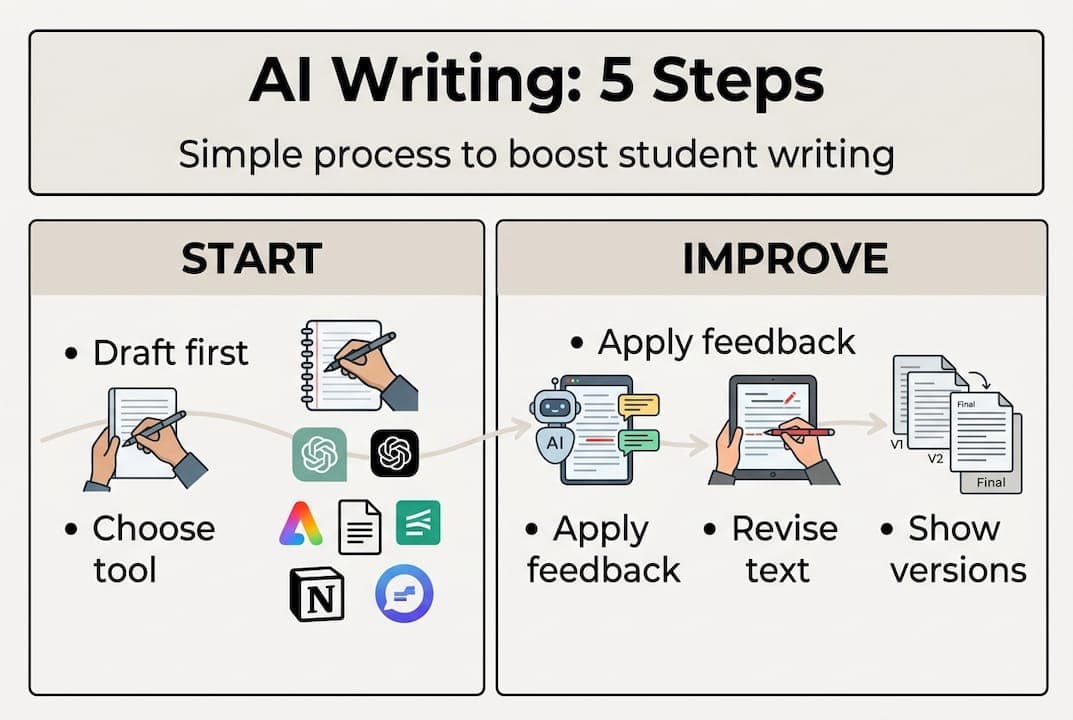
Pro Tip: Save every version of your draft with timestamps. This creates a clear record of your authorship and shows the evolution of your thinking. It's also your best defense if authenticity is ever questioned. Read more about editing AI-generated writing and balancing tech and authenticity for deeper guidance.
ASCD research confirms that students who write first drafts independently and then use AI for targeted, post-draft feedback show the strongest outcomes. AI works best as a formative tool, not a starting point.
| Draft stage | Without AI | With AI (post-draft) |
|---|---|---|
| Grammar errors | High | Low |
| Sentence variety | Moderate | High |
| Argument clarity | Variable | Improved |
| Student voice | Strong | Preserved |
| Time to completion | Longer | 56-70% faster |
After you've revised with AI, your final step is ensuring that your writing remains genuinely your own.
Authenticity verification isn't about paranoia. It's about accountability. Here's a practical checklist:
The risks of skipping this step are real. Overreliance on AI leads to shallow revisions, reduced critical thinking, and a gradual loss of your own writing identity. AI performs well on structured and argumentative writing but struggles with creative and narrative work. If you lean on it too heavily in those areas, the result often reads as flat and generic.
Common mistakes to avoid:
As research makes clear, process evidence like drafts and annotations is the most reliable way to demonstrate authentic authorship. Teachers and institutions increasingly ask for this evidence, so building the habit now pays off.
For extra assurance, check out resources on spotting AI-generated text, avoiding content duplication, and trust in AI-era writing.
Here's what most guides won't tell you: chasing "AI mastery" is the wrong goal entirely. Students who spend their energy learning how to extract better outputs from AI are optimizing for the wrong thing. The skill that actually matters is knowing when to use AI, when to ignore it, and how to stay the author of your own ideas throughout.
Pure AI reliance produces polished-sounding writing with no intellectual backbone. Pure avoidance leaves real efficiency gains on the table. Neither extreme serves you well in academic or professional life.
The students who gain the most are those who treat AI as a critical reader, not a ghostwriter. They stay in the driver's seat. They disclose their process. They build increasing text originality into every revision cycle. And because they document their work transparently, they're positioned as credible, forward-thinking writers in a world where those qualities are increasingly rare.
Disclosure and process evidence aren't just ethical requirements. They're competitive advantages.
You've got the framework. Now it's time to put it to work with tools built specifically for the challenges students face today.
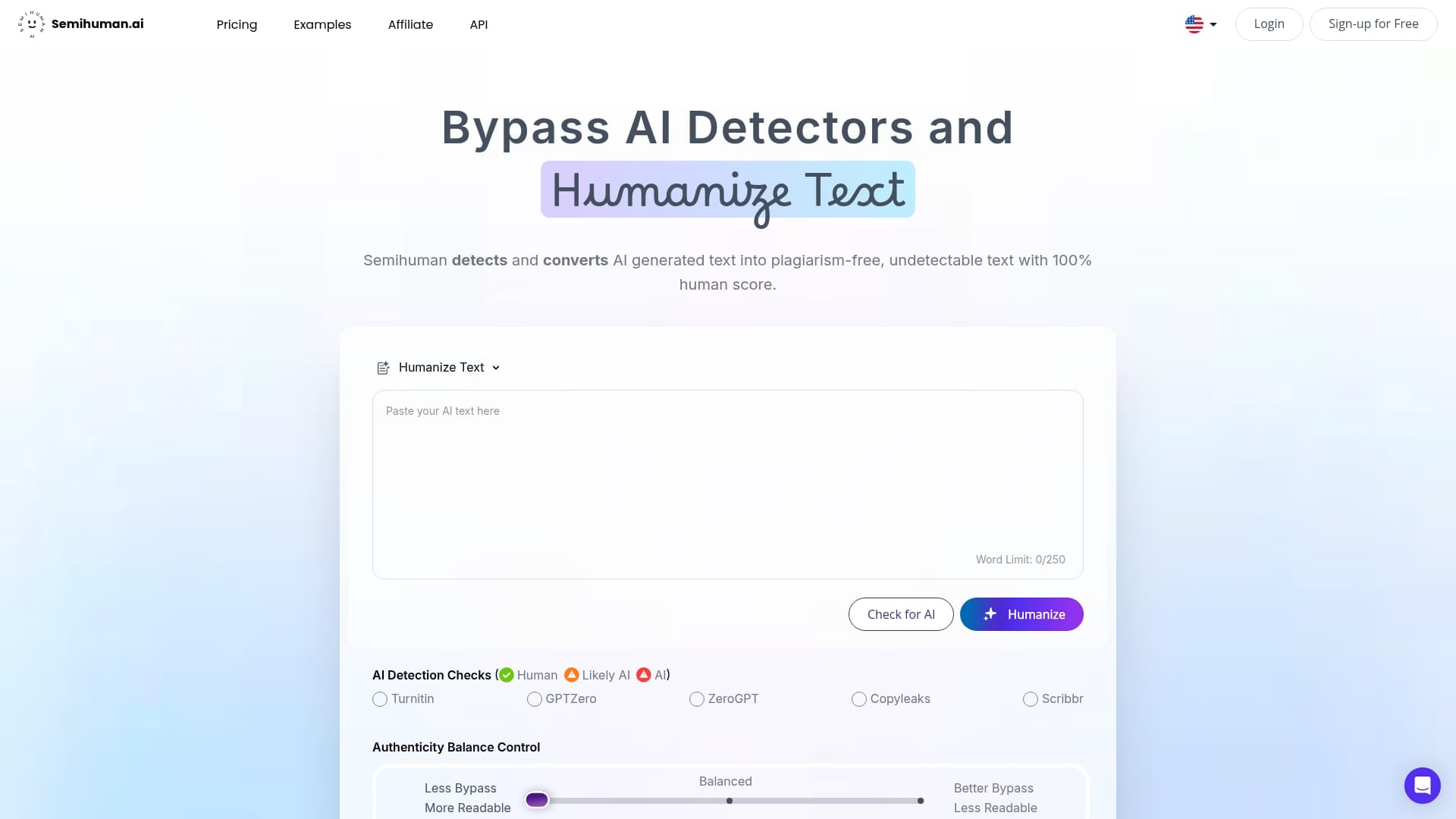
Semihuman AI helps you take AI-assisted writing and make it genuinely yours. Whether you need to bypass AI detectors that flag legitimate work, generate content that reads naturally and passes originality checks, or use the SEO text generator for research-backed writing, the platform gives you practical tools that match the strategies in this guide. Explore the full suite of advanced AI writing tools and start producing work that's both high quality and authentically yours. The gap between good writing and great writing is smaller than you think.
Start your drafts independently, then use AI for feedback on mechanics and clarity, not full rewrites, to preserve your individual style. Student-led drafts before AI input consistently protect learning and ownership.
Grammarly and QuillBot are proven to enhance structure and grammar for academic essays, especially when used post-draft. Both tools show measurable improvements in grammar, vocabulary, and coherence in student writing studies.
Maintain and submit drafts with annotations, feedback, and process evidence to demonstrate your original work. Process documentation is the most reliable way to demonstrate authentic authorship.
Using AI for grammar and structure feedback is ethical if disclosed and your ideas drive the content, but passing off AI-generated work as your own is not. Institutional policies increasingly mandate disclosure and focus on verifiable student skills.
Risks include overreliance, loss of critical thinking, and producing text that lacks originality; balance is essential. Hybrid AI-human systems are recommended to avoid shallow revisions and preserve authentic student voice.

Start
Humanizing
for Free!
Humanize