
Loading...

Every digital marketer who manages multiple web properties knows the frustration when similar content surfaces unexpectedly across different pages. This challenge matters because search engines can penalize websites with high levels of duplicate content, directly affecting visibility and trust. By addressing the myths and realities around duplicate content and understanding why context and intent are important, you can strengthen your strategies to safeguard your site's performance and reputation.
| Point | Details |
|---|---|
| Understanding Duplicate Content | Duplicate content occurs when identical or very similar text exists across various web pages, posing risks for SEO and user trust. |
| SEO Implications | Search engines penalize duplicate content by lowering rankings and diluting link equity, making original content vital for visibility. |
| Detection and Prevention | Use tools like plagiarism scanners and canonical tags to identify and manage duplicate content effectively. |
| Content Creation Strategies | Focus on producing unique, insightful content to maintain integrity and engage users, avoiding superficial modifications to existing text. |
Duplicate content represents a significant challenge in digital publishing and search engine optimization, creating potential risks for websites and content creators. At its core, duplicate content refers to substantial blocks of text that appear identical or remarkably similar across multiple web pages, either within the same website or across different domains.
In the digital publishing landscape, duplicate content can emerge through various mechanisms:
Contrary to popular misconceptions, academic plagiarism guidelines reveal that content duplication isn't just about verbatim copying. It encompasses a broader range of scenarios where substantial textual overlap occurs without transparent acknowledgment.
Search engines like Google have sophisticated algorithms designed to detect and penalize duplicate content. These systems aim to provide users with diverse, high-quality information rather than redundant search results. When search engines identify extensive content similarity, they may:
Myths about duplicate content often mislead content creators. Many believe minor text modifications or changing paragraph order eliminates duplication risks. However, sophisticated search algorithms can detect such superficial alterations.
Duplicate content isn't just an SEO problem—it's an ethical issue that undermines content integrity and user trust.
Important distinctions exist between different types of content similarity. While some repetition is normal and acceptable, systematic reproduction without adding unique value can trigger search engine penalties.
Pro tip: Always create original content that provides genuine insights, even when covering similar topics as other sources.
Duplicate content in search engine optimization manifests through multiple distinct categories, each presenting unique challenges for digital publishers and content creators. Duplicate content scenarios range from unintentional technical issues to deliberate content reproduction strategies.
The primary types of duplicate content include:
Internal duplicate content
Printer-friendly webpage versions
Multiple URL variations for same content
Product pages with similar descriptions
Category and tag archive pages
External duplicate content
Scraped content from other websites
Syndicated articles republished across multiple domains
Press releases distributed verbatim
Translated content without significant modification
Search engines distinguish between different duplicate content types using sophisticated detection mechanisms. Some forms of content similarity are considered benign, while others can trigger significant ranking penalties.

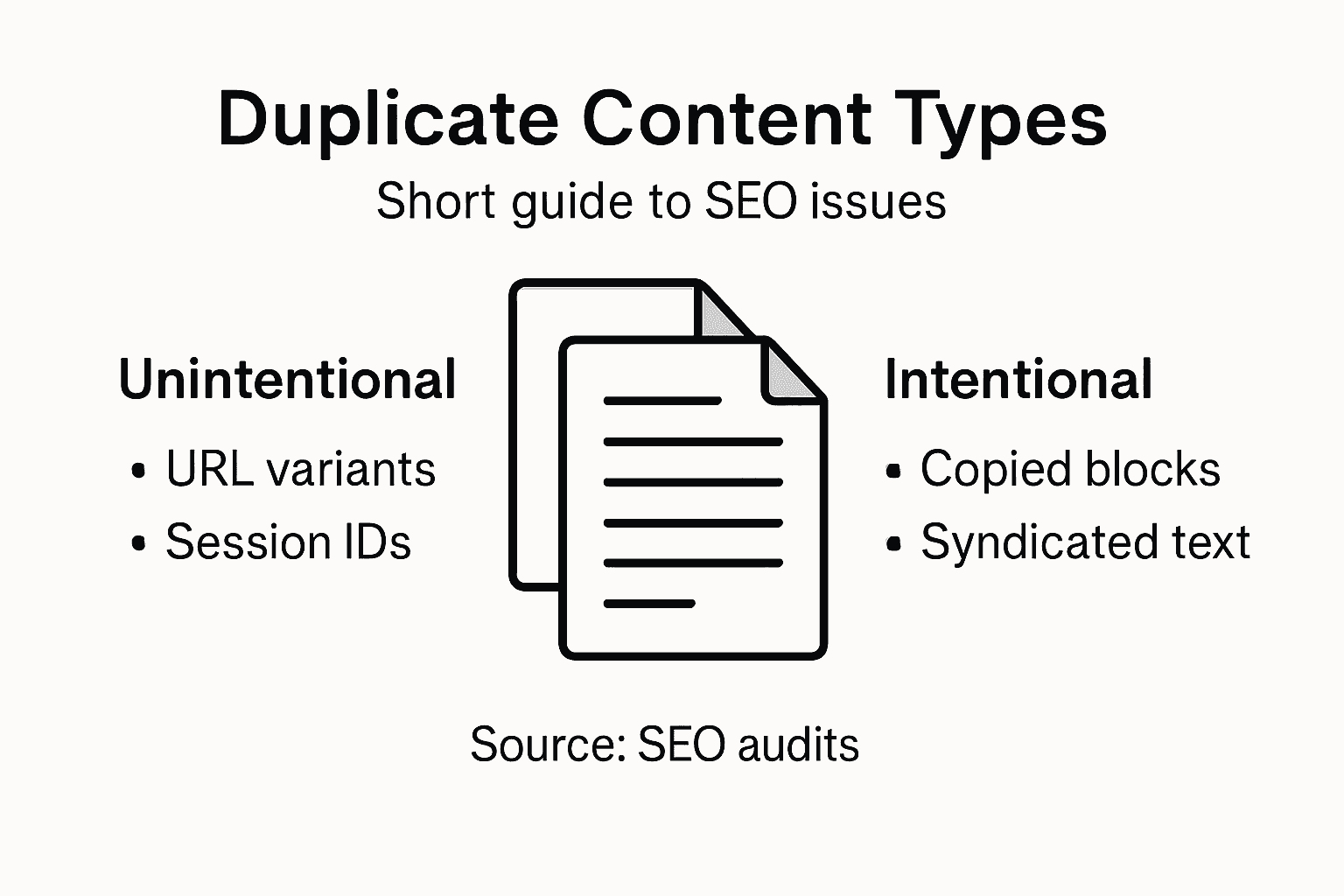
Intentional vs. Unintentional Duplication presents a critical differentiation. Unintentional duplication often stems from technical website configurations, such as:
Here is a comparison of intentional and unintentional duplicate content impacts:
| Duplication Type | Common Causes | SEO Consequences |
|---|---|---|
| Intentional Duplication | Content scraping, syndication | Manual penalties, loss of trust |
| Unintentional Duplication | URL variations, template use | Ranking suppression, equity loss |
Not all content similarity constitutes malicious duplication—context and intent matter significantly.
Moreover, scientific publication contexts reveal nuanced perspectives on content reproduction. In academic settings, duplicate content can involve republishing research with minimal alterations, potentially undermining scholarly communication integrity.
Potential Duplicate Content Risks include:
Pro tip: Regularly audit your website's content using technical SEO tools to identify and resolve potential duplicate content issues before search engines penalize your site.
Duplicate content emerges through numerous digital pathways, often unintentionally creating complex challenges for content creators and website managers. Academic publication practices reveal that content reproduction can stem from various systemic and individual motivations, ranging from technical limitations to professional pressures.
The primary mechanisms generating duplicate content include:
Technological Triggers
Content management system limitations
Automated content syndication
URL parameter variations
Multiple website versions (mobile/desktop)
Content Creation Challenges
Repurposing existing materials
Templated product descriptions
Contractor-generated content
Inadvertent text recycling
Search engines have sophisticated algorithms designed to detect and manage content similarity. These systems analyze multiple factors beyond simple text matching, including:
Not all content similarity represents malicious duplication—context and intent are critical differentiators.
Unintentional duplication frequently occurs through common plagiarism pathways, where content creators might reproduce text without malicious intent. This can happen through:
Potential Duplicate Content Sources:
Pro tip: Implement a systematic content review process that includes plagiarism checks and original content verification before publication.
Duplicate content creates significant complications for search engine optimization, fundamentally undermining a website's ability to rank effectively. Search engine ranking algorithms reveal complex mechanisms that penalize websites with redundant or unoriginal content, dramatically reducing organic visibility and user engagement.
The primary SEO ranking challenges associated with duplicate content include:
Ranking Signal Dilution
Reduced content credibility
Diminished link equity
Confused search engine indexing
Lower domain authority
Search Engine Penalties
Potential ranking drops
Decreased search result visibility
Potential manual action warnings
Algorithmic content filtering
Search Engine Response Mechanisms demonstrate sophisticated approaches to managing duplicate content. These sophisticated systems employ multiple strategies:
Not all content similarity triggers penalties—contextual relevance and intent play crucial roles in search engine evaluations.
Moreover, technical SEO considerations highlight that duplicate content challenges extend beyond simple text matching. Websites must navigate complex ranking landscapes by:
Potential Ranking Consequences:
Pro tip: Conduct regular content audits using advanced SEO tools to identify and resolve potential duplicate content issues before they negatively impact your search rankings.
Addressing duplicate content requires a multifaceted approach that combines technological tools, strategic planning, and proactive content management. Comprehensive duplicate content strategies involve sophisticated detection mechanisms and targeted resolution techniques designed to maintain search engine credibility and website performance.
Detection Methods for identifying duplicate content include:
Prevention Strategies encompass multiple technical and creative approaches:
Search engines employ sophisticated algorithms to assess content originality and differentiate between intentional and unintentional duplication. These systems analyze multiple factors:
This table summarizes key tools and strategies for managing duplicate content:
| Method | Primary Benefit | Practical Example |
|---|---|---|
| Canonical Tags | Consolidates ranking signals | Set preferred product page |
| 301 Redirects | Channels traffic, prevents confusion | Merge old URLs to new structure |
| Plagiarism Scanners | Detects content overlap | Check blog posts pre-publish |
| Editorial Review | Ensures content originality | Verify unique voice and value |
Not all content similarities constitute malicious duplication—context and intent matter significantly.
Moreover, publication ethics guidelines highlight the importance of proactive content management. Websites and content creators must develop robust strategies to:
Resolution Techniques for addressing existing duplicate content:
Pro tip: Develop a systematic content audit process that regularly checks for potential duplicate content issues and implements immediate corrective actions.
Duplicate content creates frustrating roadblocks that can undermine your website's search engine rankings and online credibility. The complexities around content duplication, from internal URL variations to unintended text recycling, demand proactive solutions that go beyond basic editing. If you want to avoid ranking penalties, protect your domain authority, and provide authentic value to your audience, embracing content authenticity is essential.
Experience the power of Semihuman.ai, an AI-driven platform designed specifically to transform AI-generated text into naturally human-like writing. Our advanced tools help you restructure content, integrate keywords seamlessly, and evade common AI detection systems to ensure your content maintains a genuine voice that search engines and readers trust. Do not let duplicate content jeopardize your SEO success when you can elevate your writing today. Start now by visiting Semihuman.ai and take the first step toward boosting your site’s search engine ranking with original, compelling content.
Duplicate content refers to sizable blocks of text that are identical or very similar across multiple web pages, either on the same site or different domains. It's problematic for SEO because search engines may suppress duplicate pages from search rankings, reducing visibility and authority for your website.
Duplicate content can lead to diluted ranking signals, meaning that search engines might not know which version of the content to rank. This can result in lower search engine rankings, decreased traffic, and potential penalties for your website.
Common causes include technical website configurations like URL variations, multiple versions of the site (e.g., mobile vs. desktop), content scraping, and republishing articles without proper attribution. Even unintentional duplication can occur through template-generated pages or similar product descriptions.
To prevent duplicate content, implement methods like using canonical tags to specify the preferred version of a page, utilizing 301 redirects for outdated pages, and regularly auditing your content. Creating unique and valuable content for each page is also crucial to avoid duplication.



Start
Humanizing
for Free!
Humanize