
Loading...

Content creators face a critical challenge in 2026: diversifying content types to reach broader audiences while maintaining authenticity and navigating AI detection complexities. The pressure to produce multiple formats from blog posts to videos, podcasts to infographics creates a balancing act between efficiency and genuine human connection. This guide delivers practical, expert-backed strategies to diversify your content effectively, preserve your authentic voice, and ethically manage AI detection concerns. You'll learn systematic approaches to repurpose core assets, maintain brand consistency across formats, and verify results that drive real engagement.
| Point | Details |
|---|---|
| Repurpose systematically | Transform core content assets into multiple formats like video, audio, and text to maximize reach |
| Prioritize authenticity | Use human editing, personal insights, and structural variety to maintain genuine voice |
| Start small, scale smart | Begin with 2-3 formats your audience prefers, then expand based on data |
| Avoid semantic drift | Keep unified brand voice and content themes consistent across all formats |
| Embrace hybrid workflows | Combine AI efficiency with human creativity for best results and detection resilience |
Before diving into content diversification, you need a clear understanding of what you already have and what your audience actually wants. Start by conducting a thorough audit of your existing content library. Identify your top-performing assets based on engagement metrics, traffic, conversions, and audience feedback. These high-performers are your goldmine for repurposing because they've already proven their value.
Next, analyze where your target audience spends their time and which formats they engage with most actively. Do they prefer watching short videos on social platforms? Are they podcast listeners during commutes? Do they bookmark long-form blog posts for deep dives? Your analytics tools, social media insights, and direct audience surveys provide this critical data. The goal is matching your content diversification efforts to actual audience behavior, not assumptions.
Multimodal content strategies involve repurposing one core asset into text, video, audio, and visuals systematically. This approach maximizes reach while managing production scope effectively. Rather than creating entirely new content for each format, you transform existing high-value assets into complementary versions that serve different consumption preferences.
Pro Tip: Start with just 2-3 formats initially to avoid overwhelming your team and diluting quality. Master the repurposing workflow for these formats first, then gradually expand as you build systems and confidence.
Use content analytics to prioritize which pieces deserve diversification investment. A webinar that generated 500 leads makes a better candidate than a blog post with minimal engagement. Focus your energy where the foundation is already strong. Document your findings in a simple spreadsheet: asset name, current format, performance metrics, target formats, and priority ranking.
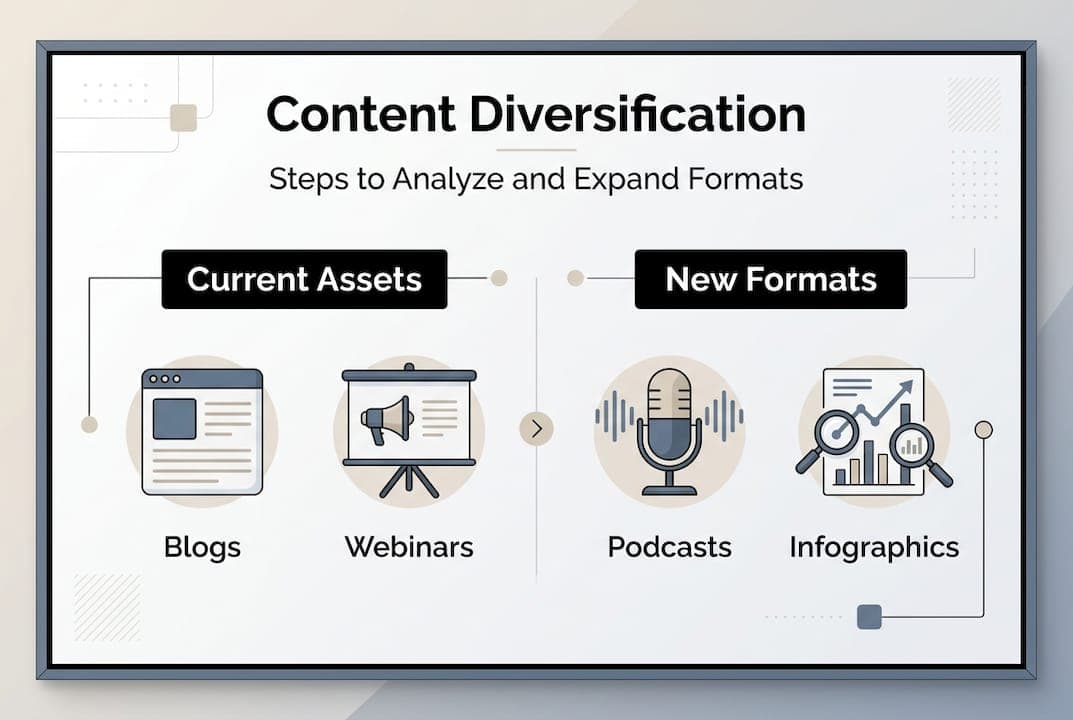
This preparation phase prevents the common mistake of diversifying randomly without strategic direction. You'll know exactly which content to repurpose, which formats to target, and why these choices align with audience preferences. This balancing tech authenticity ai content 2026 foundation ensures your diversification efforts deliver measurable results rather than just creating more content noise.
With your content audit and audience insights in hand, you're ready to execute systematic repurposing. Let's walk through transforming a single webinar into multiple high-value formats that extend your reach without starting from scratch.
This multimodal content strategy approach multiplies your content inventory from one source while maintaining consistent messaging. Each format serves different audience preferences and platform algorithms, dramatically expanding your potential reach.
Maintaining your authentic brand voice across formats requires intentional consistency. Develop a brief style guide documenting your tone, key phrases, perspective, and values. Reference this guide when adapting content to ensure a webinar's conversational energy translates appropriately into a formal blog post or casual social snippet. The core message stays consistent even as the delivery format changes.

Pro Tip: Create templates for each content format that include your brand voice guidelines, formatting standards, and quality checkpoints. These templates speed up production while ensuring consistency.
| Format | Pros | Cons | Recommended Tools |
|---|---|---|---|
| Text (blogs, articles) | SEO-friendly, searchable, easy to update | Requires strong writing skills, less engaging for visual learners | WordPress, Notion, Google Docs |
| Video (YouTube, social) | High engagement, demonstrates processes visually | Time-intensive production, requires equipment/editing skills | Descript, Camtasia, CapCut |
| Audio (podcasts) | Convenient for multitasking audiences, builds intimacy | Limited visual demonstration, requires audio quality | Riverside, Audacity, Anchor |
| Visuals (infographics) | Highly shareable, simplifies complex data | Limited depth, requires design skills | Canva, Venngage, Piktochart |
Leverage previews, summaries, and transcripts to create additional content variations. A podcast episode generates show notes, quote graphics, and an SEO-optimized blog post version. A video tutorial produces a step-by-step written guide and social teaser clips. This layered approach ensures you extract maximum value from every content creation effort.
Remember that why ai writing needs editing applies equally to content repurposing. AI tools can accelerate transcription, summarization, and initial drafts, but human editing ensures your authentic voice, brand personality, and strategic messaging shine through every format.
As you diversify content types, maintaining authenticity becomes both more challenging and more critical. The temptation to rely heavily on AI generation increases with higher content volume, but this approach risks creating generic, detectable content that damages trust and SEO performance.
Human editing and personal insights are non-negotiable for authentic content. After using AI tools for initial drafts or transcriptions, inject your unique perspective, experiences, and voice. Share specific examples from your work, challenge common assumptions in your industry, or reveal lessons from your failures. These elements create genuine connection that AI cannot replicate.
AI content that bypasses detection requires semantic variation and structural diversity rather than tricks or shortcuts. Vary your sentence structures, paragraph lengths, and transitional phrases. Use unexpected analogies, conversational asides, and rhetorical questions. Mix data-driven statements with opinion-based commentary. This natural variation mirrors human writing patterns.
Consider the current state of AI detection technology. DistilBERT AI detection accuracy study shows these tools achieve 98% accuracy in identifying AI-generated text. The evasion arms race favors hybrid human-AI workflows over pure AI generation with superficial edits. Detection algorithms continuously improve, making ethical authenticity the only sustainable long-term strategy.
"The best approach to AI detection is not evasion but genuine human enhancement. Content that starts with human strategy, uses AI for efficiency, and finishes with human refinement naturally bypasses detection because it is fundamentally human-created."
Avoid semantic drift by maintaining a unified brand voice throughout your diversification efforts. Semantic drift occurs when repurposed content gradually shifts away from your core messaging, values, or tone as it's adapted across formats. Create a content brief for each repurposing project that explicitly states the key message, target audience, and brand voice requirements.
Ethical authenticity practices include:
This approach to content authenticity for marketers supports long-term trust building with your audience. Authentic content generates genuine engagement, earns natural backlinks, and withstands algorithm updates. The common ai writing risks you avoid include detection penalties, audience distrust, and the reputational damage of being exposed as inauthentic.
Your diversified content strategy succeeds when each format feels genuinely human, strategically aligned, and valuable to your specific audience. This requires ongoing human judgment, creative input, and quality control that AI tools support but never replace.
Diversifying content types only delivers value when you systematically measure impact and refine your approach based on real data. Track engagement metrics across every format you produce to understand what resonates with your audience and what falls flat.
Analyze format-specific metrics: video watch time and completion rates, podcast download numbers and listening duration, blog post time on page and scroll depth, infographic shares and saves. Compare these metrics against your baseline performance and across different content formats. You might discover that your audience engages deeply with long-form written content but barely watches videos, or vice versa. This data guides where to focus your diversification efforts.
Identify common mistakes that undermine diversification success. Over-diversification spreads your resources too thin, resulting in mediocre content across many formats instead of excellent content in a few. Semantic drift occurs when repurposed content loses your brand voice or core messaging as it's adapted. Neglecting authenticity in pursuit of volume damages audience trust and triggers AI detection flags.
| Challenge | Solution | Expected Outcome |
|---|---|---|
| Semantic drift across formats | Create detailed content briefs with brand voice guidelines for each repurposing project | Consistent messaging and tone across all formats |
| Over-diversification diluting quality | Focus on 2-3 formats initially, expand only after mastering workflows | Higher quality content with better engagement |
| AI detection flags | Implement human editing and personal insights in every piece | Authentic content that naturally bypasses detection |
| Inconsistent publishing schedule | Build content calendars and repurposing templates | Reliable audience expectations and improved SEO |
Pro Tip: Create a simple scorecard rating each piece of diversified content on authenticity, brand alignment, and audience value. Review these scores monthly to identify patterns and improvement opportunities.
Research shows that compression ratios higher in top 10 ranking pages exist but show no direct ranking correlation. This finding reinforces that over-diversification without maintaining unified voice and content quality risks semantic drift without SEO benefits. Your diversification strategy must balance breadth with depth.
Refine your unified brand voice based on audience feedback and engagement data. If certain topics, tones, or formats consistently outperform others, double down on those elements. If specific approaches generate negative feedback or poor engagement, adjust or eliminate them. Your brand voice should evolve based on what genuinely connects with your audience.
The seo benefits of ai humanization become measurable through improved rankings, increased organic traffic, and better user engagement signals. Track these SEO metrics alongside format-specific engagement to understand the full impact of your diversification efforts. Quality authentic content in multiple formats creates more entry points for search traffic while satisfying diverse user preferences.
Optimize gradually rather than overhauling your entire strategy based on short-term results. Content performance often takes weeks or months to fully materialize as search engines index new formats and audiences discover your expanded presence. Implement small improvements consistently, measure their impact, and build on what works. This improving content authenticity iterative approach prevents the whiplash of constant strategy changes while ensuring continuous improvement.
Your verification process should answer three critical questions: Which formats drive the most valuable engagement? Where is authenticity strongest or weakest? How can we improve efficiency without sacrificing quality? Regular reviews using these questions keep your diversification strategy aligned with business goals and audience needs.
Now that you understand how to diversify content types while maintaining authenticity, consider how Semihuman AI streamlines these processes. The platform offers specialized tools designed specifically for content creators navigating the balance between AI efficiency and human authenticity.
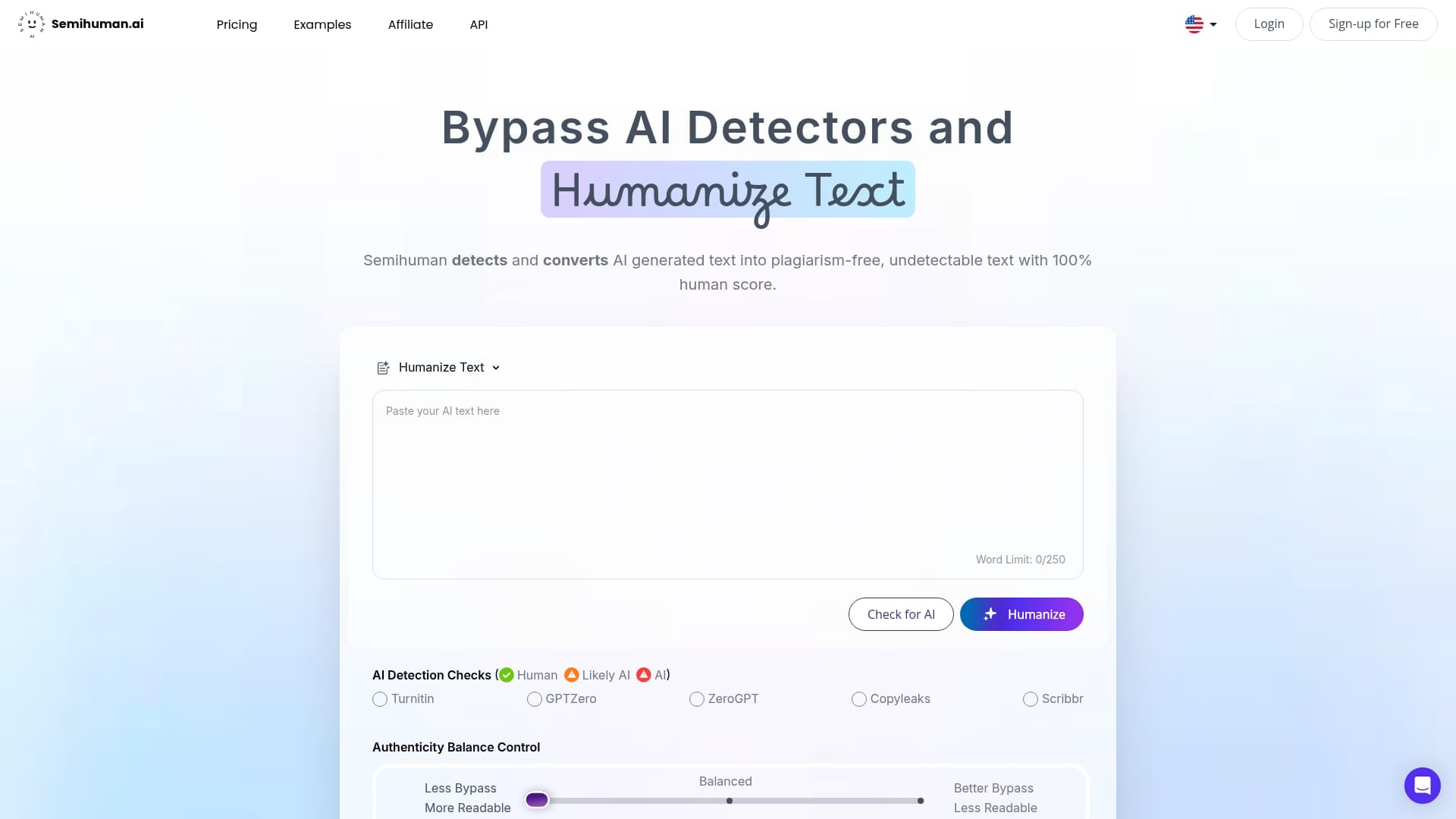
The bypass ai detectors feature helps ensure your diversified content maintains natural human characteristics that avoid detection flags. This supports your ethical authenticity efforts while scaling production. The seo text generator assists in creating optimized content across multiple formats without sacrificing your brand voice. When repurposing existing content, the ai text paraphraser helps adapt messaging for different formats while preserving core meaning and authenticity. These tools complement your human creativity and strategic direction, enabling efficient diversification that maintains the genuine connection your audience values.
Start with 2-3 formats that your audience data shows they prefer and engage with most actively. Common high-impact options include transforming written content into short videos for social media, converting webinars into podcast episodes, or creating visual infographics from data-heavy blog posts. Use your analytics to identify where your audience spends time and match formats to those platforms.
Incorporate human editing at every stage, inject personal insights and experiences unique to your perspective, and use semantic variety in sentence structure and vocabulary. Avoid shortcuts like running AI-generated content through simple paraphrasers without substantive human input. Prioritize ethical practices that add genuine value over tricks designed solely to evade detection algorithms.
AI detection tools now achieve 98% accuracy, making evasion-focused tactics increasingly futile and risky. The most effective approach combines AI efficiency with human creativity in a true hybrid workflow. Focus on creating genuinely human-enhanced content through strategic planning, personal insights, and thorough editing rather than attempting to trick detection systems with technical manipulations.
Over-diversification causes semantic drift and inconsistent brand voice by spreading resources too thin across too many formats. Failing to analyze audience preferences before repurposing leads to creating content in formats your audience doesn't use. Neglecting authenticity in pursuit of volume harms both audience trust and SEO performance. Start focused, maintain quality standards, and expand systematically based on proven results.


Start
Humanizing
for Free!
Humanize