
Loading...

TL;DR:
- Copywriting formulas serve as structural guides that support persuasion but require audience insight and creative input to be effective.
- Authentic, humanized content blending research, personality, and specific language outperforms formulaic copy that feels mechanical or generic.
- Successful content combines proven frameworks with genuine understanding and storytelling, especially in an AI-driven content landscape.
Many marketers treat copywriting formulas like paint-by-numbers kits. Follow the steps, fill in the blanks, and watch conversions roll in. The reality is more complicated. Formulas like AIDA and PAS are powerful frameworks, but when used without real audience insight or a human voice, they produce hollow, robotic copy that readers scroll past without blinking. This article breaks down the most effective frameworks, shows you exactly how they work, and explains how to adapt them so your copy, whether written by a person or an AI, actually resonates and converts.
| Point | Details |
|---|---|
| Formulas guide persuasion | Copywriting formulas structure messages to match how readers decide. |
| Research comes first | Effective copy relies on real audience insights, not just frameworks. |
| Mix and adapt | Formulas can be combined and tailored, not used as rigid scripts. |
| Human touch matters | Specificity, experience, and real voice keep AI and formula-driven content authentic. |
| Test and refine | Continual review and optimization are crucial for high-performing copy. |
Copywriting formulas are pre-built structural frameworks that guide readers through a logical and emotional sequence, from first awareness to a decision to act. Think of them as a map for persuasion. Instead of staring at a blank page wondering where to start, you follow a proven path that mirrors how human psychology actually processes information and makes choices.
The term "persuasion arc" captures this idea well. Each stage of a formula corresponds to a different mental state your reader moves through. A cold prospect who has never heard of your brand needs to be grabbed and educated before you ask them to buy anything. A warm lead who already understands the problem just needs the right emotional trigger and a clear call to action. Persuasion arcs map message stages directly to reader decision-making stages, which is why formulas remain central to professional copywriting training worldwide.
Here is why formulas matter for creators, marketers, and businesses:
The biggest myth about formulas is that they are magic scripts. Plug in your product name, add a few benefits, and watch the clicks come in. That assumption misunderstands what formulas actually do. They tell you where to put things. They never tell you what those things should be. The "what" comes from research, audience understanding, and genuine creative thinking. Good copywriting tips always emphasize this distinction: structure supports substance, it does not replace it.
"Formulas don't write your copy for you. They give you a scaffold. Whether that scaffold holds up a cathedral or a cardboard box depends entirely on what you fill it with."
Now that you understand their purpose, let's break down the most powerful formulas and see how their sequences play out.
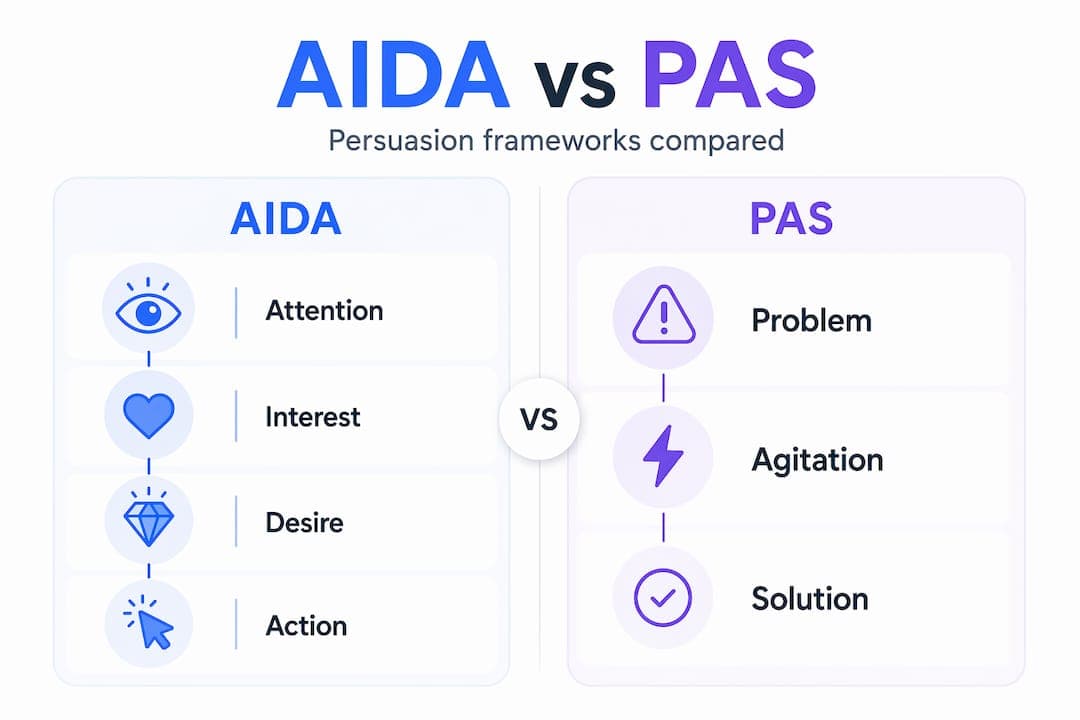
AIDA stands for Attention, Interest, Desire, Action. It is arguably the oldest and most widely taught formula in marketing.
PAS stands for Problem, Agitation, Solution. It is shorter, more emotionally charged, and widely used in short-form copy like ads, email subject lines, and landing page headlines.
AIDA is foundational for longer-form persuasive content, while PAS is better suited to concise, high-emotion writing. Understanding AIDA vs PAS comes down to your awareness stage and emotional focus.
| Feature | AIDA | PAS |
|---|---|---|
| Length | Medium to long | Short to medium |
| Emotional tone | Progressive, layered | Urgent, empathetic |
| Best for | Sales pages, email sequences | Ads, headlines, intros |
| Awareness level | Low to medium awareness | Medium to high awareness |
| Primary driver | Aspiration and desire | Pain and relief |
| Weakness | Can feel slow if audience is ready | Can feel manipulative if overdone |
Beyond AIDA and PAS, other useful frameworks include FAB (Features, Advantages, Benefits), which is excellent for product descriptions, and the 4Ps (Promise, Picture, Proof, Push), which works well for direct response copy. These add variety to your toolkit and help you tailor messaging to specific situations.
For guidance on developing persuasive copy, the key is recognizing that no single formula wins every situation. Mix and layer frameworks when one alone feels limiting.
Pro Tip: Try opening with PAS to hook emotionally, then switch into AIDA's Interest and Desire stages to build depth and aspiration. The combination is more dynamic than either formula used in isolation.
With those building blocks defined, it's crucial to recognize that structure alone is only half of the equation.

A formula gives you a template. But research gives that template its meaning. Without genuine audience insight, PAS becomes a parade of generic pain points that your reader has heard a hundred times before. AIDA's Desire stage falls flat when the benefits listed are vague and interchangeable with every competitor's website.
Formulas tell you where to put persuasion elements, while research tells you what to put there. That distinction is everything. Formulas and research are not alternatives; they are partners in a pipeline that produces effective copy.
The risks of skipping research are real and costly:
A practical two-stage pipeline looks like this:
Understanding audience needs in copywriting is what separates copy that converts from copy that simply exists on a page.
The most powerful copy often quotes the audience back to itself. When a reader sees their exact frustration described in the Problem stage of a PAS sequence, they feel understood. That emotional recognition creates trust before you have even introduced your product. Understanding how to write for digital audiences authentically is a core skill for any modern content creator.
"The best copywriters are researchers first, writers second. The formula is just the last step in a long process of listening."
Pro Tip: Before drafting any piece of copy, collect three to five real quotes from your audience describing the problem you solve. Use their vocabulary, not yours, when filling in the Problem and Agitation stages of any formula.
Even when grounded in research and a solid framework, today's content still needs a human touch, especially as AI plays a larger role.
Following a formula precisely can produce copy that feels mechanical. Every sentence moves through the correct stage, but the voice feels distant and the examples feel invented. This problem intensifies when you use AI tools to generate first drafts without giving them enough context to produce truly specific, grounded content.
Humanizing AI content means adding specificity, point of view, and lived experience to text that might otherwise read like a manual. It is the difference between "Our software saves you time" and "Our users typically reclaim six hours a week they were spending on manual reporting, hours they now spend on strategy."
Strategies for making formula-driven content feel authentic:
| Humanizing feature | What to check in your draft |
|---|---|
| Specificity | Are examples concrete and detailed, not vague? |
| Point of view | Does the copy take a clear position or stance? |
| Sentence rhythm | Does the writing vary between short and long sentences? |
| Experience signals | Are there phrases that suggest real-world knowledge? |
| Audience language | Does the copy use words the audience actually uses? |
| Emotional resonance | Does the Desire or Agitation stage feel felt, not just stated? |
For tips on authentic AI content, the recurring theme is the same: AI accelerates drafting, but humans must shape the voice, verify the specifics, and inject the personality. Explore additional AI humanization tactics to build a repeatable review process. The value of authenticity in branding is measurable, and readers increasingly recognize and reward it.
Now, let's tie these ideas together with a practical workflow that blends formulaic clarity and authentic engagement.
Formulas perform best when they are one step inside a larger, disciplined process. Dropping a formula into a chaotic workflow produces chaotic output. A well-structured process looks like this:
Copywriting formulas work best when paired with authentic voice, genuine audience understanding, and a commitment to testing and iteration. That is not optional; it is the whole point.
When working with AI tools, the quality of your input determines the quality of your output. Vague prompts produce vague copy. A detailed strategic brief, including the formula structure you want to follow, the specific audience segment, the three most pressing pain points, and the key proof points, produces dramatically better first drafts. AI copywriting tools require detailed strategic briefs and expert human review to avoid quality decline in the final output.
A well-managed content creation workflow treats AI as a fast, capable collaborator and the human writer as the quality controller and creative director. Explore more on balancing authenticity and AI to build a process that scales without sacrificing voice.
Pro Tip: Never treat formula-generated copy as final. Even excellent first drafts benefit from a round of humanization review. Set a recurring checkpoint in your workflow where a skilled writer reads every AI-produced draft aloud. If it sounds robotic when spoken, it will read robotic on the page.
Here is the uncomfortable truth about copywriting formulas in 2026: the more widely they are used, the less effective they become on their own. When every brand follows the same PAS structure, the same agitation beats, and the same solution reveal, readers develop immunity. The formula becomes background noise.
The marketers who consistently outperform their competitors are not the ones who follow formulas most precisely. They are the ones who use formulas as invisible scaffolding while building something genuinely worth reading on top. They have done the research. They know their audience at a granular level. They are willing to take a position, tell a real story, and write with actual personality.
Structure-first thinking is a trap when it becomes an excuse to skip the hard work of audience understanding. We have seen campaigns built on flawless AIDA sequences that converted poorly because the Desire stage was built around assumptions, not evidence. We have also seen messy, imperfectly structured copy outperform polished formula-driven drafts because the writer clearly understood what the reader actually cared about.
The lesson is not to abandon formulas. It is to treat them as tools in service of connection, not as the goal themselves. As AI-generated content floods every channel, the differentiator is not structure. It is specificity, genuine voice, and the unmistakable sense that a real human being who understands the reader's world wrote these words. Audience-first copywriting is not a trend; it is the durable competitive advantage that no formula alone can deliver.
Ready to put these frameworks into practice without losing the human element your audience responds to? At Semihuman.ai, we built our platform specifically for creators and marketers who need to produce high-volume, formula-structured content that still sounds authentically human.
Our SEO text generator helps you build copy that follows proven frameworks while naturally integrating your target keywords. For teams working with AI-generated drafts that need to pass authenticity checks and engage real readers, our tools to bypass AI detectors restructure and refine your content so it maintains the voice, rhythm, and specificity that distinguishes genuine human writing. When formulas give you the structure and our platform handles the humanization layer, your content achieves both scale and authenticity.
AIDA stands for Attention, Interest, Desire, Action and is a classic structural framework for guiding readers from first awareness through to a specific action. It is one of the most widely taught frameworks in marketing and advertising.
PAS focuses on identifying a Problem, agitating it emotionally, and presenting a Solution, while AIDA builds gradually through attention and desire before prompting action. The AIDA vs PAS distinction is typically an awareness-stage and emotional-intensity tradeoff.
Yes, and they work well as structural prompts, but AI-generated drafts require detailed strategic briefs and expert human review to maintain quality, specificity, and authentic voice throughout.
Adding concrete specifics, a genuine point of view, and real experience signals to formula-driven drafts is what creates authentic, engaging copy that readers trust and respond to.
Yes, content can become generic and forgettable when formulas are used without research or audience insight. Experts consistently emphasize that formulas need genuine audience understanding to remain meaningful and persuasive.


Start
Humanizing
for Free!
Humanize