
Loading...

Balancing the pressing need for authority with the demand for visibility challenges every content marketer and academic writer today. Search engines no longer reward sites for sheer production—they seek content quality and quantity working in tandem. When your writing resonates with real user intent and demonstrates genuine expertise, you build credibility with both your audience and search algorithms. This guide provides strategies to align consistent publishing with authentic, authoritative communication that elevates performance without losing the human touch.
| Point | Details |
|---|---|
| Focus on Quality | Quality content directly addresses user needs and reflects expertise, leading to higher engagement and trust. |
| Maintain Quantity Strategically | Publish content regularly to signal authority, ensuring updates are meaningful and relevant. |
| Balance Quality and Quantity | A consistent approach with high-quality updates outperforms multiple lower-quality posts in SEO and user retention. |
| Prioritize Human Authenticity | Ensure your writing feels human and genuine to enhance readability and bypass AI detection effectively. |
Today's SEO environment demands understanding the difference between these two forces. Content quality means your writing addresses real user problems with depth and accuracy. Content quantity refers to how much content you produce and publish regularly.
These aren't opposing forces—they work together. A balanced SEO strategy combines quality with consistent volume, giving search engines both valuable material and proof of your ongoing expertise.
Quality content does specific work:
For content marketers and academic writers, quality means your words sound human. They flow naturally. They don't repeat the same ideas three times in different ways. They feel like someone who actually knows the subject wrote them.
Quantity used to mean one thing: publish more, rank higher. That's changed. Today's search engines care about consistent, regular content updates that keep your site current and authoritative.
Quantity now looks like:
Search engines expect websites with real expertise to produce regular updates. A blog that hasn't been touched in six months signals abandonment, not authority.
Here's what actually works: one excellent piece of content per week beats seven rushed pieces. One updated guide that still ranks beats five new pieces competing with each other.
Expertise, authoritativeness, and trustworthiness (E-A-T) determine your rankings now. You demonstrate these through quality that readers recognize as genuine. Your writing should feel like it came from a human expert, not a content factory.
This matters especially for writers using AI assistance. Search engines reward content that reads authentically. Your audience can sense when something feels off—rushed, repetitive, or artificially constructed. When you blend quantity with quality that maintains human authenticity, you create content that performs.
Pro tip: Focus on publishing one deeply researched, thoroughly edited piece every two weeks rather than churning out shallow content daily. Quality compounds over time, building genuine authority that outlasts quantity-chasing tactics.
SEO professionals often frame quality versus quantity as competing goals. They're not. The real distinction lies in what each delivers to users and search engines. Quality content serves user intent directly. Quantity extends your reach across more search queries.
Understanding this difference changes how you approach content strategy. When quality content demonstrates expertise and trustworthiness, it builds lasting authority. When you add strategic volume, you capture more keyword opportunities without sacrificing the authenticity that readers and search engines reward.
Here's how content quality and quantity influence SEO and user experience differently:
| Aspect | Content Quality Impact | Content Quantity Impact |
|---|---|---|
| SEO Rankings | Boosts long-term authority | Enhances topical breadth |
| User Engagement | Increases time on page | Appeals to diverse search needs |
| Brand Trust | Builds credibility | Signals ongoing activity |
| Competitive Edge | Differentiates with expertise | Covers more keyword gaps |
Quality content does three things simultaneously:
For your audience—content marketers and academic writers—quality means your work feels genuinely human. It shows research. It doesn't repeat itself. It addresses nuances competitors miss.
Quantity isn't about mindless volume. It's about strategic coverage. Content volume helps capture wider keyword ranges and strengthens topical authority, but only when quality standards hold firm.
Think of it this way: one brilliant 5,000-word guide might rank for fifty keywords. Five mediocre 1,000-word pieces might rank for the same keywords poorly, or not at all.

Here's where they converge. Users don't think about quality versus quantity. They search for answers. They need content that's relevant, readable, and original.
When you blend both approaches correctly:
Google's algorithms now prioritize user-focused, valuable content. A site publishing one exceptional piece monthly outranks a competitor publishing five weak pieces weekly. But that same excellent monthly piece, combined with three quarterly updates addressing related topics? That creates compounding authority.
The winning strategy isn't quality or quantity—it's quality delivered consistently. Regular updates prove your expertise continues; deep content proves it's genuine.
For writers using AI assistance, this distinction matters critically. Search engines reward authentic human voice. Quantity-driven AI content often reads repetitive and artificial. Quality content that maintains human authenticity—refined, edited, genuinely researched—performs far better regardless of AI involvement.
Pro tip: Create one pillar piece of 4,000-5,000 words quarterly, then support it with three shorter (1,500-word) pieces exploring related subtopics. This balance captures keyword volume while maintaining the authentic quality that drives rankings and reader trust.
Human-like content isn't about tricking readers or search engines. It's about writing work that genuinely serves both. Your goal is creating authentic, readable content that demonstrates real expertise while remaining discoverable through search.
The strategy starts with understanding what makes content feel human. It's clarity. It's accuracy. It's the voice of someone who actually understands the subject, not a machine generating filler. When you balance clarity and accuracy with scientific rigor, you create work that ranks because it genuinely deserves to rank.
Human-like content begins before you write a single sentence. Deep research shows in your writing. Your readers sense when you've actually studied the topic versus regurgitating existing articles.
For content marketers and academic writers, this means:
When AI-generated content feels hollow, it's usually because the research phase was skipped or rushed.
Human writers explain complex ideas simply. They don't use jargon when plain language works. They define specialized terms on first mention.
Consistent terminology and strong titles help optimize discoverability while keeping readers engaged. Your academic audience doesn't need artificial complexity. They need clarity that proves your expertise.
Avoid keyword stuffing completely. Search engines penalize it. Readers hate it. Your authentic voice suffers.
Human writing has rhythm. It varies sentence length. It uses active voice naturally. It includes occasional contractions. It addresses readers directly when appropriate.
These elements signal humanity to both readers and algorithms:
Authentic content doesn't pretend to have all answers. It demonstrates genuine thinking about nuanced problems.
When you balance automation and creativity in content creation, you preserve the voice that makes writing feel genuinely human. Automation handles structure and optimization. Creativity and human judgment handle authenticity.
AI-generated text often needs aggressive editing to sound human. Remove repetition. Cut unnecessary phrases. Tighten transitions. Read sentences aloud—your ear catches awkwardness your eyes miss.
The editing phase is where authentic content emerges. It's where machine-generated text becomes genuinely human.
Pro tip: Write your first draft, let it sit for 24 hours, then edit with fresh eyes focusing on removing any phrases that sound generic, robotic, or repetitive. Your authentic voice emerges through revision, not initial generation.
Chasing volume destroys what makes content work. Publishers who flood the web with mediocre articles face penalties, loss of trust, and wasted resources. The quantity trap is real, and your SEO strategy pays the price.
When you prioritize quantity, you're competing against yourself. Your weak articles cannibalize your strong ones. Readers bounce. Rankings drop. Search engines learn not to trust your site.
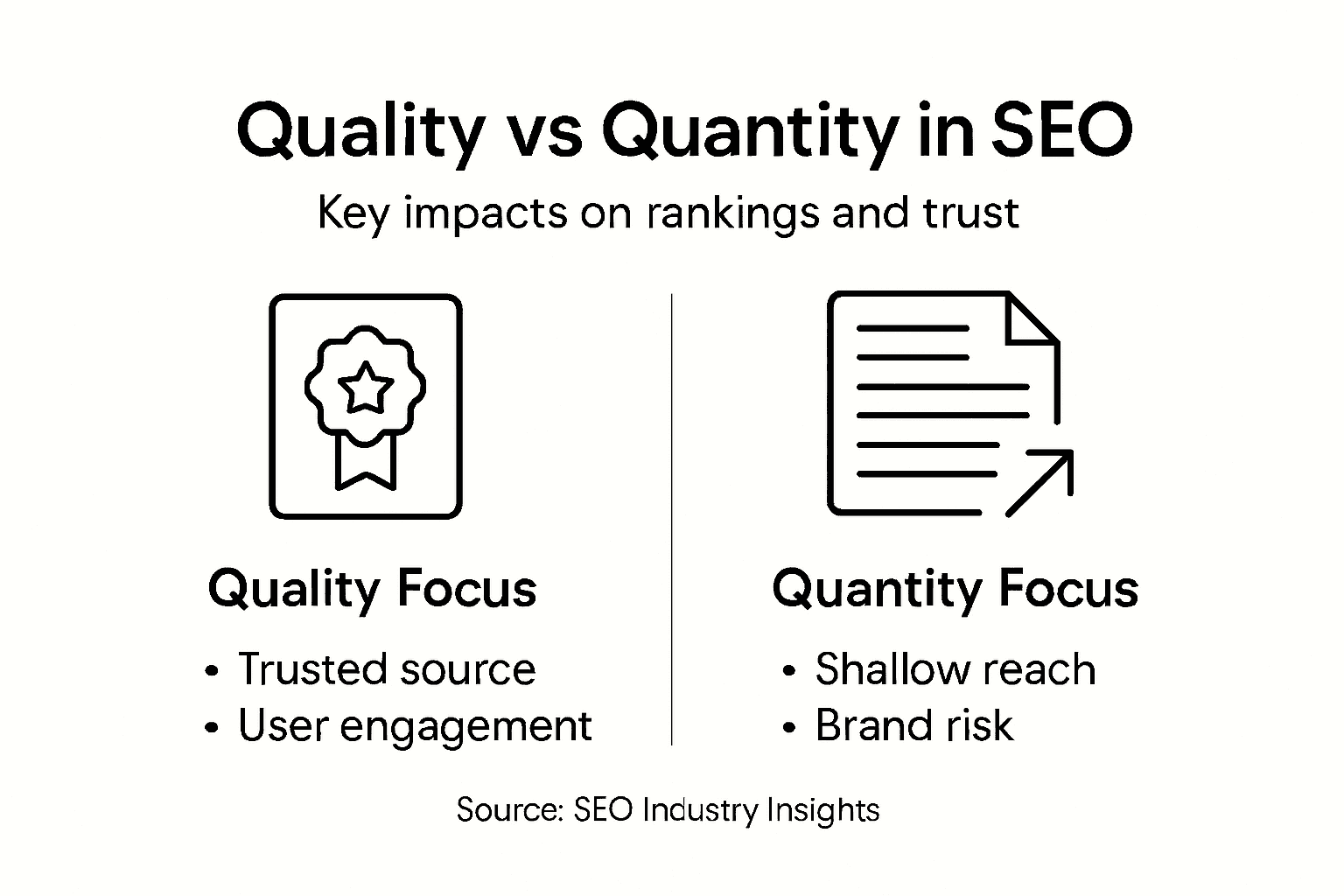
Low-quality publications undermine credibility and cause misinformation, retractions, and eroded trust. One rushed article can damage your entire brand's reputation.
For content marketers and academic writers, credibility is currency. You lose it once. Getting it back takes years.
Quantity-driven strategies create predictable problems:
Google doesn't reward volume anymore. It punishes it. Search engines penalize websites flooding the web with insufficiently researched or poorly executed articles, prioritizing content that meets user intent and offers authentic value.
Sites publishing five weak articles weekly see worse rankings than competitors publishing one strong article. The weak content actively harms your SEO.
Readers know shallow content when they see it. They leave immediately. Bounce rates spike. Time on page plummets. Search engines interpret these signals as "this site doesn't deserve visibility."
Redundant or low-value content negatively impacts user engagement and brand reputation. You're not just wasting time—you're actively training search engines to rank you lower.
Quantity sounds efficient. It's not. Writing ten mediocre articles takes nearly as long as writing two excellent ones. You spend resources producing content that doesn't convert, doesn't rank, and doesn't build authority.
Consider the math:
Quantity-driven content is dead weight. Each weak article dilutes your site's authority and confuses search engines about what you actually stand for.
Expertise builds through depth, not volume. When readers see shallow articles, they question your expertise entirely. Academic writers know this—a thin publication damages your research profile worse than publishing nothing.
Your site's topical authority comes from comprehensive, interconnected quality content. Quantity without quality produces noise, not authority.
This table highlights common risks of prioritizing quantity over quality and their consequences:
| Risk Area | Short-Term Result | Long-Term Impact |
|---|---|---|
| Credibility | Erodes reader trust | Damages brand reputation |
| Search Rankings | Triggers SEO penalties | Leads to ranking declines |
| Resource Allocation | High content churn | Wastes time, reduces ROI |
| Topical Authority | Inconsistent message | Weakens site expertise signal |
Pro tip: Audit your existing content and delete or substantially rewrite anything below your current quality standards. Search engines often rank better after you remove weak pages than when you buried them under new content. Quality improvement beats quantity addition every time.
The goal isn't to deceive anyone. It's to create content that reads naturally while maintaining genuine quality and research depth. When you understand how AI detection systems work, you can write content that passes detection while remaining completely authentic.
The key is human-in-the-loop editing. AI generates the foundation. You build the real work on top of it. This approach works because authentic content requires human judgment, original insights, and genuine voice—elements no detection system penalizes.
Starting with clear content briefs and using AI to generate constrained drafts gives you a foundation without the generic patterns detection systems recognize. A good brief includes specific angles, target audience nuances, and desired outcomes.
Constrain your AI prompts carefully:
Narrow prompts produce better starting material than broad ones.
This is where authenticity emerges. Replace generic examples with specific, original ones. Add real data from your research. Include personal experience or industry observations that only you can provide.
Detection systems flag repetitive patterns and generic statements. Original anecdotes, fresh data points, and unique perspectives bypass detection naturally because they're genuinely human.
Human writing includes rhythm variation that AI-only content lacks. Mix sentence lengths. Use contractions strategically. Employ active voice predominantly, but include occasional passive constructions naturally.
Maintaining quality and authenticity involves careful fact-checking and voice variation. Read your work aloud. Does it sound like a real person speaking, or like a machine generating paragraphs?
These variations defeat detection while improving readability:
Verify every claim. Link to sources. Acknowledge complexity and nuance. This work signals authenticity to both readers and algorithms.
Detection systems can't distinguish good from bad information, but readers can. Authentic content that's thoroughly researched and accurately sourced builds credibility that weak content never achieves.
Real authenticity comes from doing the work—researching thoroughly, thinking carefully, and writing honestly. Detection evasion is a byproduct, not the goal.
For content marketers and academic writers using AI assistance, this matters profoundly. Your reputation depends on quality. Building authentically ensures your content survives detection scrutiny because it genuinely deserves to.
Pro tip: After your AI draft, spend 40% of your editing time adding original examples, data, and observations specific to your expertise. These additions simultaneously improve quality, bypass detection, and build reader trust—all three outcomes align perfectly.
Struggling to maintain authentic, human-like content that ranks well while producing enough material to meet your audience's needs? The challenge of blending quality and quantity without sounding robotic or risking penalties is real. Your goal is to deliver thoroughly researched, naturally flowing content that search engines and readers trust. That is exactly where Semihuman.ai excels — transforming AI-generated text into vibrant, genuinely human content that strengthens your SEO and builds lasting credibility.

Discover how our AI-powered platform can help you enhance your writing with advanced features like text restructuring and keyword integration while bypassing AI detection systems such as Turnitin and GPTZero. Don’t let quantity overwhelm your quality. Take control now with Semihuman.ai, and start creating content that truly connects and ranks. Visit https://semihuman.ai and experience how authentic, consistent content creation becomes easier today.
Content quality refers to how well the content meets user needs, demonstrating expertise and authenticity. Content quantity refers to the amount of content produced and published consistently. Both elements work together to enhance SEO performance.
Quality content boosts long-term authority, engages users more effectively, and builds brand trust. Search engines prioritize high-quality, authentic content that serves user intent over mere volume.
It's beneficial to publish new content on a predictable schedule and update existing pages with fresh information regularly. Aim for a balance ensuring that you consistently address user needs while maintaining quality standards.
Yes, prioritizing low-quality content over genuine, well-researched articles can damage your credibility, lead to search engine penalties, and diminish user engagement, ultimately affecting your site's authority and rankings.



Start
Humanizing
for Free!
Humanize