
Loading...

Every American digital marketer has faced the challenge of making content feel genuinely personal without slipping into generic messaging. Content personalization is the key to turning data into real connections with your audience, transforming standard campaigns into experiences that feel tailored for each user. By using advanced data analytics and AI-powered personalization techniques, you gain new ways to create more authentic, relevant communication while keeping your strategies effective and protected against AI detection.
| Point | Details |
|---|---|
| Content Personalization Enhances Engagement | Effective content personalization improves user engagement, conversion rates, and customer loyalty. |
| Utilize Advanced Techniques | Employ AI-driven techniques like predictive analytics and machine learning to create hyper-personalized experiences. |
| Ensure Data Privacy | Maintaining user trust requires transparent data handling and consent processes in your personalization strategies. |
| Avoid Generic Approaches | To succeed, move beyond basic segmentation and develop a nuanced understanding of individual user preferences and behaviors. |
Content personalization represents a strategic marketing approach that transforms generic communication into targeted, individualized experiences. By leveraging advanced data analytics and machine learning technologies, marketers can craft messages that resonate deeply with specific audience segments. Personalized marketing strategies enable brands to move beyond traditional one-size-fits-all communication models, delivering precisely tailored content that speaks directly to consumer preferences.
At its core, content personalization involves collecting and analyzing user data to understand individual behavioral patterns, interests, and engagement signals. This process allows marketers to segment audiences with unprecedented precision, creating highly contextual experiences across digital platforms. Modern personalization techniques leverage multiple data points including browsing history, purchase behavior, demographic information, and real-time interaction metrics to dynamically adjust content presentation.
The strategic implementation of content personalization offers significant advantages for digital marketing professionals. By delivering hyper-relevant content, brands can dramatically improve user engagement, conversion rates, and customer loyalty. Advanced AI-driven personalization tools enable marketers to predict consumer needs before they arise, creating anticipatory experiences that feel intuitive and seamless. Advanced analytics platforms now allow marketers to generate micro-targeted campaigns that adapt in real-time based on user interactions.
Pro tip: Start building comprehensive user personas by integrating data from multiple touchpoints to create more nuanced and accurate personalization strategies.
Content personalization solutions have evolved dramatically, offering digital marketers sophisticated tools to deliver targeted experiences. AI-driven personalization techniques now encompass multiple strategic approaches designed to transform how brands interact with individual consumers. These solutions range from intelligent recommendation systems to dynamic content generation, each addressing unique marketing challenges and audience engagement goals.
The primary categories of content personalization solutions include behavioral targeting, predictive analytics, and machine learning-powered content generation. Behavioral targeting involves tracking user interactions and preferences to create customized content experiences. Predictive analytics uses historical data and complex algorithms to anticipate user needs before they explicitly emerge. Machine learning-powered solutions can dynamically adjust content in real-time, creating hyper-personalized experiences that feel intuitive and seamless. Personalized digital marketing strategies now leverage these technologies to deliver unprecedented levels of user engagement.

Modern content personalization solutions typically incorporate multiple techniques simultaneously. Some advanced platforms combine recommendation engines, contextual targeting, and AI-generated content to create multidimensional personalization strategies. These solutions analyze data points including browsing history, purchase behavior, demographic information, and real-time interaction metrics to generate highly precise content recommendations. Digital marketers can now implement granular personalization that adapts instantly to changing user preferences and behaviors.
Here is a comparison of major content personalization techniques and their primary benefits:
| Technique | How It Works | Key Benefit |
|---|---|---|
| Behavioral Targeting | Analyzes user actions and habits | Delivers relevant content |
| Predictive Analytics | Uses data to forecast preferences | Anticipates user needs |
| Machine Learning Content | Adjusts messages in real time | Enables instant adaptation |
Pro tip: Implement a multi-layered personalization approach by integrating at least three different data sources to create more comprehensive and accurate user profiles.
Content personalization operates through complex algorithmic processes that transform raw user data into tailored digital experiences. Advanced machine learning techniques enable systems to analyze individual user behaviors, preferences, and interactions across multiple digital platforms in real-time. These sophisticated algorithms continuously collect and process data points, creating dynamic user profiles that adapt instantly to changing engagement patterns.

The technical architecture of content personalization involves multiple sophisticated filtering methodologies. Collaborative filtering examines similarities between user behaviors, recommending content based on collective user patterns. Content-based filtering analyzes specific attributes of content and user interactions, matching individual preferences with precise accuracy. Reinforcement learning algorithms take this a step further by creating predictive models that learn and optimize recommendations through continuous feedback loops. AI-powered personalization strategies now employ complex decision-making models that can anticipate user needs before explicit actions are taken.
Modern personalization technologies integrate multiple data sources to create comprehensive user understanding. These include explicit data like user profiles and preferences, and implicit data such as browsing history, interaction times, and contextual signals. Machine learning models process these diverse inputs through neural networks and statistical algorithms, generating nuanced content recommendations that feel intuitive and precisely targeted. The result is a highly responsive system that can customize content across different channels and touchpoints with remarkable precision.
Pro tip: Implement a robust data governance framework to ensure accurate, ethical data collection and usage in your personalization strategies.
Consumer trust in digital content hinges on maintaining a genuine, human-like approach to personalized communication. Authenticity in AI-generated content requires sophisticated strategies that go beyond simple text generation, focusing on creating nuanced, contextually rich experiences that feel naturally human. The key is to develop content that reflects individual voice, emotional intelligence, and contextual understanding, rather than producing generic or robotic-sounding text.
Successful authenticity involves multiple technical and creative approaches. Content creators must integrate contextual storytelling techniques that mimic natural human communication patterns. This means developing adaptive writing styles that can adjust tone, complexity, and emotional resonance based on specific audience segments. Advanced personalization technologies now enable writers to craft content that feels uniquely tailored, avoiding repetitive linguistic patterns that trigger AI detection algorithms. Ethical AI content strategies emphasize the importance of human oversight and creative intervention in the content generation process.
Technical methods for avoiding AI detection include sophisticated text restructuring, semantic variation, and contextual randomization. These techniques involve breaking predictable language models by introducing natural variations in sentence structure, vocabulary choice, and narrative flow. Machine learning algorithms can help identify and eliminate potentially algorithmic writing patterns, ensuring that generated content maintains a genuine, spontaneous quality. By combining advanced natural language processing techniques with human creativity, digital marketers can produce content that feels authentic and engaging.
Pro tip: Regularly audit your content using multiple AI detection tools to identify and eliminate potential algorithmic writing patterns before publication.
Personalization privacy challenges represent a critical concern for digital marketers seeking to implement effective content strategies. Many organizations inadvertently compromise user trust by mishandling personal data or applying overly intrusive personalization techniques. The most significant mistakes involve collecting excessive user information without transparent consent, creating invasive experiences that make consumers feel uncomfortable and potentially violating data protection regulations.
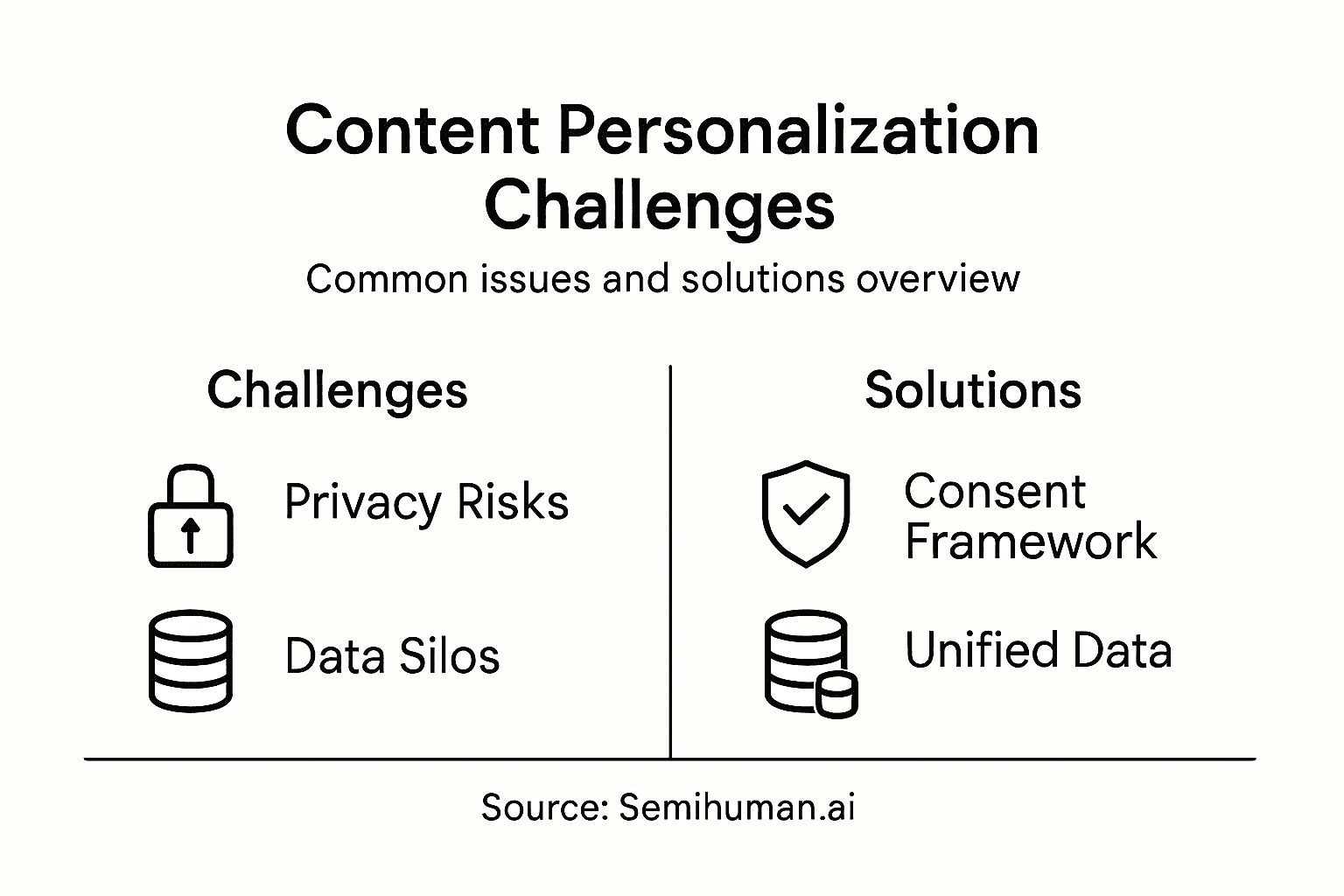
Technical implementation errors frequently derail personalization efforts. Digital marketers often struggle with inconsistent data integration across multiple channels, leading to fragmented and disconnected user experiences. Personalization strategy effectiveness requires sophisticated approaches that balance precision with user comfort. Common technical pitfalls include relying too heavily on algorithmic recommendations, failing to provide clear opt-out mechanisms, and neglecting to continuously refine personalization models based on user feedback and changing preferences.
Additionally, content personalization strategies frequently falter by applying generic segmentation approaches that fail to capture nuanced individual preferences. Successful personalization demands granular understanding of user context, emotional states, and evolving interests. Marketers must move beyond simplistic demographic categorizations and develop adaptive systems that can interpret subtle behavioral signals. The most sophisticated personalization technologies integrate machine learning algorithms capable of understanding complex user intent and dynamically adjusting content in real-time.
The following table summarizes frequent challenges in content personalization and how to avoid them:
| Challenge | Impact on Marketing | Solution Approach |
|---|---|---|
| Data Privacy Issues | Reduces user trust | Implement clear consent workflow |
| Poor Data Integration | Leads to inconsistent UX | Unify data across channels |
| Overly Generic Segmentation | Misses individual context | Use granular behavioral signals |
| Algorithmic Overdependence | Feels impersonal to users | Blend AI with human oversight |
Pro tip: Implement a comprehensive user consent framework that provides transparent data usage explanations and granular privacy controls to build consumer trust.
The article highlights the challenge of maintaining authenticity and avoiding AI detection when using content personalization strategies. Key pain points include creating genuine, emotionally resonant messaging and overcoming the pitfalls of algorithmic, robotic-sounding text. Marketers and creators aiming for real engagement need solutions that blend advanced AI capabilities with a natural human voice. This is where Semihuman.ai offers a powerful advantage by transforming AI-generated content into authentic, human-like writing that boosts SEO, builds trust, and bypasses detection tools like Turnitin and GPTZero.
With features designed for text restructuring, keyword integration, and AI detection evasion, Semihuman.ai empowers you to meet the rising demand for sophisticated, emotionally intelligent content personalization. By combining your data-driven insights with Semihuman.ai’s humanizing technology, you ensure every interaction feels intuitive, genuine, and compelling.
Ready to make your personalized content truly authentic? Discover how you can enhance your marketing strategies by using Semihuman.ai today.
Experience seamless humanization for AI-written text to increase conversion and build loyal audiences. Visit Semihuman.ai now and take your personalized digital storytelling to the next level.
Content personalization in marketing is a strategic approach that tailors communication and content to individual user preferences and behaviors by utilizing data analytics and machine learning.
By delivering hyper-relevant content that resonates with individual users, content personalization enhances user engagement, boosts conversion rates, and fosters customer loyalty.
Major types of content personalization solutions include behavioral targeting, predictive analytics, and machine learning-powered content generation, each designed to create tailored user experiences.
Common challenges include data privacy issues, poor data integration across channels, overly generic segmentation, and an overreliance on algorithms, which can lead to impersonal user experiences.

Start
Humanizing
for Free!
Humanize