
Loading...

TL;DR:
- Originality in content extends beyond wording to include argument structure, experience signals, and personal voice.
- Regular audits and human validation are essential to ensure genuine uniqueness and maintain trust from both readers and Google.
Every piece of content you publish is competing with millions of AI-generated articles, recycled listicles, and thinly veiled paraphrases. In that environment, following content originality best practices is not a nice-to-have. It is the difference between content that builds trust and rankings versus content that gets buried. Google reduced low-quality, unoriginal content by 45% after its scaled content abuse policy took effect, and that trend has only intensified. This guide gives creators, marketers, and students a clear path from understanding what originality actually means to executing it consistently.
| Point | Details |
|---|---|
| Originality goes beyond wording | Structural plagiarism, copying argument logic, counts as much as copying text. |
| Experience signals win rankings | Google's E-E-A-T framework rewards first-hand knowledge, specific data, and documented outcomes above all else. |
| AI is a partner, not a ghostwriter | Using AI for research and drafting is fine, but human editorial control determines final quality. |
| Auditing is not optional | Regular content audits for authenticity signals protect rankings and reader trust over time. |
| Tools amplify, not replace, human judgment | Plagiarism checkers and AI editing tools work best when paired with strong editorial discipline. |
Most creators think originality means not copying someone else's sentences. The real standard is higher than that, and misunderstanding it is the most common reason otherwise well-intentioned content still fails.
Structural plagiarism includes copying argument flow or logic even when the wording changes entirely. If you read three articles on SEO strategy, mentally absorb their structure, and reproduce the same sequence of points in the same order with the same examples, you have committed structural plagiarism regardless of how differently you phrased each sentence. This is one of the most overlooked forms of plagiarism in content marketing.
"True originality in 2026 is defined as synthesis with soul: combining experience, voice, and audience connection rather than just novelty." — Medium, 2026
Here are the most common originality mistakes creators make without realizing it:
Honest attribution matters both ethically and practically. Citing your sources does not weaken your authority. It actually demonstrates it. Good note-taking discipline that clearly distinguishes exact quotations from paraphrases is one of the most underrated habits in content creation.
Originality does not happen at the keyboard. It happens in the preparation phase, and most creators skip straight past it.

Primary research is what separates the top 10% of content from the rest. This means conducting your own surveys, testing tools firsthand, interviewing practitioners, or pulling data from raw sources rather than relying on what other articles have already summarized. When you work from original source material, your content naturally diverges from everyone else's because your starting point is different.
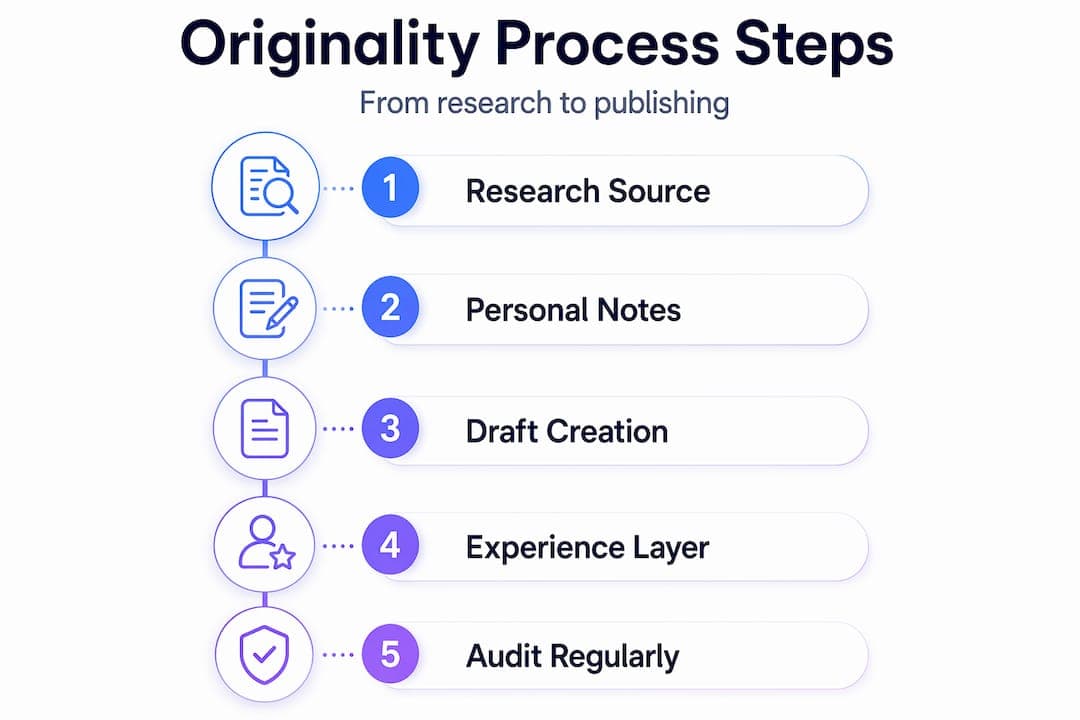
Building a personal knowledge base changes this process permanently. Keep a running document of your own observations, client results, tool comparisons, and tested workflows. When you write, you draw from that layer of genuine experience rather than recycling the same publicly available information your competitors already covered.
Here is how to choose tools that support originality rather than undermine it:
| Tool type | Best use | What to avoid |
|---|---|---|
| Plagiarism checker | Catching accidental duplication before publishing | Treating a "0% match" as proof of originality |
| AI drafting assistant | Generating research outlines and structural options | Accepting AI-generated paragraphs without editing |
| AI detection tool | Identifying patterns that read as generic or automated | Over-relying on passing scores instead of genuine editing |
| Note-taking app | Logging source quotes with full attribution from the start | Mixing your own words with copied phrases in one document |
Pro Tip: When you plan a piece, write two or three sentences about your own experience with the topic before you read any sources. That raw observation becomes the editorial spine of your piece and keeps your voice from getting absorbed into your research.
This is where best practices for unique content translate into actual writing decisions. The steps below are not theoretical. They are the habits that separate content with measurable trust signals from content that ranks for a week and then disappears.
Write a raw opinion draft first. Before you structure anything, write two to three paragraphs of your honest take on the topic. What do you actually think? What have you seen work or fail? This creates a voice anchor that AI cannot replicate and that no competitor can directly copy.
Layer in first-hand outcomes. Google rewards content that demonstrates first-hand experience through specific details, original data, and documented outcomes. Replace vague claims with specific ones. Instead of "email marketing improves conversions," write "our client's welcome sequence increased trial sign-ups by 34% after we removed four of the six automated follow-ups."
Use AI as a research and drafting partner, not a sole creator. Organizing content around human experience and pairing it with AI for research and drafting is the recognized best practice for 2026. Generate an outline with AI, fact-check the sources manually, then write the sections yourself based on your own knowledge and notes.
Eliminate AI filler patterns. Humanizing AI content requires removing filler language and adding real experience signals. Phrases like "it is worth noting," "in today's fast-paced world," and "there are several key considerations" are red flags to both readers and ranking algorithms. Cut every sentence that could have been written without anyone knowing anything about the actual topic.
Add named specifics throughout. Editing AI content by adding specific data points, named sources, and first-hand commentary is the critical step that separates reviewed content from automated content. Name the tool you tested, the metric you tracked, and the outcome you observed.
Take a clear position. Authoritativeness requires not only knowledge but visible responsibility, clear authorship, and willingness to take nuanced positions. If you hedge everything, you signal that no real human is accountable for the content. That destroys trust faster than any AI detection tool.
Pro Tip: Read your draft aloud before publishing. Every sentence that sounds like it came from a corporate brochure needs to be rewritten. If it sounds like something a chatbot would generate as a "safe" answer, it probably did.
Creating original content once is not enough. Originality in content creation is an ongoing practice, not a one-time achievement. The best creators build audit habits into their workflows.
Watch for these warning signs when reviewing existing content:
Google's Helpful Content System emphasizes user satisfaction metrics like time on site and bounce rate to evaluate genuine helpfulness. If readers arrive and leave quickly, the algorithm interprets that as a signal that the content did not deliver real value. Engagement is a proxy for authenticity.
Here is a quick-reference quality signal framework based on current Google guidance:
| Quality signal | Strong example | Weak example |
|---|---|---|
| First-hand experience | "I tested this tool for 30 days and here is what happened" | "Many users report positive results" |
| Specific data | "Conversion rate improved from 1.8% to 3.4%" | "Significant improvement in conversions" |
| Named authorship | Clear byline with verifiable credentials | Anonymous or generic author attribution |
| Engagement indicator | Average session duration over 4 minutes | Bounce rate above 80% on informational content |
When you audit, the decision between updating and rewriting comes down to one question: does the core experience layer still hold? If the information is dated but your first-hand perspective is still relevant, update the data and refresh the examples. If the piece has no genuine experience signals at all, a full rewrite is the only honest fix. Content recovery post-2026 depends more on authentic experience signals than technical SEO fixes or surface-level rewrites.
Even creators who understand the principles of unique content development run into predictable obstacles. Here is how to handle the most common ones honestly:
Volume pressure pushes quality down. When your output target is ten articles a week, originality becomes a casualty. The fix is not to produce less content blindly. It is to front-load the experience layer during planning so that each piece has at least one original insight, example, or perspective before drafting begins.
Topic saturation feels like a dead end. If a topic has 500 articles already, the angle is what creates originality, not the subject. Ask what question those 500 articles collectively failed to answer, or what perspective no one with your specific background has taken yet.
Accidental plagiarism happens through sloppy notes. The single best prevention is source discipline. When you copy a quote or statistic into your research file, mark it immediately with quotation marks and a full citation. Mixing sources and your own words in the same document without labeling them creates contaminated drafts.
AI assistance can homogenize your voice. If you use the same AI tool with the same prompts repeatedly, your drafts start to sound identical regardless of the topic. Vary your inputs, prompts, and the level of AI involvement depending on how much direct experience you have with each subject.
Limited personal experience does not mean zero originality. When you lack first-hand experience, you can build it fast. Run a small test, conduct three interviews, or document your own learning process in real time. That process itself becomes original content no one else has.
I have spent a lot of time watching how creators respond to AI, and the pattern I see most often is this: people treat AI as a shortcut to originality when it is actually a shortcut to mediocrity, unless you do the hard part yourself.
AI content reviewed and validated by humans with real experience consistently outperforms fully automated content in rankings and reader engagement. The key word there is "validated." Not skimmed. Not lightly edited. Actually interrogated by someone who knows enough to catch what the AI got wrong, flattened, or borrowed structurally from its training data.
The uncomfortable truth is that experience-based edits do not have to be long to be powerful. A single paragraph where you say "I tried this, it failed, and here is why" is worth more than 800 words of competently organized generic advice. That is what readers remember. That is what algorithms are increasingly being built to detect and reward.
The human-in-the-loop model for content creation is not a compromise between AI efficiency and human quality. When executed well, it produces better content than either approach alone. What I have learned is that the creators who thrive are not the ones who use AI the most or avoid it entirely. They are the ones who know exactly where their own judgment adds something irreplaceable, and they protect that space fiercely.
— Tilen
If you are producing content at scale while trying to maintain genuine authenticity, Semihuman gives you the tools to close the gap between AI-drafted and truly human-quality writing. The AI text paraphraser restructures AI-generated text so it carries your voice instead of sounding like a generic output, while the AI proof writing tool catches the filler phrases and generic patterns that undermine reader trust and SEO performance. For teams building content workflows at scale, the SEO text generator creates optimized drafts designed to be layered with human expertise from the start.
Semihuman is built for creators who understand that AI is most powerful when it works underneath human judgment, not instead of it. Whether you are a marketer managing a blog, a student refining academic work, or a content team producing at volume, these tools help you maintain the authenticity signals that matter in 2026.
Content originality means expressing ideas through your own voice, experience, and synthesis rather than reproducing the structure or wording of existing sources. Google's E-E-A-T framework now treats experience as the primary ranking differentiator, which means generic or unoriginal content faces both ranking penalties and reduced reader trust.
Label every source quote and paraphrase with a full citation the moment you paste it into your research notes, and never mix unattributed source text with your own writing in the same document. Good note-taking discipline that clearly separates quotations from paraphrases is the most reliable prevention method.
AI-generated content can contribute to original work, but only when a human editor adds first-hand experience, removes generic patterns, and takes a clear editorial position. Content that is reviewed and validated by humans with real expertise performs measurably better than fully automated outputs.
Watch for vague claims without specific data, no named examples or outcomes, sections that could apply to any industry, and a complete absence of authorial opinion or stance. High bounce rates are also a reliable signal that readers did not find the content genuinely useful or distinctive.
Audit high-traffic pages at least every six months, and review any content that drops in rankings immediately rather than waiting for a scheduled review. Improving content originality through regular audits protects your authority and prevents outdated or generic content from dragging down your site's overall trust signals.


Start
Humanizing
for Free!
Humanize