
Loading...

Did you know that over 40 percent of AI-generated articles contain factual errors or awkward phrasing that can slip past an untrained eye? With more businesses relying on AI writing tools, the need for thorough editing and quality control has never been greater. Mastering the process of reviewing and refining AI-created content ensures that every sentence reads smoothly and communicates your message with clarity and confidence.
| Key Point | Explanation |
|---|---|
| 1. Assess AI text for tone and accuracy | Ensure AI-generated content maintains a consistent tone and factual correctness through careful review. |
| 2. Use grammar checkers for errors | Leverage multiple grammar checking tools to identify common mistakes like subject-verb agreement and punctuation issues. |
| 3. Simplify sentence structures | Examine sentences for clarity and coherence, breaking down complex constructions into more digestible parts. |
| 4. Refine word choice and punctuation | Improve vocabulary by replacing generic terms and checking punctuation for clarity and impact. |
| 5. Utilize humanizing tools for authenticity | Apply advanced tools to transform AI text into more natural, conversational language, ensuring a human touch. |
Getting AI-generated content ready for professional review requires strategic editing and careful assessment. According to Oyova, AI writing tools frequently produce content with potential inconsistencies in tone and factual accuracy, making human oversight critical.
Start by running your AI-generated text through a comprehensive review process. First, check for contextual understanding and emotional nuance. As Yomu highlights, AI often struggles with complex linguistic elements like idioms and metaphorical expressions. Read the text carefully and identify any phrases that sound robotic or disconnected from natural human communication.
Next, systematically evaluate the content for repetitive language patterns and generic phrasing. Look for opportunities to inject personality and unique perspectives. Pay special attention to technical accuracy, ensuring that any claims or statements are factually correct. By taking a methodical approach to reviewing AI-generated text, you can transform initial drafts into polished professional content that reads authentically and maintains high quality standards.
A helpful pro tip: When in doubt, read the text out loud. If something sounds awkward or unnatural when spoken, it likely needs refinement.
Understanding and identifying common grammar mistakes in AI-generated text requires a systematic and strategic approach. According to Centfeel, AI-powered grammar checkers are excellent tools for detecting frequent errors like subject-verb agreement problems, incorrect verb tenses, and punctuation mistakes.
Start by running your AI text through multiple grammar checking platforms. As IJFMR research indicates, sophisticated AI algorithms can provide contextual feedback that helps you understand not just the errors but the underlying grammatical rules. Look for consistent patterns such as repeated verb tense shifts, subject-verb misalignments, or awkward sentence structures that sound unnatural when read aloud.
Develop a personal checklist of grammar elements to review. Focus on core areas like verb conjugation, pronoun usage, article placement, and sentence complexity. Pay special attention to nuanced grammatical constructions where AI tends to make subtle mistakes. By methodically analyzing each section of your text and cross-referencing with multiple grammar tools, you can systematically improve the linguistic quality of your AI-generated content.

Pro tip: Create a running log of mistakes you frequently encounter. This personalized reference will help you quickly spot and correct similar errors in future AI-generated texts.
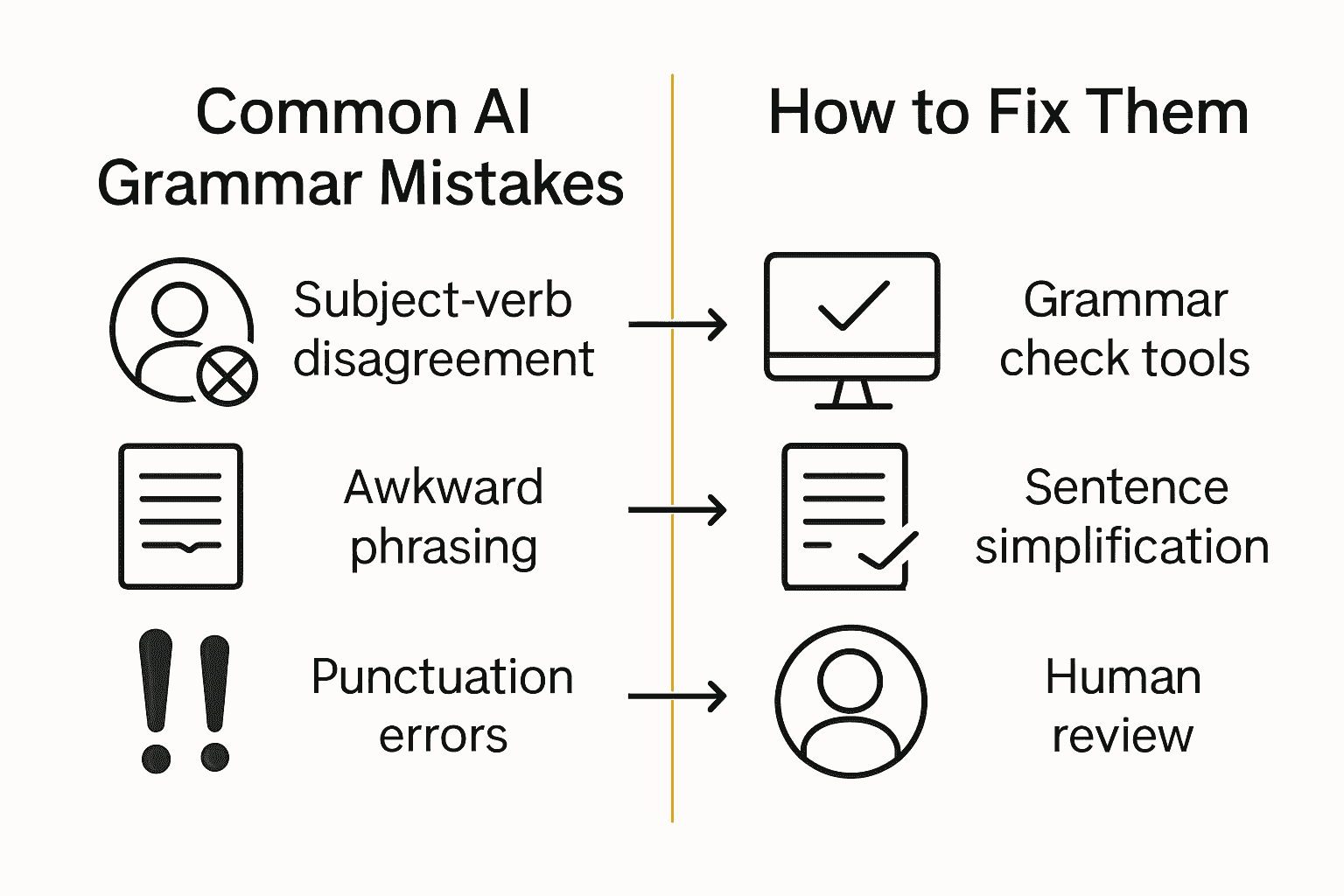
Addressing sentence structure and grammatical agreement is crucial for transforming AI-generated text into polished writing. According to Centfeel, AI grammar checkers provide powerful assistance in identifying and correcting complex issues like subject-verb agreement and inconsistent verb tenses.
Begin by carefully examining each sentence for structural coherence and grammatical alignment. As IJFMR research highlights, automated grammar correction tools can offer immediate feedback that helps writers understand and rectify subtle grammatical nuances. Focus on verifying that subjects and verbs match in number and tense, ensuring singular subjects use singular verb forms and plural subjects use plural verb forms. Watch for compound subjects that require careful verb agreement and pay attention to sentences with complex grammatical constructions that might confuse AI language models.
Develop a systematic approach to reviewing sentence structure by reading your text both silently and aloud. Check for sentences that sound awkward or unnatural and break them down grammatically. Look for opportunities to simplify complex sentences while maintaining their original meaning. Restructure sentences that feel convoluted or overly long by breaking them into more concise and clear statements.
Pro tip: Create a personal reference guide of common grammatical patterns and agreement rules specific to the type of content you frequently generate. This targeted approach will help you quickly identify and correct recurring structural issues in AI-generated text.
Polishing word usage and punctuation transforms AI-generated text from generic to professional writing. According to Centfeel, AI tools excel at identifying redundant words and suggesting precise vocabulary enhancements that elevate overall writing quality.
Start by conducting a comprehensive vocabulary review. As IJFMR research indicates, AI systems provide contextual feedback that helps writers make more nuanced word choices. Focus on replacing generic terms with specific descriptive language and eliminating unnecessary filler words. Scrutinize each sentence for opportunities to introduce more precise terminology that communicates your message with greater clarity and impact.
Pay careful attention to punctuation placement and consistency. Examine your text for proper comma usage especially around complex sentence structures and dialogue. Watch for run-on sentences that can be clarified through strategic punctuation. Verify that quotation marks periods and other punctuation elements follow standard writing conventions. Replace repetitive punctuation patterns with more dynamic and engaging sentence constructions that maintain grammatical accuracy.
Pro tip: Develop a personal style guide that captures your preferred writing tone and punctuation preferences. This personalized reference will help you quickly refine AI-generated content to match your unique communication style.
Validating your AI-generated text requires strategic use of advanced humanizing tools that can detect and transform artificial writing patterns. [Explore some of the best undetectable AI tools to humanize text that can help refine your content and make it sound more natural.
Research from Arxiv highlights sophisticated methods like the Raidar technique which analyze text editing distance to detect and transform AI-generated content. These advanced tools work by prompting language models to rewrite text in more human-like ways, helping you identify and eliminate telltale signs of artificial writing. Focus on tools that can restructure sentences break up repetitive patterns and inject natural language variations that make your text sound authentically human.
Develop a systematic approach to verification by running your text through multiple humanizing platforms. Compare the outputs to identify consistent improvement strategies. Look for tools that not only detect AI writing but provide specific recommendations for making your text sound more conversational and less algorithmic. Pay attention to subtle linguistic nuances like emotional tone contextual understanding and natural flow that distinguish human writing from machine generated content.
Pro tip: Always do a final manual review after using humanizing tools. No automated system is perfect and your personal touch can catch subtle refinements that AI might miss.
AI-generated content often carries challenges like inconsistent tone, grammatical errors, and unnatural phrasing that can make your writing feel robotic and less engaging. This article highlights common pain points such as subject-verb agreement issues, awkward sentence structures, and repetitive vocabulary that frustrate creators striving for authentic, polished text. If you find yourself spending hours correcting these mistakes or worrying about your content being flagged by AI detection tools, you are not alone.
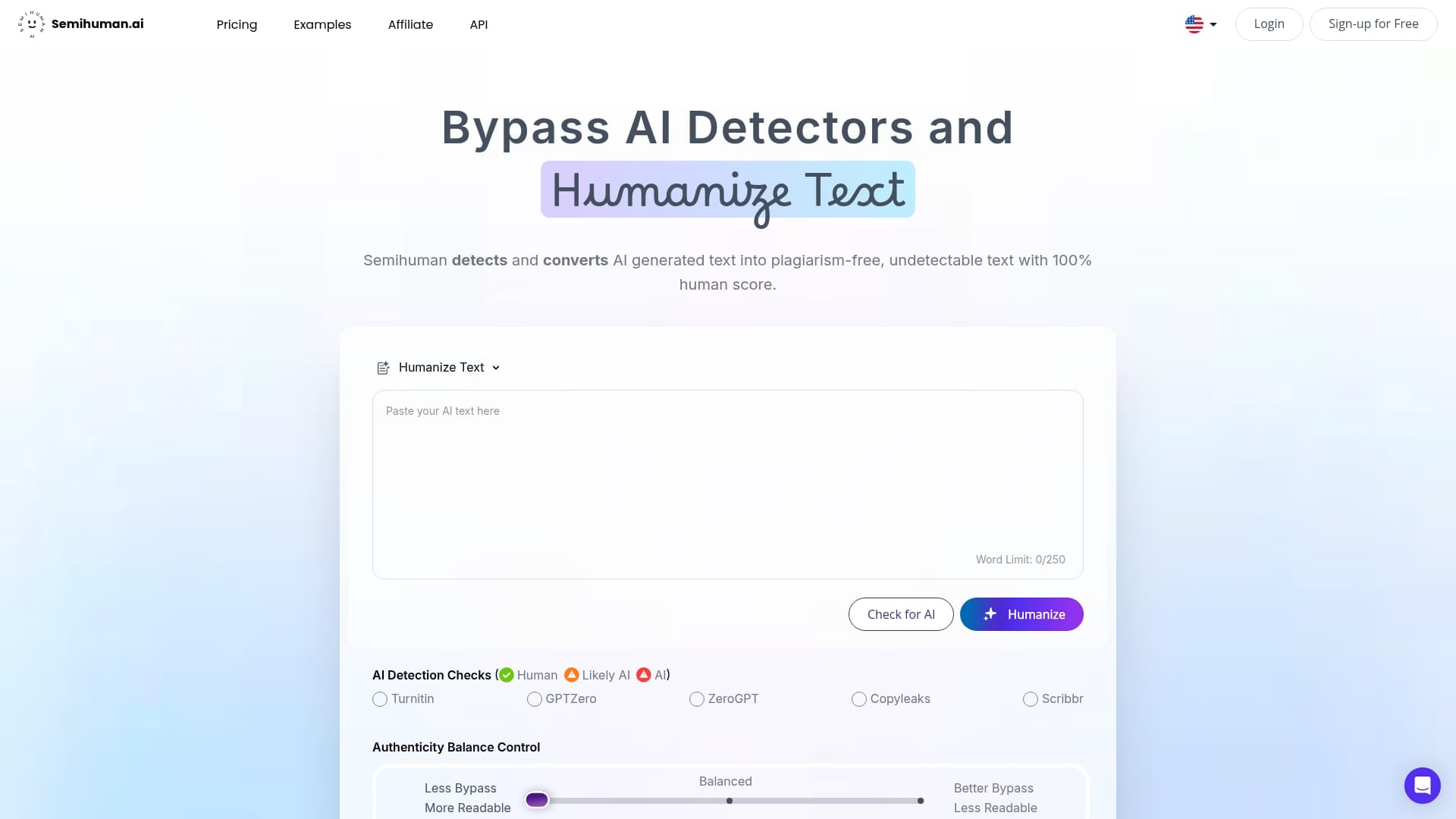
Experience a better way to refine your AI writing with Semihuman.ai. Our platform is specifically designed to humanize AI-generated text by correcting common grammar mistakes while improving sentence flow and word choice. With powerful features like text restructuring, keyword integration, and advanced evasion of detection systems, Semihuman.ai helps you produce content that sounds truly natural and resonates with your readers. Don’t let grammar errors undermine your message or SEO performance. Visit Semihuman.ai now to transform your drafts into compelling writing that passes detection tools such as Turnitin and GPTZero with confidence.
To easily fix common grammar mistakes in AI writing, start by using grammar-checking tools to identify errors such as subject-verb agreement and incorrect verb tenses. Run your text through multiple platforms for comprehensive feedback and use this information to make targeted corrections.
To improve sentence structure in AI-generated content, read each sentence carefully for coherence and grammatical alignment. Break down complex sentences into simpler statements, ensuring subjects and verbs agree in number and tense.
To verify the accuracy of facts in AI-generated text, cross-reference the claims made in the content against reliable sources or databases. Make a note of any discrepancies and correct them to ensure your writing maintains factual integrity.
When refining word usage in AI writing, focus on replacing generic terms with specific, descriptive language that conveys your message clearly. Remove unnecessary filler words to enhance impact and clarity within each sentence.
Humanizing tools can assist in detecting grammar mistakes by analyzing the text for unnatural patterns and suggesting more human-like alternatives. Use these tools to make your writing sound more conversational, but always conduct a final manual review to catch any subtle mistakes.



Start
Humanizing
for Free!
Humanize