
Loading...

TL;DR:
- Trust in digital media now depends on provenance, transparency, and community relevance rather than tone alone. Content marketers must focus on verifiable claims, community alignment, and clear disclosures to build genuine audience trust in AI-assisted content. A structural trust framework embedded in workflows ensures content remains authentic, accountable, and contextually credible.
Most content marketers assume that if their writing sounds human, audiences will trust it. That assumption is now outdated. Overall trust in news sits at 40%, stable for the third consecutive year, while skepticism around AI platforms and social media continues to grow. Trust is no longer something you earn purely through tone or style. It comes from context, provenance, transparency, and genuine alignment with the communities you're trying to reach. This article walks you through a clear framework for building that trust using humanized AI content strategies that actually work in 2026.
| Point | Details |
|---|---|
| Trust relies on context | Audience trust is shaped by platform, provenance, and community signals, not just content style. |
| Transparency is essential | Clear sourcing, disclosure, and visible accountability foster trust in digital and AI-driven media. |
| Community alignment wins | Creating content aligned with shared values and community 'circles' is more effective than generic broad messaging. |
| Workflow signals build trust | Explicit evidence, authorship, and update indicators in AI workflows are a must for maintaining credibility. |
| Practical steps matter | Marketers increase trust by using operational tactics like trust indicators and open disclosure in every workflow. |
Before you can fix a trust problem, you need to understand the terrain. Right now, that terrain is uneven and shifting fast. Trust in news remains low at 40%, with audiences expressing consistent skepticism about content they encounter on social media and AI-generated platforms. That number hasn't moved in three years, which tells us that conventional trust-building methods, like writing in a warm tone or using first-person language, are not moving the needle.
The picture gets more complex when you break it down by age. Teens aged 13 to 17 are the only age group where the majority, 57%, get news from social media at least daily. Meanwhile, adults 65 and older rely overwhelmingly on TV, at 74%. These behavioral differences matter enormously for content marketers. A strategy that works for reaching younger digital audiences may actually backfire when applied to older demographics, and vice versa.
Here's how platform trust and daily usage break down across key age groups:
| Age group | Primary news source | Trust level (approx.) | AI content receptivity |
|---|---|---|---|
| 13 to 17 | Social media (57%) | Moderate, social-dependent | Higher, if socially validated |
| 18 to 34 | Social + online news | Low to moderate | Variable |
| 35 to 64 | Mixed sources | Moderate | Skeptical |
| 65+ | TV (74%) | Moderate, brand-dependent | Low |
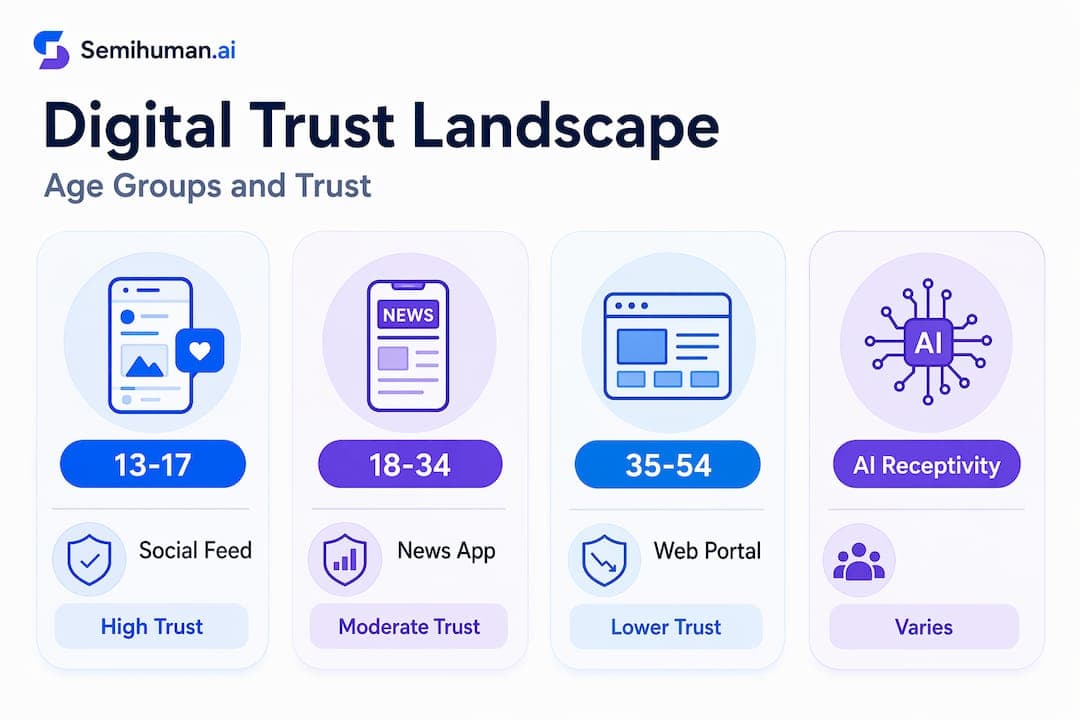
What does this mean for content marketers? It means you can't apply a single trust playbook across your entire audience. Understanding where your readers live digitally, and what those platforms signal to them about credibility, is the first step. Explore how AI content humanizers compare as tools that adapt to these different audience contexts. And if you need a broader strategic lens, humanizing content strategies for 2025 and beyond lay out the foundational tactics.
A few critical trust patterns to keep in mind:
"Audiences are not uniformly skeptical; they are selectively skeptical. The platform, the presenter, and the perceived intent all filter how trust is assigned to any given piece of content."
This is the operating environment. Now let's look at what actually builds trust within it.
For years, content marketing advice has centered on voice. Write like a human, use conversational language, avoid jargon. That guidance is not wrong, but it is incomplete. Trust in digital media is now strongly affected by perceived provenance and verification. In other words, audiences want to know where the information came from and who is accountable for it, not just whether it reads naturally.

This is a meaningful shift. Provenance means the documented origin and chain of custody for a claim or piece of content. Think of it as the difference between a recipe that says "add seasoning" and one that specifies exactly which ingredients, why they work, and who developed the method. Specificity builds confidence. Vagueness erodes it.
Designing for conditional trust is the new methodology for content marketers. Instead of assuming your polished tone will do the work, you build content systems that hold up to scrutiny at every point. That means citing sources inline, explaining how you reached conclusions, and making it easy for readers to verify claims independently.
Here's how traditional "authentic tone" stacks up against provenance-driven trust:
| Trust factor | Authentic tone approach | Provenance-driven approach |
|---|---|---|
| Author identity | Implied through voice | Explicitly named with credentials |
| Source attribution | Occasional, informal | Consistent, linked, verifiable |
| Content update signaling | None or rare | Visible "last updated" timestamps |
| Accountability mechanism | Brand reputation only | Named editors, review processes |
| Audience verification options | None | Links, citations, methodology notes |
Pro Tip: Add a "how we created this" note at the end of AI-assisted content. Even a single sentence explaining your research process and editorial review signals accountability without requiring a full disclosure statement.
Marketers who want to go deeper on practical implementation should read humanizing AI text tips for specific techniques. For a broader view on how to balance technology and authenticity without sacrificing either, that resource covers the strategic tradeoffs you'll face in 2026.
Key principles for provenance-driven content:
Here's something most trust guides skip entirely. Trust is not universal. It's earned within communities, not broadcast to audiences. The Edelman Trust Barometer 2026 describes a significant shift: trust is now earned more "in the circle," meaning within values-aligned communities, rather than through mass messaging. Edelman calls this the insularity problem: audiences trust content creators who share, or appear to share, their values and worldview.
This has direct implications for how you structure your AI-assisted content strategy. Generic content that tries to appeal to everyone signals that it belongs to no one's circle. Community-aligned content, even if AI-assisted, will outperform polished but generic messaging almost every time.
What does this look like in practice? Consider a brand producing content for B2B sustainability professionals. Generic content might say, "sustainability is increasingly important." Community-aligned content would reference specific regulatory frameworks those professionals navigate, cite research their peers cite, and use the vocabulary of that industry. The trust signal is not the quality of writing alone. It's the evidence that the author belongs or at least genuinely understands the reader's world.
AI-humanized newsletters are a strong example of how this plays out at scale. Email formats allow for segmented, personalized delivery that matches content to specific audience segments, a direct application of the "in the circle" principle. The advantages of AI humanization for authenticity and SEO also become clearer when content is shaped around community context rather than generic optimization signals.
Here are the key levers for community-aligned trust:
Pro Tip: Before publishing AI-assisted content, run it through a "circle test." Would a well-informed member of your specific target community recognize this as written for them? If the answer is no, the content needs more specificity before it earns trust.
This is where strategy meets execution. A trust framework for AI-assisted content is not a one-time audit. It's a workflow you embed into every content production cycle. Here's a practical, repeatable process:
Define your trust signals upfront. Before writing begins, identify what trust indicators you will include: author name, editorial process, source list, update date, and disclosure statement. The Trust Project's Trust Indicators are a proven operational model for outlet transparency. These include standards like best practices disclosures, author expertise statements, and labeled content types. Adapt them for your content format.
Humanize and verify in separate steps. AI drafts content; humans verify claims, check sources, and adjust for community fit. These should be two distinct workflow stages, not simultaneous. This separation is what makes your editorial review credible.
Disclose AI use clearly but contextually. A blanket "this content was AI-assisted" note is a start, but context-specific disclosure is stronger. Note what AI did (drafting, summarizing, restructuring) and what humans did (fact-checking, editing, adding expert commentary).
Show your evidence inline. Every statistical claim, every research reference, every specific assertion should be linked or attributed. AI content that reduces perceived transparency causes trust to drop even when the underlying information is accurate and helpful. Audiences forgive imperfection. They don't forgive opacity.
Build in revision signals. A visible "last reviewed" date on evergreen content tells readers the information hasn't been abandoned. This is especially important for AI-generated content, where readers may wonder whether anyone is actively maintaining accuracy.
Acknowledge limitations explicitly. If a piece covers a fast-moving topic where your AI-assisted research has a knowledge cutoff, say so. Intellectual honesty is a trust amplifier, not a weakness. Readers who see you acknowledge limitations trust you more on the things you do claim with confidence.
Resources that support this workflow include data-driven AI content optimization, which helps you measure whether trust signals are improving engagement metrics. For teams working with existing content libraries, repurposing content for AI workflows shows how to apply this framework retroactively. And for teams facing resistance to AI adoption internally, overcoming AI content challenges addresses the real operational friction points.
Most trust strategies we see in the wild are still fighting the last war. They focus on tone, readability scores, and stylistic authenticity while ignoring the structural factors that actually determine whether audiences believe what they're reading.
Here's the uncomfortable truth: you can produce beautifully written, perfectly humanized AI content and still lose audience trust completely if the provenance is unclear, if the community context is wrong, or if the platform where it's distributed signals the wrong things to your readers.
The Edelman insularity framing captures this well. Trust signals are not universal. They depend on perceived shared values, shared background, and the perceived "circle" you're trying to enter. A content marketer who thinks they can bypass this with clever humanization techniques is misreading what trust actually is.
We've seen this play out with brands that invest heavily in AI-powered content personalization while ignoring the community context that makes personalization credible. The result is content that feels targeted but not trusted, optimized but not genuine. Readers can detect the difference, even if they can't articulate it.
The winning approach is what we'd call structural trust: building every piece of content around verifiable claims, visible accountability, and clear community relevance. Style matters, but it's the finishing layer, not the foundation. Start from substance, add provenance, then humanize the delivery. Reversing that order is where most strategies break down.
Read more about how AI impacts content marketing broadly, and where the evidence points for long-term trust-building in AI-assisted publishing.
Trust-building in digital media requires tools that go beyond surface-level humanization. Semihuman.ai is designed specifically for content marketers and SEO professionals who need AI-generated content to hold up to audience scrutiny while performing in search.
Our platform helps you restructure AI drafts, integrate keywords naturally, and produce content that passes both AI detection tools and real human judgment. Whether you're building trust-rich blog content with our SEO text generator, ensuring your content passes scrutiny with tools that bypass AI detectors, or refining your drafts with an AI text paraphraser that preserves your voice, Semihuman.ai gives you the workflow infrastructure to apply the trust framework covered in this article at scale. Authentic content is not just a style choice. It's a competitive advantage, and we're built to help you maintain it.
Trust depends primarily on platform context, transparent sourcing, clear provenance, and perceived alignment with the reader's community values, as research confirms. Tone and readability matter but are secondary to these structural factors.
Trust Indicators, as defined by The Trust Project, give audiences concrete signals about editorial standards, author expertise, and content origins, making it easier to evaluate intent and decide whether to trust what they're reading.
Trust is increasingly earned within values-aligned communities rather than through mass broadcasting, as Edelman's 2026 research shows. Generic messaging lacks the specific signals that tell community members "this was made for you."
Humanizing AI content does improve trust, but only when transparency and provenance are also visible. Conditional trust design means your content must signal both authenticity and accountability to move audiences from skeptical to engaged.
Use clear disclosure statements, show your sourcing and revision dates, and explicitly acknowledge content limitations. AI-generated content that reduces perceived transparency causes trust to drop even when the underlying information is accurate, so opacity is the real risk to manage.

Start
Humanizing
for Free!
Humanize