
Loading...

TL;DR:
- Generic AI content diminishes audience engagement by sounding robotic and lacking authenticity.
- To improve, marketers should layer human insights over AI output, personalizing content and fostering genuine connections.
Generic AI content is killing your engagement metrics, and most marketers don't realize it until the data tells a painful story. Audiences have grown sharp at spotting robotic prose, and search engines are catching up just as fast. The fix isn't to abandon AI tools. It's to use them smarter, layering genuine human insight over efficient AI output so your content actually connects. This guide walks you through a proven roadmap: setting clear engagement goals, personalizing AI drafts, building feedback loops, and benchmarking against real-world data.
| Point | Details |
|---|---|
| Map the user journey | Start with clear engagement goals matched to specific audience stages for best results. |
| Humanize AI content | Transform AI drafts with expert insights and real-world context for stronger connections. |
| Embed feedback loops | Encourage two-way communication to boost ongoing engagement and refine your approach. |
| Benchmark realistically | Measure success using industry and platform benchmarks instead of broad universal targets. |
| Focus on authenticity | Prioritize genuine, valuable interactions over engagement hacks for lasting audience loyalty. |
Every strong content strategy starts with one honest question: what do you actually want your audience to do? Not a vague answer like "stay engaged." A specific, measurable outcome tied to a stage in their journey. When you build a content strategy that maps content to the audience's journey and measures it with explicit KPIs, you stop guessing and start optimizing.
The user journey typically moves through three broad phases: awareness, consideration, and retention. Each phase demands different content formats, different tones, and different success metrics. A blog post pulling cold traffic needs to measure scroll depth and new session rate. A nurture email aimed at warm leads should track click-through and reply rates. A loyalty-focused newsletter lives or dies by open rates and referral actions.
User engagement tactics for retention should be tied to user journeys and operationalized with personalization, feedback loops, rewards, and measurable signals. This isn't theory. It's the operational backbone of every high-performing content program.
How to set up your engagement KPIs in four steps:
Use the table below as a starting framework for matching KPIs to journey stages.
| Journey stage | Content type | Primary KPI | Secondary KPI |
|---|---|---|---|
| Awareness | Blog posts, social content | Organic sessions | Scroll depth |
| Consideration | Case studies, comparison pages | Time on page | Email sign-ups |
| Decision | Landing pages, demos | Conversion rate | Bounce rate |
| Retention | Newsletters, tutorials | Open rate / return visits | Referral clicks |
Pro Tip: Limit yourself to no more than three KPIs across your entire strategy at any one time. More than that creates analysis paralysis. Pick the metrics that directly feed the business goal and ignore the vanity stats that feel good but don't move revenue.
You can explore proven content marketing strategies to see how other creators are structuring their KPI frameworks for 2025 and beyond.
Once engagement goals and the user journey are mapped, making your AI-driven content truly resonate comes down to humanizing every interaction. This goes well beyond switching passive voice to active or swapping formal words for casual ones. Real humanization changes the substance of content, not just its surface texture.

Humanizing AI-generated content for SEO engagement means improving E-E-A-T signals (Experience, Expertise, Authoritativeness, Trustworthiness) and removing the generic patterns that make AI output feel hollow. That means adding genuine insights drawn from real data, naming specific experiences, and speaking to your audience's actual problems rather than their theoretical ones.
Practical personalization actions you can apply today:
The before-and-after difference is dramatic when you apply these tactics consistently.
| Version | Sample output | What's missing |
|---|---|---|
| Generic AI | "AI content can help businesses improve their digital marketing results by increasing efficiency." | No specificity, no voice, no real claim |
| Humanized | "When our team replaced templated product descriptions with AI drafts we'd layered with customer review language, conversions jumped 18% in 30 days." | Specific, credible, experience-driven |
Pro Tip: Invite a subject-matter expert or a loyal customer to contribute one quote or a short anecdote to each major AI-drafted piece. This single addition can elevate an average post into something genuinely authoritative, and it signals real-world experience to both readers and search engines.
Understanding how to humanize AI text at the sentence level is a skill worth building. You'll also find a set of tips for authentic content that goes deeper on voice calibration, and if your primary channel is email, check out the specific guide on humanizing AI for newsletters for format-specific advice.
Personalization makes your content stick, but to keep engagement rising, you need ongoing interaction and adaptation. A single campaign sprint won't sustain your metrics. What does sustain them is a systematic process of listening, rewarding, and adjusting.
The simplest feedback channels cost almost nothing to deploy. A poll embedded in your newsletter asking "Was this useful?" gives you directional data in 48 hours. A comment prompt at the end of a blog post ("What would you add to this list?") signals to your audience that their input matters. Even a brief exit survey on high-traffic pages can surface objections you'd never anticipate by looking at scroll data alone.
Rewards for engagement don't have to be expensive. Consider these high-impact, low-cost tactics:
"Continuous measurement allows marketers to fine-tune strategies for sustained engagement."
This isn't just a motivational quote. It describes an operational mindset. Set a recurring calendar event, weekly for high-velocity channels like social, monthly for longer-cycle content like blog and SEO, to review your core KPIs and ask one question: what changed, and why?
Understanding how AI elevates content marketing in practice helps contextualize what these measurement loops actually track. You'll also find a thorough breakdown of the advantages of AI humanization and why it creates compounding returns over time.
Even the most dynamic strategies need validation. Here's how to keep your efforts anchored in meaningful, actionable data rather than benchmarks you invented on a slow Tuesday.
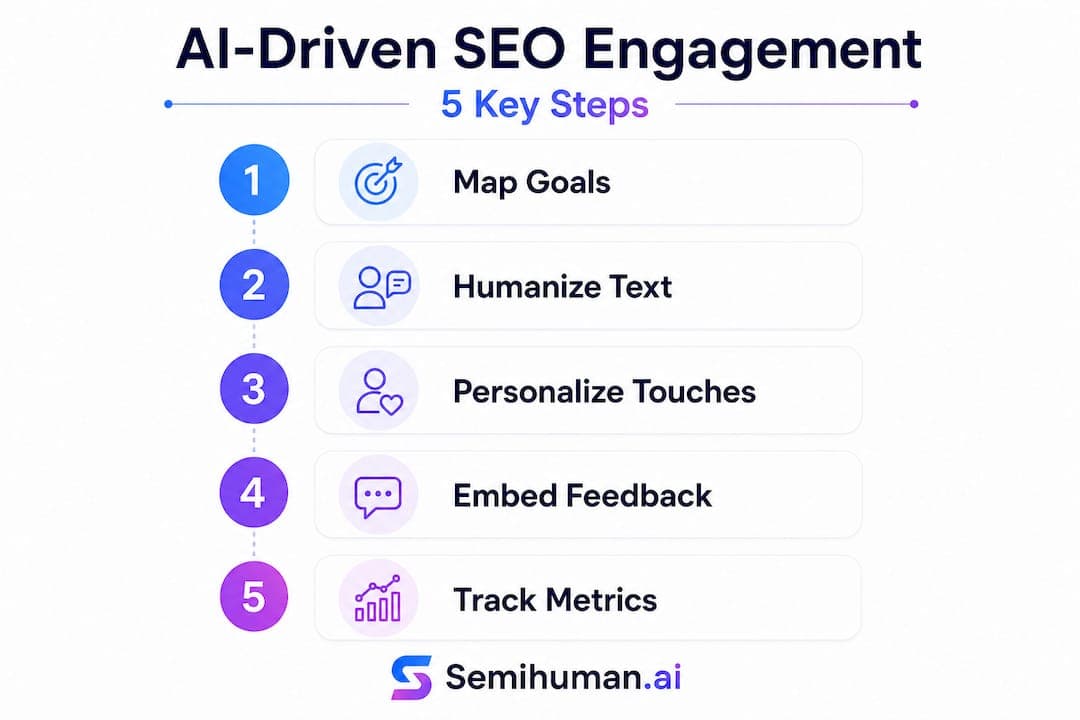
The biggest mistake content teams make is setting engagement goals in a vacuum. "We want a 5% engagement rate" sounds disciplined, but it's meaningless without context. A 5% rate on LinkedIn B2B content is exceptional. On TikTok for a consumer brand? That's underperforming. Use platform and industry benchmark datasets rather than absolute goals because Hootsuite, for example, publishes average social media engagement rates by industry that give you a real baseline.
Resources for benchmarking your engagement:
Here's a simplified view of what realistic engagement benchmarks look like across common platforms:
| Platform | Content type | Low engagement | Average engagement | Strong engagement |
|---|---|---|---|---|
| Posts (B2C) | Under 1% | 1% to 3% | Above 5% | |
| Posts (B2B) | Under 0.5% | 0.5% to 2% | Above 3% | |
| Email (general) | Newsletters | Under 15% open | 15% to 25% open | Above 35% open |
| Blog (SEO) | Long-form posts | Under 40% return rate | 40% to 55% return rate | Above 60% return rate |
The data reveals something counterintuitive: smaller, niche audiences consistently outperform mass audiences on engagement rate. A focused newsletter with 2,000 highly relevant subscribers will typically beat a 50,000-subscriber list built from giveaways or generic lead magnets.
Once you know your benchmarks, interpreting them is straightforward. If you're below average on a metric, that's a signal to investigate one layer deeper. Is your content format mismatched to the platform? Is the topic drifting away from your core audience's interest? Are you publishing at high-competition times?
For a side-by-side look at how different tools support this kind of analysis, read the AI content humanizer comparison to see which platforms pair best with your benchmarking workflow.
With tools and tactics in hand, it's time for a candid look at where most engagement strategies fall short, including some we've seen repeated by well-meaning marketers who should know better.
The most common trap is chasing surface-level engagement. Clickbait headlines, keyword-stuffed intros, and "engagement bait" posts (think: "Comment YES if you agree!") generate short-term spikes and long-term trust erosion. Audiences and algorithms are both smarter than they were two years ago. A cheap trick that worked in 2022 now actively signals low quality.
The second trap is mistaking activity for engagement. Page views are not engagement. Impressions are not engagement. Someone who reads 80% of your article, clicks through to a related resource, and returns two weeks later is engaged. Someone who clicks a clickbait headline and bounces in eight seconds is just traffic. These are not the same thing, and optimizing for the wrong one will steer your entire strategy in the wrong direction.
The real magic lives at the intersection of authentic voice and genuine usefulness. When a piece of content solves a specific, real problem using language that sounds like a trusted colleague rather than a corporate brochure, something different happens. Readers share it without being asked. They come back. They quote it in their own content. No trick replicates that outcome.
Data is a compass, not a destination. Metrics tell you where you are and what's changing. They cannot tell you what your audience actually cares about at a gut level. That requires listening, real conversations, and the willingness to say something specific and occasionally controversial rather than producing safe, generic content that offends no one and moves no one.
The hardest lesson we've observed: giving up shortcuts is the actual unlock. Spending an extra hour sharpening one article's angle, sourcing one real quote, or rewriting one generic introduction pays more than producing three additional AI-generated pieces that say nothing new.
Explore how to balance balancing tech and authenticity in your workflow, and when you're ready to build content that connects on a deeper level, the guide on writing for audience with AI offers a practical framework.
Applying the strategies in this guide takes intention and the right tools. Semihuman AI was built specifically to support content marketers who need to scale authentic, human-feeling content without sacrificing efficiency or SEO performance.
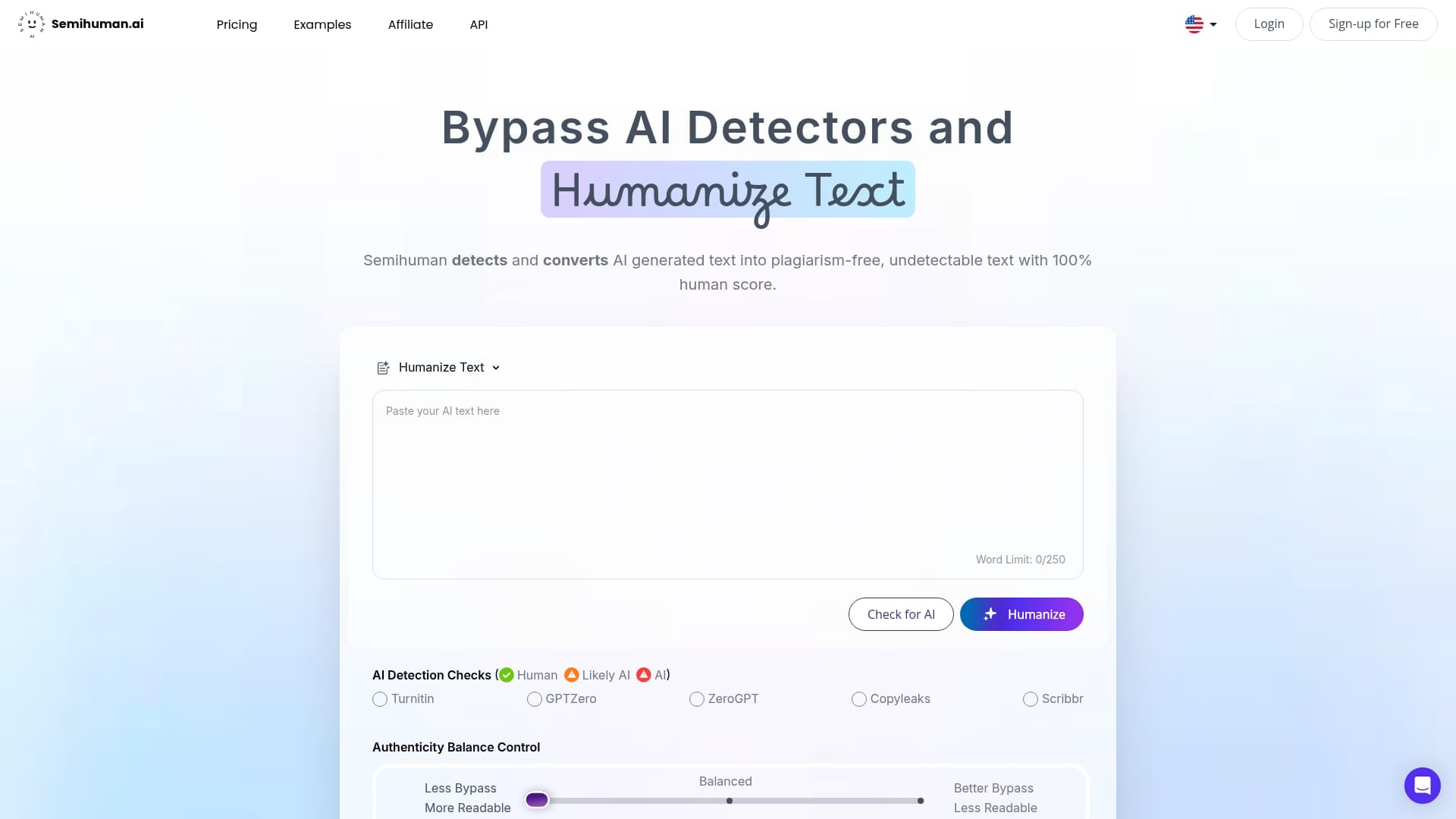
The platform's core features map directly to everything covered here. The AI text paraphraser restructures AI-generated drafts into natural, reader-first prose. The SEO text generator integrates targeted keywords in ways that support rankings without sounding forced. And for teams that need content to pass detection tools while maintaining authentic voice, the ability to bypass AI detectors ensures your humanized content stays compliant across platforms. Semihuman AI doesn't replace your strategy. It accelerates the execution of it, giving you more time to focus on the human judgment that no tool can replicate.
The best KPIs tie to journey stage and include engagement rate, conversion rate, and time on page, each mapped to a specific goal like brand awareness or lead generation.
Blend AI drafts with first-person insights, expert quotes, and user feedback loops to add authentic touches at scale without rebuilding every piece from scratch.
Yes, significantly. Engagement rate norms vary widely by industry and platform, so always compare against relevant datasets rather than applying a universal target.
Search engines reward content that demonstrates real experience and expertise. Improving E-E-A-T signals through humanization directly strengthens your content's authority and ranking potential.
Engagement improvements typically become measurable within four to six weeks, but tracking metrics from your first week of implementation accelerates your learning curve and shortens the feedback cycle considerably.


Start
Humanizing
for Free!
Humanize