
Loading...

Every American content strategist confronts the challenge of balancing fast automation with genuine creative storytelling. With artificial intelligence redefining how narratives are generated, the line between machine capability and human ingenuity grows thinner. By understanding the dynamic partnership between automation tools and human creativity, you can master strategies that amplify authenticity, improving SEO results while engaging audiences more deeply. Bold collaboration and continuous adaptation help digital marketers stand out in a marketplace crowded with AI-powered content.
| Point | Details |
|---|---|
| Balance Between Automation and Creativity | Successful content strategies leverage both AI's efficiency and human creativity to create compelling narratives. |
| Collaborative Human-AI Interaction | Future content creation models should focus on mixed-initiative systems that enhance human creativity through AI collaboration. |
| Challenges of Content Authenticity | The rise of AI-generated content demands effective strategies to maintain authenticity, balancing technology's capabilities with ethical considerations. |
| Future Trends in Content Production | Emerging technologies will emphasize the integration of human creativity with AI tools, creating more nuanced and engaging content. |
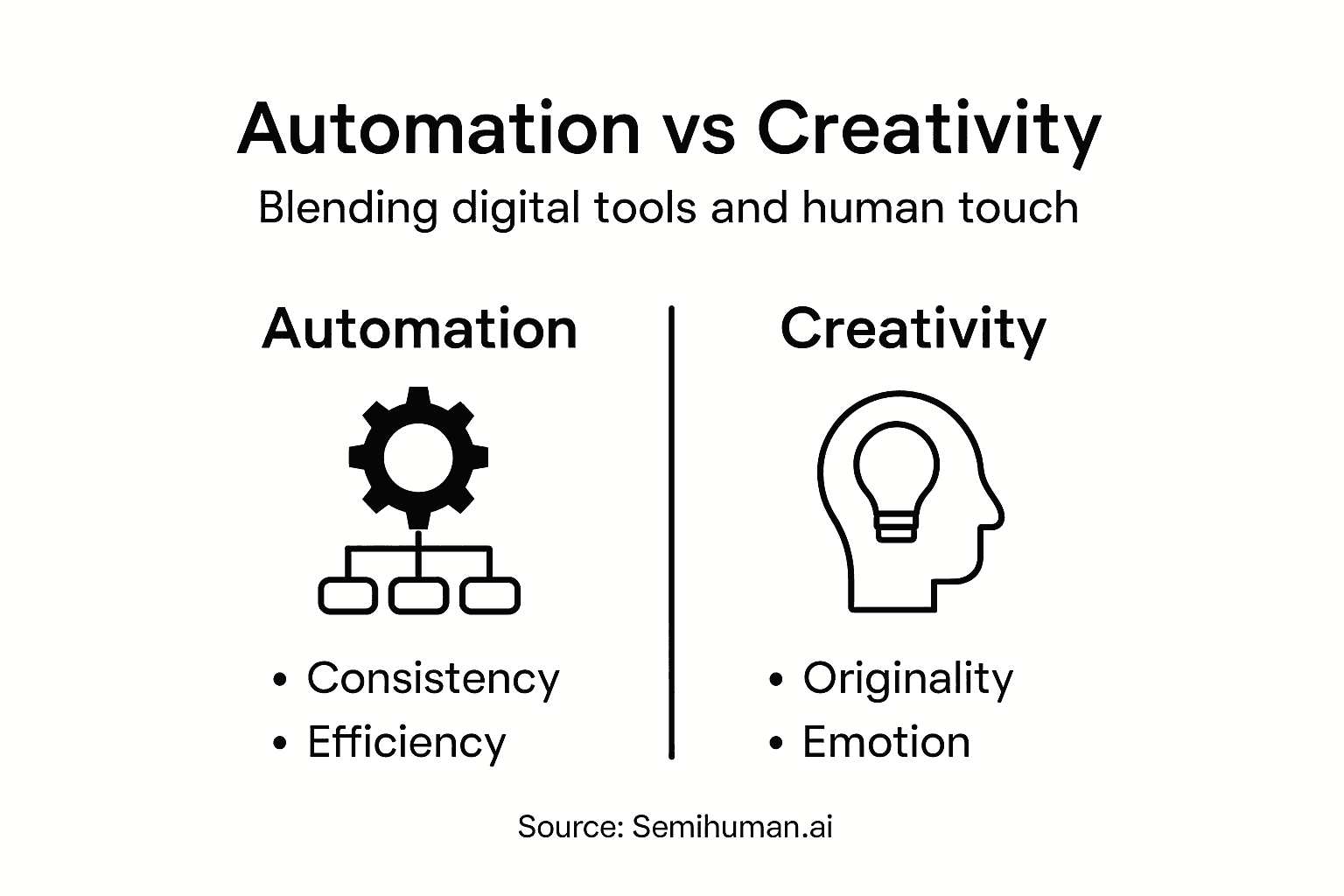
Content creation sits at a fascinating intersection of technological automation and human creativity, where artificial intelligence and human imagination converge to produce compelling narratives. Understanding this relationship requires recognizing how machine capabilities and human ingenuity complement each other in modern content production.
At its core, automation represents the systematic process of generating content using predefined algorithms and machine learning techniques. Emerging research demonstrates that AI can operate along a creative continuum - from basic computational tasks to more sophisticated content generation strategies. These systems analyze vast datasets, recognize patterns, and produce text with remarkable efficiency.
Creativity, by contrast, remains a distinctly human attribute characterized by novel thinking and unexpected connections. Cognitive research defines creativity as the ability to develop ideas that are simultaneously innovative, useful, and contextually appropriate. While AI can simulate creative processes, true originality still emerges from human experience, emotional intelligence, and nuanced understanding.
The most effective content strategies recognize this dynamic balance between automation and creativity:
To clarify the roles of automation and creativity in content production, here is a comparison table:
| Aspect | Automation (AI) | Human Creativity |
|---|---|---|
| Main Strength | Rapid content generation | Original idea creation |
| Limitation | Lacks emotional depth | Time-consuming process |
| Best Use Case | Repetitive tasks | Strategic storytelling |
| Business Impact | Boosts productivity | Enhances audience trust |
Pro tip: Treat AI as a collaborative tool that amplifies your creative potential, not a replacement for human imagination.
The landscape of content creation is rapidly evolving, with human-AI collaboration emerging as a sophisticated partnership rather than a simple tool-user relationship. Recent research highlights a paradigm shift where generative AI systems are increasingly viewed as creative collaborators capable of enhancing human imaginative processes across multiple domains.
Modern collaboration models focus on developing mixed-initiative systems that facilitate dynamic interactions between human creativity and machine capabilities. These frameworks are designed to support co-creative processes where AI provides computational insights, pattern recognition, and generative suggestions, while humans contribute strategic vision, emotional intelligence, and contextual understanding. Emerging interaction frameworks emphasize transparency, ethical considerations, and human-centered design principles.
The most effective human-AI collaboration strategies typically involve several key approaches:
These collaborative approaches recognize that AI is not a replacement for human creativity, but a powerful augmentation tool that can unlock new levels of innovative content production. By understanding each other's strengths, humans and AI can create more nuanced, engaging, and authentic content.
Pro tip: Approach AI collaboration as a creative dialogue, not a one-way generation process.
The relationship between automation tools and creative processes represents a complex and dynamic interaction that goes far beyond simple technological replacement. Recent scientific research demonstrates that AI generative technologies are most effective when viewed as collaborative enhancement tools rather than standalone creative engines.

Understanding this nuanced relationship requires recognizing the distinct strengths of both human creativity and machine capabilities. Automation tools excel at tasks like rapid data processing, pattern recognition, and initial content generation, while human creators provide critical elements such as emotional depth, contextual understanding, and innovative conceptualization. Empirical studies reveal that peak creative productivity emerges when humans strategically filter and refine AI-generated content.
Key distinctions between automation tools and creative processes include:
The most sophisticated content strategies recognize these complementary capabilities, treating AI as an intelligent assistant that amplifies human creative potential rather than a replacement for human imagination. By understanding each system's unique strengths, creators can develop more dynamic and authentic content production workflows.
Pro tip: Treat AI tools as collaborative partners that accelerate your creative process, not as autonomous content generators.
The digital content landscape is increasingly complicated by sophisticated AI technologies that blur the lines between human and machine-generated writing. European policy research highlights757583_EN.pdf) the growing challenges of maintaining content authenticity in an era of advanced generative AI systems.
Understanding detection evasion requires recognizing the complex technological arms race between AI content generators and detection mechanisms. Some key challenges emerge from the sophisticated methods AI systems employ to mimic human writing styles, including nuanced language patterns, contextual understanding, and stylistic variations. Research investigations reveal significant vulnerabilities in current detection technologies, demonstrating the ongoing complexity of differentiating between human and AI-generated content.
Primary challenges in maintaining content authenticity include:
The most effective strategies involve developing adaptive approaches that recognize the dynamic nature of AI content generation. Creators must balance technological capabilities with ethical considerations, understanding that authenticity is not about avoiding AI tools but using them intelligently and transparently.
Pro tip: Develop a nuanced approach to AI content creation that prioritizes human creativity and contextual understanding.
Humanizing automated content requires a strategic approach that transforms machine-generated text into engaging, authentic narratives. Content marketing experts emphasize the critical need to infuse AI-generated content with personal stories, emotional nuance, and contextual relevance to create truly resonant communication.
Successful content humanization goes beyond simple editing, involving a comprehensive transformation of AI-generated drafts. Effective strategies require creators to understand AI's limitations and intentionally inject human elements that provide depth, personality, and genuine connection. Research on content refinement techniques demonstrates that treating AI as a collaborative assistant rather than a standalone content creator enables more authentic and engaging outputs.
Key practices for humanizing automated content include:
Ultimately, the goal is not to disguise AI involvement but to leverage its capabilities while preserving the irreplaceable human touch that makes content truly compelling and meaningful. Creators must view AI as a powerful tool for enhancement, not a replacement for human creativity and emotional intelligence.
Pro tip: Approach AI-generated content as a collaborative draft to be refined, not a finished product.
The digital content landscape is undergoing a profound transformation, with emerging technologies reshaping how we create, consume, and validate written materials. Emerging research highlights the development of sophisticated hybrid content production models that blend artificial intelligence capabilities with human creative intelligence.
Future content authenticity will likely revolve around sophisticated verification mechanisms that go beyond traditional detection tools. These emerging approaches will focus on creating transparent, collaborative frameworks where AI serves as an enhancement tool rather than a replacement for human creativity. The most innovative models will prioritize maintaining the unique emotional and contextual nuances that distinguish truly compelling content.
Key emerging trends in content authenticity and automation include:
The ultimate goal of these technological developments is not to eliminate human creativity, but to amplify and support it through intelligent, responsive tools that understand context, emotion, and narrative complexity. Creators will increasingly view AI as a powerful collaborative partner that can unlock new dimensions of creative expression.
Here’s an overview of future trends shaping content authenticity and automation:
| Trend | Key Benefit | Potential Challenge |
|---|---|---|
| Hybrid writing platforms | Integrates AI and humans | Requires user skillful input |
| Content provenance tools | Ensures transparent authorship | May increase process friction |
| Emotional AI generation | Promotes engaging narratives | Risk of artificial emotion |
| Real-time authenticity | Immediate trust verification | Needs robust technology |
Pro tip: Invest in understanding AI technologies as collaborative tools, not replacement mechanisms.
Struggling to maintain the authentic human touch while leveraging the efficiency of AI-generated content is a challenge many creators and marketers face today. This article highlights the critical balance between automation's speed and human creativity's emotional depth. At the heart of this struggle is the need to produce content that feels genuine, engages audiences, and bypasses AI detection systems without losing originality or voice.
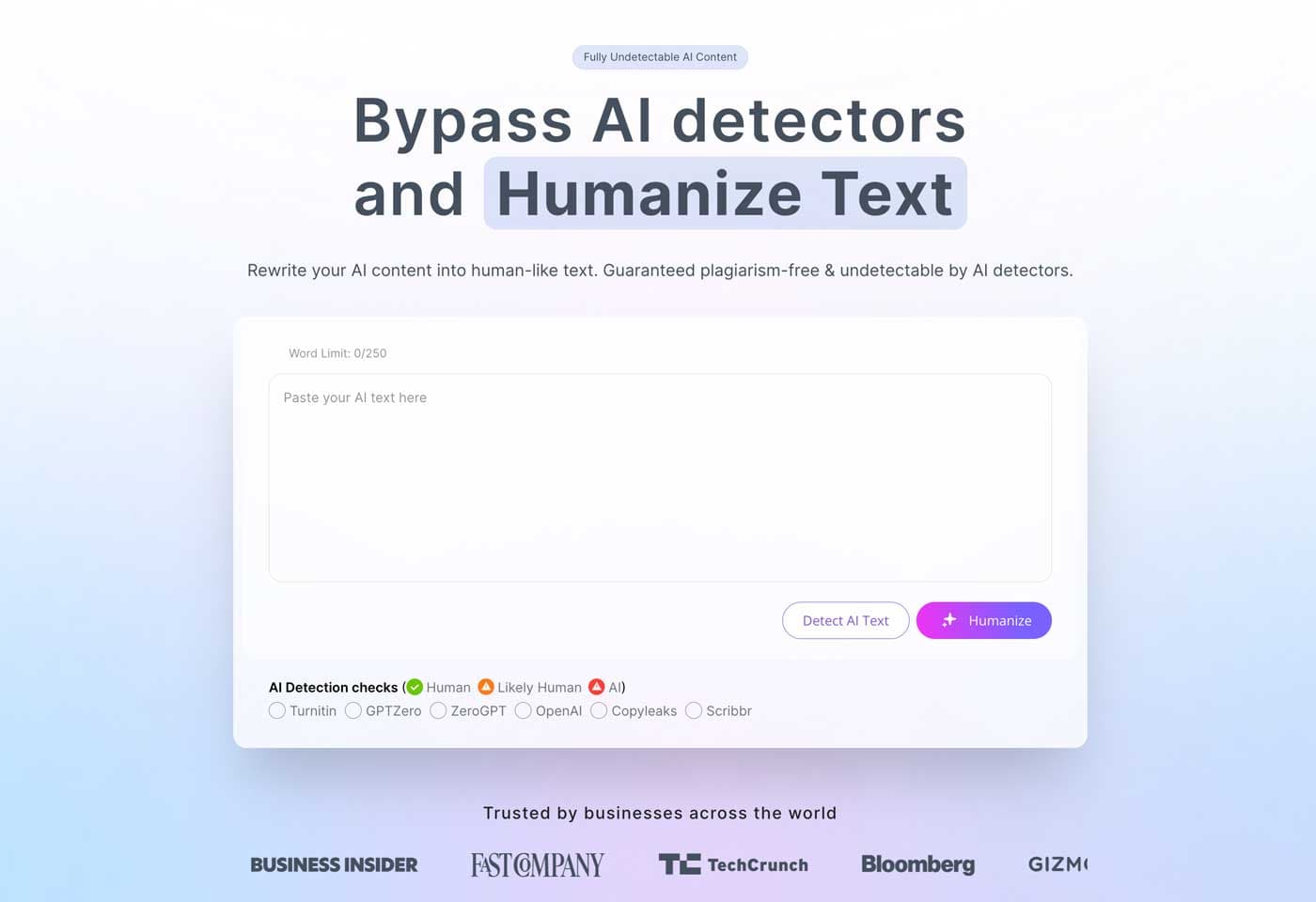
Semihuman.ai understands these pain points and offers a specialized solution designed to humanize AI-generated text seamlessly. Our platform enhances your content by restructuring sentences, integrating keywords naturally, and helping avoid detection tools like Turnitin and GPTZero. By treating AI as a collaborative tool rather than a replacement, you can amplify your creative potential and produce SEO-optimized, authentic narratives that resonate deeply with your audience.
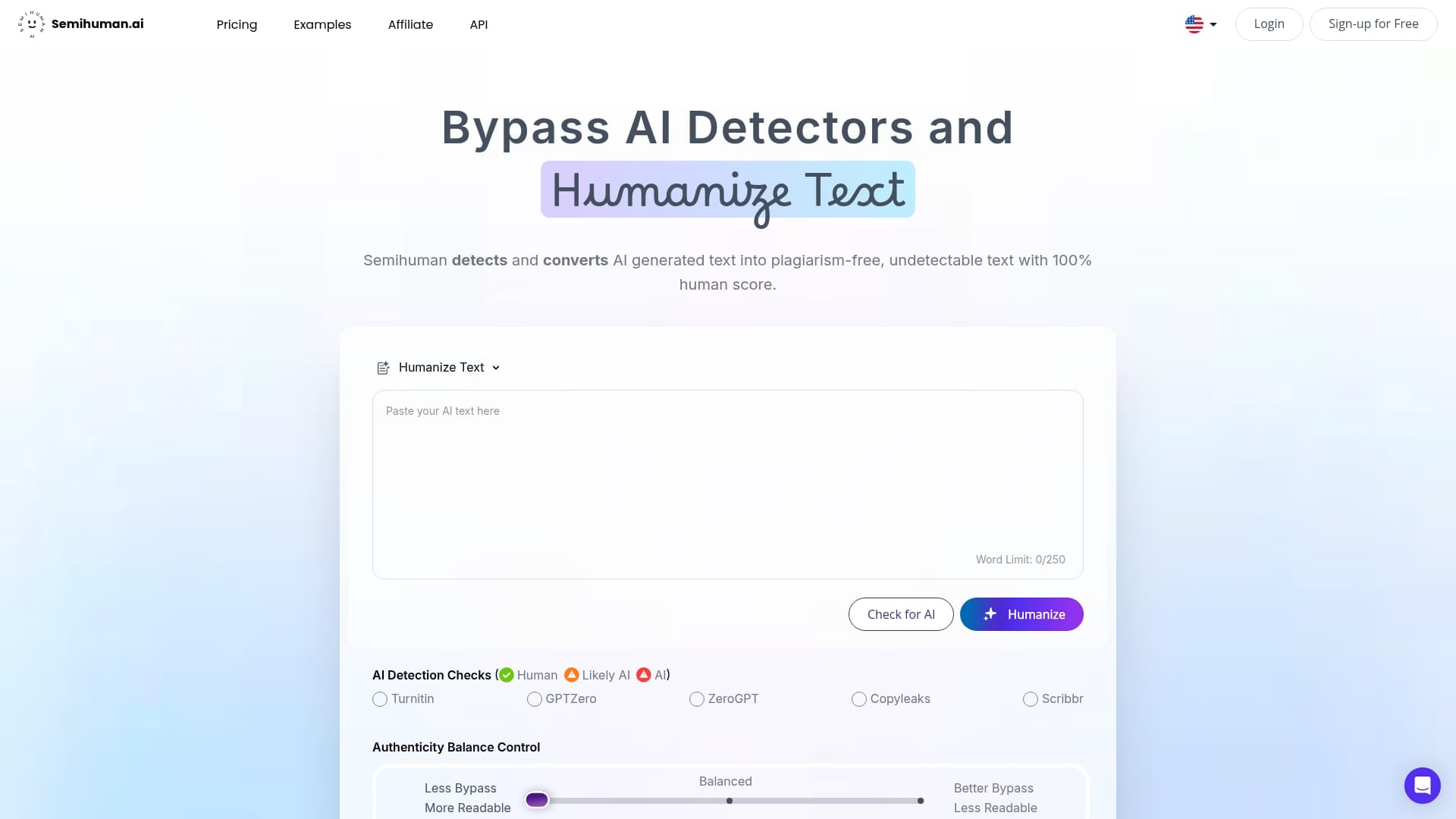
Discover how to transform automated drafts into compelling, human-like content with Semihuman.ai. Embrace the future of content authenticity today and gain the competitive edge your brand deserves. Start crafting genuine narratives that connect by visiting https://semihuman.ai now.
Automation in content creation involves using predefined algorithms and machine learning techniques to generate content efficiently. It excels at handling repetitive tasks and rapid data processing, ultimately boosting productivity.
Human creativity adds emotional depth, unique perspectives, and strategic vision to AI-generated content. By infusing personal insights and storytelling elements, creators can transform machine-generated drafts into authentic and engaging narratives.
Best practices for humanizing automated content include incorporating personal anecdotes, adjusting the tone for the target audience, adding emotional context, and performing thorough editorial reviews to maintain natural flow and connection.
Businesses can effectively collaborate with AI by utilizing prompt engineering, iterative refinement of AI-generated content, and strategic human oversight. This partnership allows for a dynamic interplay where AI provides insights while humans contribute creativity and contextual understanding.


Start
Humanizing
for Free!
Humanize