
Loading...

TL;DR:
- Automation in newsrooms handles repetitive tasks like transcription, SEO, and content drafting, freeing journalists' time.
- Effective automation requires human review to ensure ethics, accuracy, and maintain editorial voice.
- Successful implementation starts small, with clear workflows, ongoing monitoring, and fostering a culture of responsible automation.
Automation has a reputation problem in newsrooms. Many journalists assume it means trading accuracy for speed, or worse, letting a machine write stories that demand human judgment. That assumption is costing teams real time. AI automates end-to-end processes but relies on human review for quality and ethics, which means the best newsrooms aren't choosing between people and technology. They're combining both deliberately. This guide breaks down what journalist workflow automation actually looks like in practice, where it wins, where it fails, and how you can build it into your process without sacrificing the work that makes your reporting worth reading.
| Point | Details |
|---|---|
| Automate repetitive tasks | Automation excels at routine jobs like transcription, SEO, and basic drafting to boost efficiency. |
| Human review is critical | AI tools must be paired with editorial oversight to ensure factual accuracy and ethical reporting. |
| Focus on quality impact | Properly-implemented automation grows newsroom output, engagement, and frees time for deeper reporting. |
| Start small and scale | Begin with quick-win workflows, document the process, and expand automation as trust and impact grow. |
Workflow automation, in simple terms, means using software to handle tasks that follow predictable, repeatable patterns. For newsrooms, that's a surprisingly large category. Think about how much time your team spends transcribing interviews, tagging content for SEO, reformatting press releases, or sending newsletters. None of those tasks require editorial judgment. They just require time.
Here's what automation typically handles in a modern newsroom:
The critical distinction here is between automating drudgery and automating judgment. AI automates tasks like data scraping, analysis, drafting, and deployment, but human review for ethics remains non-negotiable. Automation should absorb the mechanical work so reporters can spend more time on the reasoning, verification, and narrative that no algorithm can replicate.
Understanding AI writing risks is part of using these tools responsibly. The goal isn't to remove journalists from the process. It's to remove friction.
"The newsrooms winning with automation aren't the ones using the most AI. They're the ones who've been clearest about what AI should never touch."
With the basics clear, let's look at where your day-to-day can gain the most from automation.
The gap between knowing automation exists and knowing where to apply it is where most teams get stuck. Let's be specific about what's working.
The numbers back this up. KosovaPress combined AI tools for research, drafting, transcription, and SEO, driving a 23% increase in news output and 73.9% subscriber growth. That's not a modest efficiency gain. It's a structural shift in what a small team can produce.
| Task | Traditional approach | Automated approach |
|---|---|---|
| Interview transcription | 2 to 4 hours manual | 5 to 10 minutes AI |
| Newsletter drafting | 3 hours per edition | 30 to 45 minutes with prompts |
| SEO tagging | Post-publish manual review | Real-time during drafting |
| Research aggregation | Hours of tab-switching | Structured AI summaries |
| Social content creation | Separate production session | Auto-generated from source content |
Pro Tip: Start with your team's most complained-about tasks. Transcription and newsletter generation tend to deliver the fastest visible wins, which builds internal buy-in for broader automation.
For teams interested in automating newsletters, reusable prompt templates are the fastest path to consistent output. A well-crafted prompt library can cut newsletter production from three hours to under 45 minutes. The trick is balancing that speed with tech and authenticity so readers still feel a human voice behind the work.
Automation also opens doors to stories that weren't previously possible. When AI handles data aggregation, reporters can boost audience engagement with data-driven stories that would have taken weeks to compile manually.

These case studies reveal what's possible, but there's nuance to consider in how and when to automate.
Automation isn't a uniform upgrade. It's excellent in some places and genuinely dangerous in others.
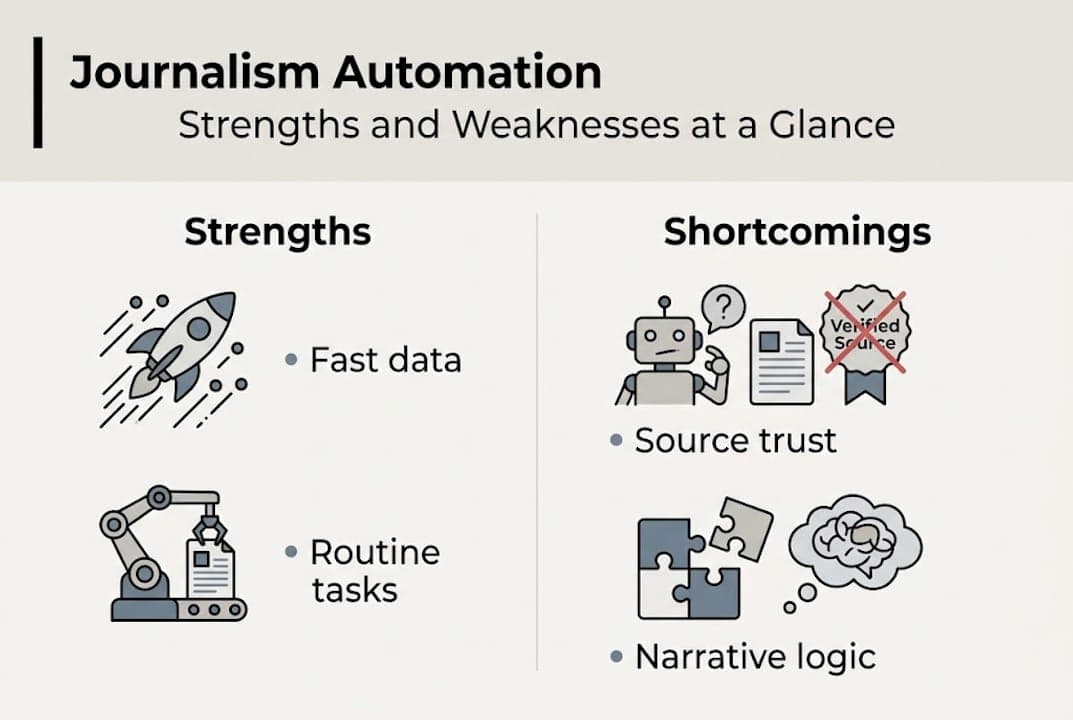
Where AI excels:
Where AI fails journalists:
| AI strengths | Human strengths |
|---|---|
| Processing large datasets quickly | Evaluating source credibility |
| Applying consistent formatting | Crafting narrative and voice |
| Generating structured first drafts | Detecting bias and ethical red flags |
| Scheduling and distribution | Making judgment calls on publication |
| Keyword and metadata suggestions | Building community trust over time |
The NEWSAGENT benchmark shows agents retrieve facts but falter at planning and narrative coherence. That's a critical limitation for any story requiring more than a structured summary.
More alarming: hallucinations and invalid citations persist in automated tools, with error rates reaching up to 22% in some models. Publishing a hallucinated statistic or a broken citation in a news story isn't a minor bug. It's a credibility crisis.
Common editorial problems that automation does not solve:
This is why AI editing needs to be treated as a formal step, not an afterthought. The automation vs creativity tension is real, and the publications that handle it best treat human editing as the final authority every time. Understanding drudgery removal as the primary use case for AI keeps expectations calibrated correctly.
Knowing both upside and pitfalls, how can you build practical automation into your newsroom without losing trust or quality?
The best newsroom automation rollouts share a common trait: they start small, validate quickly, and expand deliberately.
Governance is essential for sustainable automation: 20 to 60% of operational time can be saved, but only with human oversight for factual risks built into every workflow.
Pro Tip: Document your automation workflows in a shared file, sometimes called a CLAUDE.md or workflow brief, so any team member can step in and maintain the process. Knowledge silos are the fastest way to break an otherwise solid automation setup.
Coding agents with journalism-specific skills can enable quick, transparent replication of data investigations, but human fixes are still needed for edge cases and unexpected outputs.
Building ethical content automation standards from the start prevents the messy retrofitting that happens when teams scale before they're ready. And understanding automation challenges ahead of time means fewer surprises when something breaks.
With practical implementation mapped out, it's time to consider what makes automation truly successful for journalists, not just the tech, but the culture and standards around it.
Here's the uncomfortable reality most automation guides skip: the technology is the easy part. The hard part is culture.
Newsrooms that treat automation as a tool someone in IT manages will always underperform compared to teams where every journalist understands what the automation does, why it's there, and how to override it. Journalists must balance technology and authenticity, and unions and policies increasingly enforce human oversight and disclosure.
Upskilling in automation should be treated as seriously as learning to conduct a source interview or verify a document. It's a core professional competency now, not an optional technical add-on.
The newsrooms we respect most aren't the ones with the most sophisticated AI stacks. They're the ones that have written clear policies about what automation can and cannot do, disclosed those practices to their audiences, and created space for reporters to flag when something feels wrong.
Pro Tip: Hold regular team conversations about where automation is helping and where it's introducing risk. Open discussion builds the shared standards that protect your publication's balancing authenticity over the long term.
Done right, automation doesn't make journalism less human. It makes it more so, by freeing your team to do the work only humans can.
The frameworks in this guide give you a strong foundation. But applying them to real stories, real deadlines, and real readers requires tools that match the quality standards journalism demands.
Semihuman.ai is built for exactly that. Whether you're using our SEO text generator to optimize your content at scale, our AI proof writing tools to sharpen AI-assisted drafts, or our technology to bypass AI detectors and keep your content sounding genuinely human, the platform is designed to keep quality and authenticity at the center of every workflow. Try it with a live project and see how much time your team gets back without giving up the voice your readers trust.
Tasks like transcription, SEO tagging, newsletter generation, and initial drafting are best automated, while human review ensures reporting quality stays high. AI automates end-to-end processes but requires human oversight for ethics and accuracy.
Use AI only for initial drafts and research, then review all facts, citations, and narrative framing before publishing. Hallucinations and invalid citations persist in automated tools at error rates between 1 and 22%, making human review non-negotiable.
Yes. KosovaPress integrated AI tools for research, drafting, and SEO, yielding a 23% increase in news output and 73.9% subscriber growth, showing automation can deliver measurable results at scale.
Factual errors, hallucinations, and loss of editorial voice can seriously damage audience trust when human review is skipped. The NEWSAGENT benchmark confirms that agents struggle with planning and narrative coherence, which makes oversight essential.



Start
Humanizing
for Free!
Humanize