
Loading...

Most American universities are now seeing artificial intelligence transform how research is evaluated, with some institutions reporting AI-assisted screening slashes peer review times by over 60 percent. This shift matters because the reliability of academic publishing shapes everything from scientific credibility to public trust. As advanced AI tools take on tasks like plagiarism detection and reviewer matching, understanding their impact is essential for anyone navigating modern scholarship.
| Point | Details |
|---|---|
| AI Enhances Peer Review | AI tools improve the efficiency and accuracy of academic evaluations by automating key processes such as manuscript formatting checks and plagiarism detection. |
| Human Oversight is Essential | While AI aids in peer review, it should complement rather than replace human judgment, ensuring critical analysis remains a priority. |
| Emerging Challenges | AI integration presents risks like algorithmic bias and detection difficulties that must be addressed to preserve academic integrity. |
| Ethical Guidelines are Crucial | Developing clear protocols for AI use in peer review can help mitigate risks while promoting transparency and accountability in academic publishing. |
Artificial Intelligence is dramatically reshaping academic research evaluation through sophisticated technological interventions. Advanced screening technologies now enable rapid assessment of scholarly submissions, transforming traditional peer review methodologies with unprecedented efficiency and precision.
AI tools can rapidly analyze research manuscripts across multiple dimensions, performing complex evaluations that previously required extensive human review. These technologies assess critical aspects like manuscript formatting, language quality, potential plagiarism risks, and preliminary research significance. Screening algorithms now intelligently categorize submissions, recommend appropriate expert reviewers, and identify potential conflicts of interest with remarkable accuracy.
The integration of AI in peer review processes introduces several key capabilities that enhance scholarly communication:
While AI technologies offer significant advantages, they are not intended to replace human academic judgment but rather to augment and streamline complex evaluation processes. Researchers and academic institutions must develop nuanced frameworks that leverage AI's computational power while maintaining critical human oversight and interpretative skills.
Pro Tip: Implement AI tools as collaborative assistants, not replacement systems. Always maintain human critical analysis and contextual understanding in final evaluation processes.
Traditional peer review methodologies are undergoing significant transformation with the emergence of AI-driven evaluation techniques. Modular AI frameworks now enable systematic experiments that complement human academic judgment, introducing new possibilities for more consistent and structured research assessments.
The landscape of peer review currently encompasses several distinct approaches where AI plays an increasingly sophisticated role:
Interestingly, generational research reveals significant differences in AI adoption. Early-career researchers, particularly those with less than 5 years of experience, are more likely to integrate AI tools into their academic workflow, viewing these technologies as essential productivity enhancers rather than potential threats.
AI's role in peer review is not about replacement but augmentation. These technologies provide robust computational support that helps researchers overcome language barriers, manage time constraints, and increase overall evaluation consistency. The goal remains maintaining human critical thinking while leveraging technological efficiency.

Pro Tip: Start small with AI integration. Begin by using AI for initial manuscript screening and formatting checks, gradually expanding its role as you become more comfortable with the technology.
Here's a comparison of traditional peer review and AI-augmented peer review in academic publishing:
| Dimension | Traditional Peer Review | AI-Augmented Peer Review |
|---|---|---|
| Reviewer Selection | Manual, expertise-based | Algorithm-driven, expertise-matched |
| Submission Screening | Time-intensive, manual checks | Instant, automated assessment |
| Bias Management | Subject to human bias | Attempts algorithmic fairness |
| Plagiarism Detection | Often done post-review | Automated in initial screening |
| Efficiency | Weeks to months | Hours to days |
| Quality Assurance | Inconsistent across reviewers | Systematic, standardized checks |
The integration of artificial intelligence into academic peer review introduces complex challenges that demand critical examination. Scientific publishing incidents have already exposed significant vulnerabilities, such as AI-generated text slipping through review processes and fabricated research imagery compromising scholarly integrity.
Three primary challenges emerge in AI-assisted peer review:
The fundamental concern lies not in AI's capabilities but in maintaining rigorous academic standards. Researchers must develop adaptive strategies that leverage AI's computational power while preserving human critical thinking and contextual understanding. This requires continuous refinement of detection algorithms, ethical guidelines, and interdisciplinary collaboration.
Moreover, transparency becomes crucial. Academic institutions must implement robust verification mechanisms that can identify potential AI-generated content without stifling technological innovation. The goal is creating a balanced ecosystem where AI serves as a supportive tool rather than a replacement for human intellectual scrutiny.
Pro Tip: Develop a multi-layered review process. Combine AI initial screening with human expert evaluation to maximize accuracy and maintain scholarly integrity.
Generative artificial intelligence introduces profound ethical challenges that demand rigorous scrutiny across academic research landscapes. Complex ethical considerations encompass multiple dimensions, including transparency, potential bias, data fabrication, copyright violations, and significant privacy implications.
The primary ethical concerns in AI-driven academic environments can be categorized into several critical domains:
Communication transformation within peer review processes highlights both opportunities and risks. Academic institutions must develop sophisticated frameworks that balance technological innovation with rigorous ethical standards.
Researchers and academic administrators must proactively establish comprehensive guidelines that address emerging AI challenges. This requires interdisciplinary collaboration, continuous technological assessment, and adaptive regulatory mechanisms that protect academic integrity while embracing technological potential.
Pro Tip: Create a structured AI ethics protocol. Develop clear guidelines for AI tool usage, emphasizing transparency, proper attribution, and continuous human oversight in research processes.
The following table summarizes key risks and mitigation strategies when implementing AI in peer review:
| Challenge Area | Risk Example | Mitigation Strategy |
|---|---|---|
| Algorithmic Bias | Favoring certain paradigms | Continuous model auditing |
| Data Fabrication | Generated fake research data | Require human result validation |
| Privacy | Mishandling reviewer data | Enforce strict data governance |
| Transparency | Opaque AI decision criteria | Publish clear AI usage policies |
Pedagogical integration of AI and peer feedback represents a nuanced approach to enhancing academic review processes. Modern research suggests that effective humanization requires strategic blending of technological capabilities with human critical thinking, recognizing the unique strengths of both AI and human reviewers.
Key strategies for humanizing AI-assisted reviews include:
Academic research highlights significant opportunities and challenges in AI-assisted review methodologies. While AI can potentially improve review quality through enhanced writing clarity and systematic evaluation, researchers must remain vigilant about maintaining the fundamental purpose of rigorous scientific assessment.
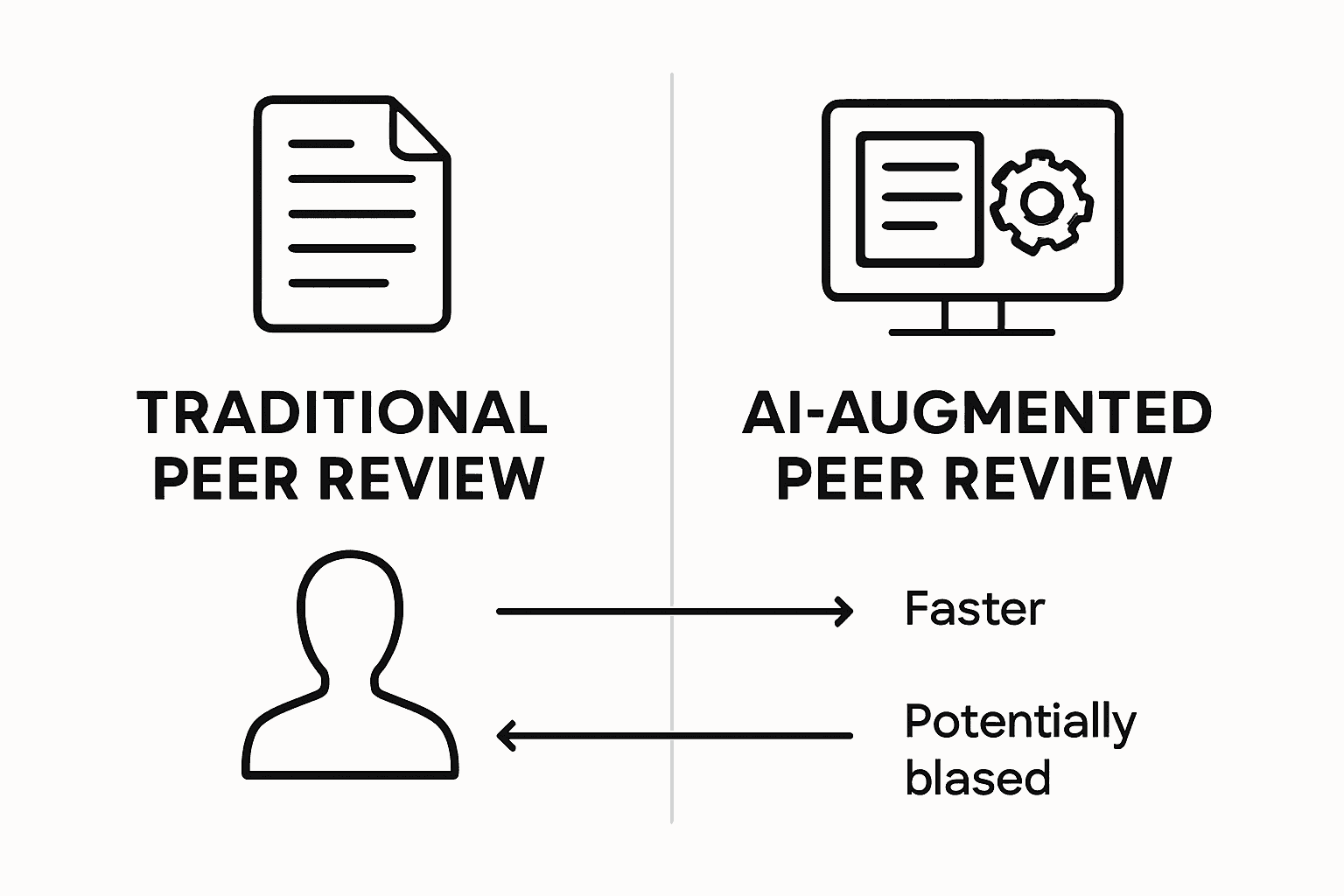
Successful humanization requires a balanced approach that views AI as a collaborative tool rather than a replacement for human intellectual engagement. Academic institutions must develop flexible frameworks that leverage technological efficiency while preserving the critical interpretative skills of human experts.
Pro Tip: Design hybrid review workflows. Create clear guidelines that specify exactly where and how AI can assist, ensuring human reviewers maintain primary intellectual responsibility.
The article "AI and Peer Review Challenges – Ensuring Fair Evaluation" highlights critical issues like algorithmic bias, accuracy limitations, and the ethical risks involved with AI in academic evaluations. These challenges can compromise content integrity and fairness during peer assessments. If you are looking to maintain human oversight while embracing AI's efficiency, addressing issues like AI-generated text detection and authenticity is essential.
With Semihuman.ai, you gain a specialized AI-powered solution designed to transform AI-generated content into naturally human-like writing. Our platform helps minimize detection risks by tools such as Turnitin and GPTZero, ensuring your submissions maintain a genuine academic voice while preserving originality. Semihuman.ai actively supports creators, researchers, and marketers who want to overcome the challenges of AI content scrutiny and maintain ethical standards.
Discover how to safeguard your academic work from AI detection risks and enhance content authenticity today. Visit Semihuman.ai for advanced text restructuring, keyword integration, and detection evasion tools. Don't let AI-generated content challenges jeopardize your scholarly integrity—try our platform now and support fair, transparent evaluation processes backed by trustworthy humanized content. Explore more about transforming AI content at Semihuman.ai and learn how to balance AI assistance with human critical thinking from the insights shared in AI and Peer Review Challenges – Ensuring Fair Evaluation .
The primary challenges include algorithmic bias, accuracy limitations in understanding complex research contexts, and difficulties in detecting sophisticated AI-generated content.
AI can automate initial manuscript screenings, conduct rapid plagiarism checks, and intelligently match reviewers with submissions based on their expertise, greatly improving the speed and consistency of evaluations.
Researchers should maintain human oversight to ensure critical analysis, develop clear guidelines for AI usage, and implement multi-layered review processes that combine AI assessments with human expertise.
Ethical concerns can be mitigated by establishing transparency protocols, ensuring proper attribution, conducting continuous audits for algorithm fairness, and promoting interdisciplinary collaboration to develop guidelines and best practices.

Start
Humanizing
for Free!
Humanize