
Loading...

Most advice about artificial intelligence blog content overlooks one critical shift—over half of American businesses already use AI tools to generate digital writing. As more blogs and articles are produced by machines, understanding how AI creates content and its impact on quality becomes essential for readers, writers, and brands. This guide shows what sets AI blog writing apart and why every American content creator should recognize both its power and its pitfalls.
| Point | Details |
|---|---|
| AI-Generated Content | Artificial Intelligence Generated Content provides rapid, scalable, and consistent writing across multiple domains, transforming traditional content creation processes. |
| Legal and Ethical Challenges | Content creators must navigate issues such as copyright infringement, plagiarism, and potential misinformation when using AI-generated material. |
| Humanization Techniques | Effective humanization of AI-generated content involves adding emotional nuance and personal touches to create engaging text that resonates with readers. |
| Collaborative Tool Use | AI content generation should be viewed as a collaborative tool to enhance creativity, requiring human review and personalization to maintain authenticity. |
Artificial Intelligence Generated Content (AIGC) represents a transformative approach to digital writing where machine learning algorithms create textual content autonomously. Unlike traditional content creation methods, AI blog content leverages advanced language models to produce coherent, contextually relevant text across various topics and styles.
At its core, AI blog content is generated through sophisticated machine learning processes that understand and replicate human communication patterns. These systems analyze massive datasets, learning grammatical structures, semantic nuances, and stylistic variations to produce writing that mimics human-created text. Modern AI content generators can craft blog posts, articles, and digital content with increasing sophistication, drawing from vast repositories of information to create contextually appropriate narratives.
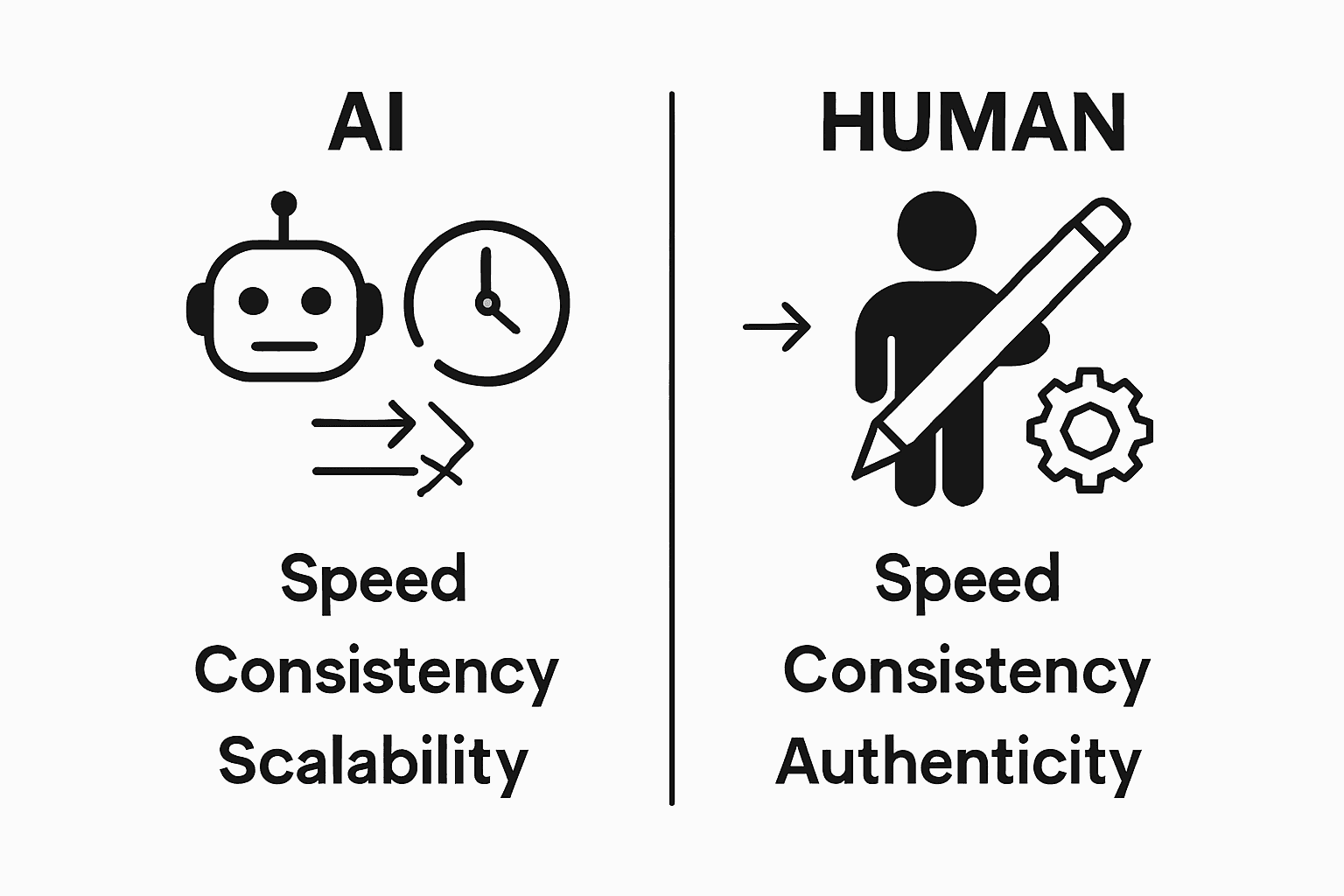
The primary characteristics of AI blog content include rapid generation, scalability, and the ability to produce content across multiple domains. Unlike human writers constrained by time and expertise, AI systems can quickly generate drafts on complex technical subjects, creative narratives, and industry-specific topics. Artificial Intelligence Generated Content complements traditional content creation approaches by providing a flexible, efficient alternative to manual writing processes.
Pro Writer Tip: Use AI content generation as a collaborative tool, not a replacement. Always review, edit, and personalize machine-generated content to maintain authenticity and inject your unique voice into the final piece.
Here's a summary comparing traditional human writing and AI-generated blog content:
| Aspect | Human Writing | AI-Generated Writing |
|---|---|---|
| Speed | Hours or days per article | Minutes to generate drafts |
| Consistency | Varies by writer and expertise | Highly consistent style and format |
| Scalability | Limited by human resources | Easily scales to large volumes |
| Creativity | High, with unique perspective | Mimics creativity from training data |
| Cost | Ongoing labor expenses | Lower per-article cost after setup |
Artificial Intelligence Generated Content (AIGC) presents a diverse landscape of content creation possibilities that extend far beyond traditional writing formats. These variations showcase the incredible potential of machine learning technologies in content generation, enabling creators to produce multiple content types with remarkable efficiency.
The primary variations of AI blog content include technical writing, creative narratives, marketing copy, research summaries, and industry-specific articles. Each variation leverages different algorithmic approaches to match specific writing styles and objectives. Technical AI content, for instance, focuses on precise, data-driven language, while creative AI narratives prioritize emotional engagement and storytelling nuances. Marketing-oriented AI content emphasizes persuasive language and strategic messaging designed to drive reader action.
Content Generation Categories typically encompass text-based formats such as:
Content writing AI systems specialize in machine-generated content across multiple domains, demonstrating remarkable adaptability in producing contextually appropriate text. The key distinguishing factor among these variations lies in the specific training data, algorithmic parameters, and targeted writing objectives used during content generation.
Pro Writing Strategy: Experiment with different AI content generation tools to understand their unique strengths and limitations. Always review and personalize machine-generated content to maintain your distinctive voice and ensure high-quality, authentic writing.
Machine learning algorithms power the intricate process of AI blogging, transforming raw data into coherent, contextually relevant content. AI content generation follows a systematic approach to creating user-specific written materials, utilizing advanced natural language processing techniques that simulate human writing patterns.

The AI blogging workflow typically involves several complex stages. Initially, sophisticated language models analyze extensive training datasets, learning grammatical structures, semantic relationships, and writing styles. These models then use sophisticated predictive algorithms to generate text, drawing from their learned knowledge base. The process includes critical steps like topic interpretation, context understanding, semantic mapping, and dynamic content generation that mimics human cognitive processes.
Key Technical Components of AI blogging include:
Content writing AI systems specialize in producing machine-generated content across multiple writing domains, demonstrating remarkable adaptability in generating blog posts, articles, and other text-based formats. The underlying technology continuously learns and improves, refining its ability to create more nuanced, contextually appropriate content with each iteration.
Pro Writing Strategy: Regularly update and diversify your AI content generation training datasets to enhance the sophistication and contextual accuracy of machine-generated blog content. Treat AI as a collaborative tool that augments human creativity, not a complete replacement for original thinking.
Artificial Intelligence Generated Content introduces complex legal and ethical challenges that creators must carefully navigate. Recent research highlights significant security, privacy, and ethical concerns surrounding AI content generation, demanding a nuanced approach to responsible content creation.
The primary legal risks involve potential copyright infringement, intellectual property disputes, and plagiarism concerns. AI systems draw from vast training datasets, which can inadvertently reproduce substantial portions of existing content without proper attribution. This raises critical questions about originality, ownership, and the boundaries of machine-learned information. Academic and professional institutions increasingly scrutinize AI-generated content, implementing sophisticated detection mechanisms to identify and potentially penalize unauthorized machine-generated materials.
Key Ethical Considerations include:
The potential for misinformation represents another significant ethical challenge. AI systems can inadvertently generate content that appears credible but contains factual inaccuracies or perpetuates existing biases present in training data. Content creators must implement rigorous verification processes, critically examining AI-generated text for accuracy, context, and potential unintended implications.
Pro Writing Strategy: Establish clear ethical guidelines for AI content use, including mandatory human review, fact-checking protocols, and transparent disclosure of machine-generated content to maintain trust and intellectual integrity.
The following table highlights key legal and ethical risks associated with AI-generated content:
| Risk Area | Example Issue | Potential Consequence |
|---|---|---|
| Copyright | Reusing large text chunks from sources | Liability for infringement |
| Plagiarism | Failing to credit original ideas | Academic or legal penalties |
| Misinformation | Factually incorrect statements | Loss of credibility, harmful impact |
| Bias | Reinforcing stereotypes present in data | Skewed or unfair content |
| Privacy | Using sensitive user data | Breach of confidentiality laws |
Text humanization transforms algorithmic machine-generated content into natural, engaging writing that resonates with human readers. Content writing AI systems generate foundational text structures that require strategic refinement to sound authentic and compelling.
The humanization process involves multiple sophisticated techniques designed to inject personality, emotional nuance, and contextual understanding into machine-generated text. Writers must carefully modify sentence structures, introduce conversational elements, and incorporate stylistic variations that break predictable algorithmic patterns. This approach goes beyond simple grammatical corrections, focusing on creating a genuine narrative voice that feels organic and relatable.
Key Humanization Strategies include:
Semantic understanding and contextual adaptation play crucial roles in transforming robotic text into authentic content. Successful humanization requires a deep understanding of audience expectations, writing styles, and the subtle linguistic nuances that distinguish human communication from machine-generated text.
Pro Writing Strategy: Develop a personal editing checklist that specifically targets mechanical language patterns, focusing on transforming AI-generated drafts into vibrant, engaging content that sounds uniquely human.
The article highlights key challenges in AI blog content such as maintaining authenticity, humanizing machine-generated text, and overcoming legal and ethical pitfalls. If you have ever struggled with making AI-generated drafts sound genuinely human and worry about detection tools like Turnitin or GPTZero flagging your content, you are not alone. Semihuman.ai is designed to solve these exact problems by transforming robotic outputs into natural, engaging writing that connects with readers and improves your SEO ranking.

Discover how Semihuman.ai can help you restructure AI content, integrate keywords naturally, and avoid AI detection systems while preserving your unique voice. Don't let your content get lost in mechanical phrasing or trigger plagiarism concerns. Take control of your digital presence today with intelligent humanization tools that turn AI-generated text into authentic blog articles and marketing copy. Visit Semihuman.ai now to start creating content that performs and resonates.
Explore our platform to learn more about humanizing AI-generated content and how this innovation can elevate your writing quality across all your projects.
AI content for blogs refers to text generated by artificial intelligence algorithms that can produce coherent and contextually relevant writing on various topics. It leverages advanced machine learning models to mimic human writing styles.
AI content can enhance authenticity by serving as a collaborative tool that assists human writers. By reviewing and personalizing machine-generated text, creators can maintain their unique voice and ensure the content resonates with readers.
AI-generated content can improve SEO by enabling rapid generation of high-quality articles, increasing content volume, and enhancing consistency in posting, which can positively impact website rankings and visibility.
To humanize AI-generated blog content, incorporate personal anecdotes, use conversational language, modify technical terms to be more approachable, and ensure variations in sentence structure to create a natural flow that resonates with readers.


Start
Humanizing
for Free!
Humanize